I was a skinny kid. That’s my earliest memory. My parents regularly emphasized it. It makes sense, if I project back. They both struggled chronically with being overweight, so my skinniness would be more than incidental. It also makes sense that I was skinny, because I was heavily asthmatic and that made me what the classical authors would call “sickly.” I was in and out of the hospital due to severe asthma attacks. Bottom line, as current lexicon would convey it, I identified as skinny.
My parents were also from a generation of Eastern European Jews who remembered the Holocaust, and more broadly, World War II. My mother was born in Canada in 1940, and my father was born in Romania in 1938. Both had been lucky enough not to have faced the war directly, but nobody of that generation escaped the impact of it. That, and just the Eastern European mentality in general, translated into ideas surrounding food. You do not waste food. If your children are eating, it’s a blessing. If they are eating a lot, it’s wonderful.
When you’re the child in question, you learn that your parents love when you eat. It makes them happy to feed you, and it lights them up when you ask for more. Eating a lot becomes a way to make love surround the home. My asthma and maybe a speedy metabolism afforded me a lot of leeway in this endeavour. Skinny I stayed. For a while.
I remember the first time I noticed I was not skinny. It was my butt. Maybe I was 10? I have a clear mental image of looking at my profile in the mirror and noticing that my butt looked “like a girl’s.” I raised my concern with my dad. He looked me over and pronounced me fine. I trusted him. Sort of. Doubt had started to enter my mind. A kind of disconnect between external input and an observed reality. But that was likely quickly erased when my mother bought a bag of Halloween-sized Peanut Butter Cups after Halloween (reduced for clearance!), and I ate the whole bag reading Richie Rich comics. I still remember how pleased she was.
I was not a skinny teenager. We can fast-forward through that part. Through learning to wear loose shirts, to hold in my gut so much and so instinctively that to this day I have to consciously relax my core sometimes. Through plummeting down the social pole. Through learning that being invisible was much easier than having the Popular-Crowd-Eye-of-Sauron turn my way. Through becoming invisible so much and so instinctively that to this day I have to consciously decloak sometimes.
As an adult, I had some success with weight loss. I think the first time I thought I had Fat-Rich beat was in my early 30s. I had a rock-bottom moment when I carried my son upstairs to his change-table and could not immediately change his diaper because I was too out of breath to do anything but rest my head in my forearms on the pad and wait until my heart rate slowed. I just stood there with my hands resting on him so he wouldn’t accidentally launch himself off the table for about 10 minutes. A few days later I discovered The Zone. It worked. For a while. I went from 225 lbs and a size 40 waist to about 190 lbs and a size 32, as I recall. I felt really good. I felt like I had found the lane I would stay in for the rest of my life.
Turns out I had not.
We can fast-forward through this part. Through discovering the gym, learning that to gain muscle you need to be in a calorie surplus. Through being immersed in a culture that is simultaneously fitness-oriented and body-dysmorphic. Through dieting down for a bodybuilding competition so that I weighed in at 168 lbs and was wearing a size 28. Through “bulking” until I could no longer claim I had left 225 in my rear-view mirror.
Yeah, I was gaining muscle. That part’s a legitimate win. But the muscle-gaining food attitude layered on top of the child psyche that learned that eating is love was not really a recipe for overall health. I got up to 230 lbs.
Then I had a heart attack.
I was 45 years old. As myocardial infarctions go, I was lucky. It didn’t infarct me up as much as it might have. I was actually well enough to start the school year a week later, to the day, from when it happened, albeit sporting three shiny new stents (fun fact: stents aren’t actually shiny). My cardiologist (because I have a cardiologist now) said that I didn’t have any modifiable risk factors. As much as one might think to blame my weight, I wasn’t obese. I don’t drink or smoke. I am not diabetic. Just a genetic win that created an environment of turbulence where plaque could build up in my arteries. But now that we knew, with some light medication and the stents, there was no reason to think I was just waiting for the next one. And as of today, 12 years later, every visit to the cardiologist reassures us that this is the case. There is no permanent damage and no new blockages forming that we would want to address.
We can fast-forward through the next part. Through getting it through my dumb head that I may not have modifiable risk factors, but that doesn’t mean I should keep eating like an idiot. Through realizing that my heart doesn’t go on vacation, so there are no days off from eating properly. Through getting down to 190 lbs, feeling and looking great, and knowing, with absolute certainty, that I would never be fat again. That I could sit down to any meal and make the right choices, and sit in front of a plate of cookies or a bowl of chips and know I wasn’t going to have any, because even though they were right there, for me, they were not on the menu. Through travelling to Singapore for work in 2016 and finding myself alone at a restaurant and ordering a meal I should not have ordered, telling myself that if I was setting a precedent that every time I’m in Singapore alone at a restaurant it’s OK if I have an indulgent meal, I should be good.
Turns out that wasn’t precisely the precedent I was setting.
My brain may have thought so. Food-is-love-is-comfort-is-entertainment-is-experiencing-the-world-Rich learned the precedent was you can eat like an idiot and not die. That’s the Fat-Rich “free-pass” gambit. I have learned it’s an opening that Fat-Rich uses to start his sales pitch as he works his way in. Fat-Rich isn’t evil. Fat-Rich loves me. His issue is that he’s operating on a faulty signal that got embedded early. His warning signals light up when we’re not using food for love, or as a reward, or for comfort. And he is a hell of an ad man. When he tells me I deserve the fries, or that finishing the pizza will make tomorrow easier, or that I may as well eat the ice cream because I’m already fat, he isn’t trying to hurt me. When he says “You know what? Just let me drive”, he thinks he’s taking care of me. Apparently he is even more persuasive than a heart attack.
And he is me.
Bring on the slow crawl back up. Bring on a worldwide pandemic. Bring on learning to make potato chips and doughnuts at home. Bring on creating a recipe for deep-fried Wunderbar.
In November of 2025, I weighed 240 lbs. It wasn’t a number I got to without a fight. I saw it coming. I tried things that had worked in the past. I hired two different fitness/diet coaches. Spent thousands on them. The second one had me on a carnivore diet. “If it ran, swam, or flew, you can eat it. If not, you can’t.” Maybe that works for some people. It doesn’t work for me. Any kind of free pass will not work for me. I don’t get full. I’m like a pug whose gene for detecting satiation has been edited out. I can and will eat three bacon cheeseburgers with no bun and still have a bowl of cottage cheese because I see it in the fridge. Nothing would take. The scale kept climbing. I was buying size 40 again. XXL shirts. XXXL shirts. I was depressed. I was sure my metabolism had shifted to old-man mode. I resigned myself to being fat for the rest of my life. After all, my parents were. It was my destiny. I no longer believed anything would work.
But there was this little pilot light in my brain that would not extinguish. A small, tentative voice from the chasm that was crying. We have to do something! What, though? I’ve tried everything. And pizza and fries taste so good.
OK, yeah. But this can’t be it. I can’t be this guy. I can’t.
I searched “weight loss for middle-aged men.” I found a program that I already knew about in Toronto. My dad had tried it and had some success. I literally did not find a single other option that claimed to be specifically for middle-aged men. I filled out the intake form on their website. Answering the questions was an exercise in self-loathing. To make it worse, I knew that the owner of the program was a childhood friend of my son’s and that it was very likely he would read my submission. Fuck it. Who cares. Can’t get any worse than this. They contacted me, and I don’t remember how much it was to join, just that it was in the thousands and I couldn’t bear to throw yet more money at my hopeless cause. I didn’t join. My depression spiralled. I was watching myself from outside myself. I wasn’t the same guy in ways that transcended weight. I wasn’t the same teacher. Not the same friend. Not the same husband. Not the same father. I didn’t recognize me, even as I acknowledged, in open-mouthed horror, that in fact, I did. This was me. This was the me I was seeing. This was the me the world was seeing. And depression is a fun spiral—you’re depressed because you treat yourself like shit, so you treat yourself like shit because you’re depressed, and the whole thing is reinforced by the way you see the world seeing you.
I called the program back. Said take my money. I had no expectation that it would work. I just knew that doing nothing was not working.
We can fast-forward through this part. Through being so overwhelmed by the details of the meal plan that I created a one-day plan that fit the rules and just repeated it every day for the first week. Through attending Sunday morning meetings and feeling some kind of way about being in a room full of guys who had a relationship with food a lot like mine. Through slowly starting to resent the guy who led them because he would confidently make up demonstrably false facts to establish himself as an authority. Through realizing I could not sit through one more meeting listening to him explain that “jacked” came from Jack LaLanne, or enthusiastically nod while guys accepted that getting weaker in the gym was simply the price of eating healthy. Through briefly wondering whether OA might fill the same role and realizing that wasn’t my jam. Through finally stopping the meetings because they were making me angrier than they were helping me.
We can fast-forward through all that because here’s where I am today. I am still eating the exact same meals every day. Sure, I adjusted the macros almost right away. More than double the protein the plan allowed for. About twice the fat. The same level of carbs. I was literally starving. Every day felt like Yom Kippur. But that’s not important.
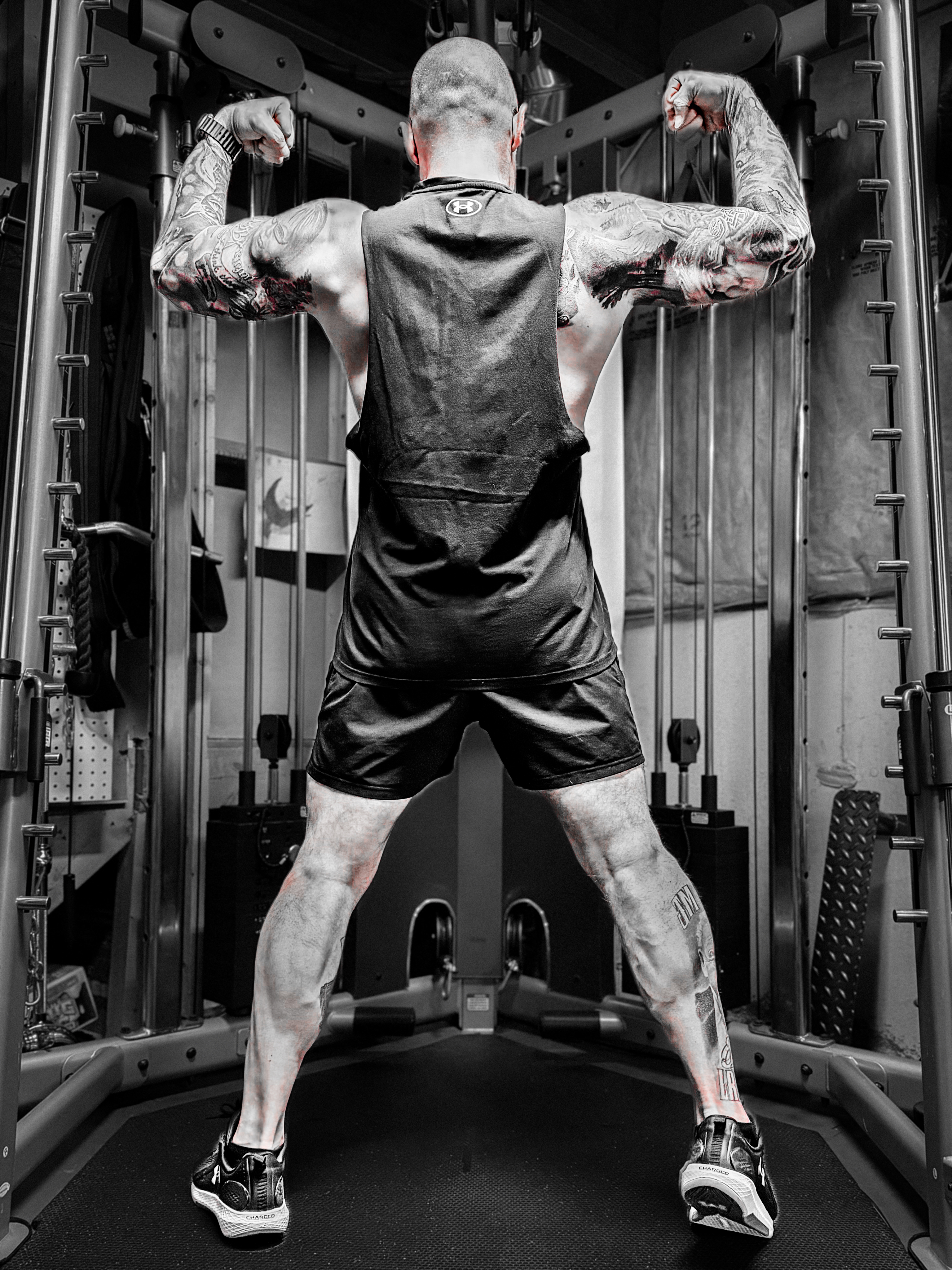
I EAT THE SAME THREE MEALS EVERY DAY.
And I love it. It’s liberating. Not one of the meals I eat is a chore. I look forward to them. I’m just slightly above 190 lbs and wearing size 32. That’s about 50 lbs of fat lost. My lean mass has stayed pretty constant. My strength is up in some areas and constant in others. I gave away about $5,000 in clothes. There are no “in case I get fat again” options in my closet.
I eat the same three meals every day.
I do not recommend this plan. I do not think it’s a terrible plan. It’s a great plan. For me. I’m a compulsive eater. Food for me is like booze for an alcoholic. Knowing what I am going to eat each day, and knowing that there is no room for choice or judgment, is why it works.
But I’ve been here before. In this place where I thought I had Fat-Rich beat. He has shown me he doesn’t get beaten. He doesn’t go away. He is content to wait. He doesn’t have the wheel anymore, and maybe he’s not even in the front seat. But he’s there in the third-row bench seats. He’s content to wait. And I can’t promise he won’t make it to the driver’s seat again. He has before, and it would be naïve of me to assume it can’t happen again.
But he won’t make it there today.
I’m me again. My jokes are back. My smile is back.

