I was not an adventurous child. My mother loved to tell the story about how, as a toddler, when I wanted to get off a chair I would turn around and slowly back off, turning my head at least twelve times to check and see how far from the floor my feet were. It’s an apt summary of my nature. Cautious to a fault.
As I got older, though, I realized that while caution is a valuable consideration, when it is the driving force behind all decisions it is really suffocation masking as prudence. So I learned to take risks. Heavily mitigated risks, propped on as many sides as possible by cautious supports, but risks nonetheless. Things that seem tame to many are fraught for me: Riding a roller coaster for the first time in my teens. Diving off the deck of a sailboat. Moving away from home to attend university. Travelling solo to Chicago for a business trip. Travelling to Africa for three weeks. The list continues. In every case, whether the risks seem large or small, I had to prep myself mentally with extensive research, physical preparation, and all sensible precautions taken. I grew accustomed to adventure. Gusseted by safety nets, admittedly, but still. Adventure.
There was one adventure that hovered above the others, though. A blur of colour and chrome that first caught my attention when I was about 17 years old. I was walking back to school from lunch with some friends and the guy flew by. It wasn’t the first time I had seen a motorcycle, obviously. But it was maybe the first time the vibration of the exhaust and the shine of the chrome strummed my nervous system like Clapton’s opening Layla riff. And the guy riding it just looked so fucking cool.
For 40 years I held that image and filled my mental motorcycle album with thousands more. Every year I thought this summer I’ll learn to ride. But summers are short, and life moves along. Stomping on the glass under the chuppah. Changing diapers. Hanging pictures. Negotiating mortgage rates. Road trips to PEI. Watching Sons of Anarchy …
40 years of picturing myself riding the back roads, noticing the way the temperature changes every few kilometres, and the way the smells change after every turn – or so I assumed.
40 Septembers of saying, “Ok. Next year.”
But life either happens or it doesn’t. So this year I made it happen. It’s not hard to get your M1 license. It’s a multiple choice test that is about 85% common sense and 15% studying. I studied for about a week in between sets in the gym, on a website I found that lets you take infinite practice tests. I studied until I was getting them all right every time. Then, sort of on a whim, I took the actual test and passed. It’s amazing. Having a G1 means you are allowed to drive a car as long as there is a licensed adult driver in the passenger seat. Motorcycles don’t have that kind of passenger seat. Pass that multiple choice test and now you are legally allowed to get onto a Harley Road King and ride on public roads. Not me though. Not Richie P. Cautious.
I messaged a bunch of friends who ride. What gear do I need? What course do you recommend? What bike makes sense for a beginner? I spent probably a hundred hours watching YouTube videos on everything from getting on a motorcycle for the first time, to recommendations for starter bikes, to what skills are the most important to master. I signed up for the M2 course and did not even want to attempt to ride a motorcycle until the first day of the course. But in the meantime, I went to 5 different dealerships to sit on bikes. I picked the bike I would buy and the seller agreed to wait until after I passed the M2 course before selling. Super nice guy. Turns out every rider I have met is super nice.
Instagram and Facebook figured out I was into motorcycles. The algorithms started supplying me with endless reels. I learned that there is at least a large subset of riders who are fascinated by falls. I also heard “Oh, you’re going to start riding a motorcycle? Be careful!” from pretty much every person I told. The entire culture, from within and without, has a built-in “this is dangerous” backdrop. Even the instructor of the M2 course, when I took it, said more than once “When it’s your time it’s your time, but we do everything we can to ride safe and smart.” Like you just have to accept that you’re probably going to die doing this.
That is not me. I don’t have that extreme-sport, adrenaline junkie, adventure seeker gene that causes people to think it would be fun to free-solo El Capitan. At the same time, every rider I spoke to, without exception, gets this unmistakable warm cast to their features when they talk about riding. And most people I know who ride have been doing it for years, and have been safe. And I know myself – if there’s a precaution, I’ll take it. When I went to buy the gear for the course, I bought the safer versions of everything. AAA-rated pants with armour. ECE 22.06 helmet. If the guy at the store said there was an extra safety advantage to something, I bought that version.
Finally, the day of the course comes around. They put me on a Honda Grom. And I immediately realized there’s a whole collection of things you need to learn and master, and none of them are automatically intuitive.
Friction zone. Did I turn off my signal. Rear brake. Pylons. Countersteering. Why did my horn honk. Down for first, up for second, third, etc. Why am I suddenly in neutral. Why won’t the bike go into first. Look through the turn.
Ok. I passed the course. I got my M2. But now I knew something I didn’t understand beforehand. Taking the course and getting your M2 does not mean you’re ready to ride on roads. It means you’re ready to learn how to. I was excited. I was nervous. I was anxious to start. I was afraid of making mistakes.
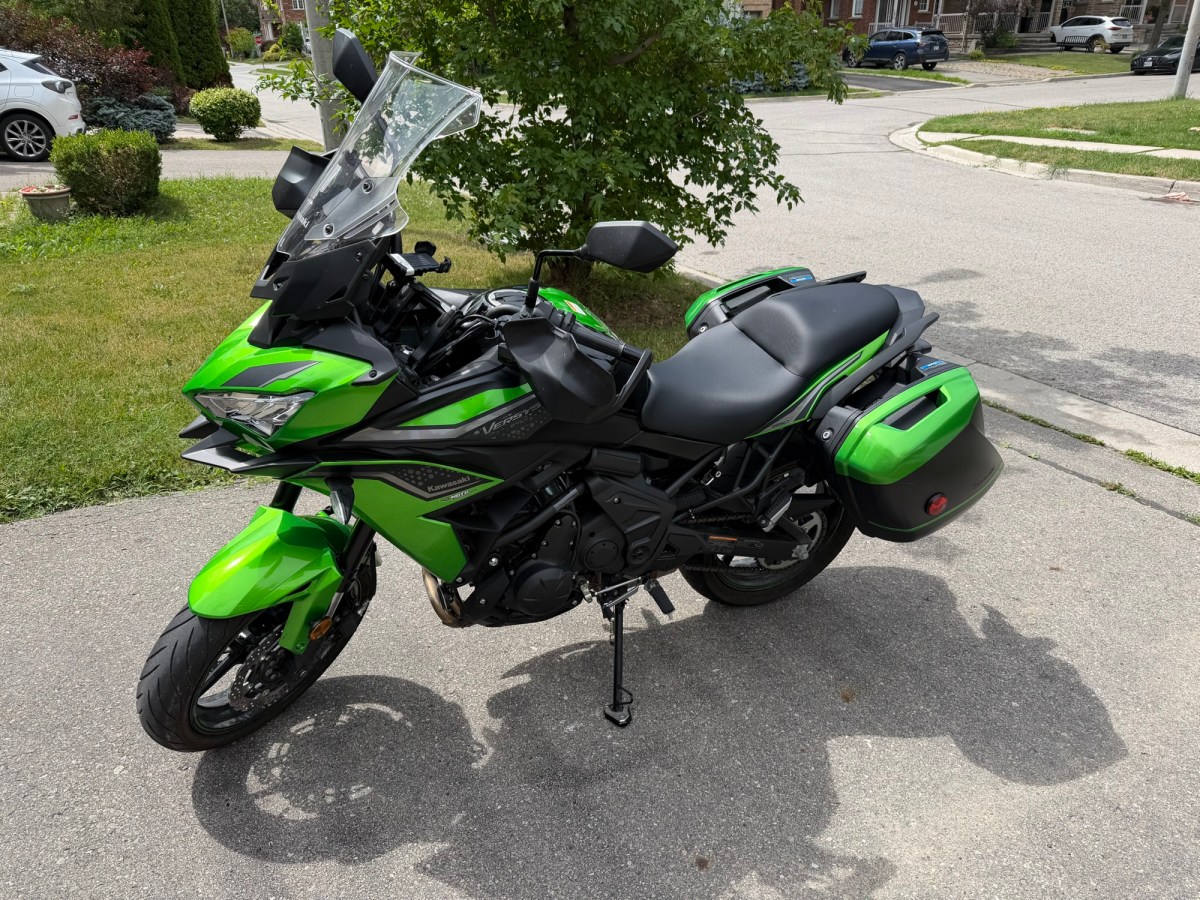
I bought my bike. A 2022 Kawasaki Versys 650. The seller was a very experienced rider who took great care of it. The bike looked new. It was stunning.
It was also about 480 lbs wet. The Grom is less than half that. But the Versys was one of the bikes that was repeatedly recommended to me as a sensible beginner bike. And when I sat on it, it felt right. Sport bikes and cruisers aren’t for me. Touring is how my body wants to sit.
I bought it on a Wednesday. I booked a private lesson for as soon as the instructor was available, which was the Friday morning. He would come to me so I didn’t have to ride the bike on any road with a speed limit over 40 km/h to get to a parking lot. In the meantime, I figured I could practice riding up and down the small residential streets near my house. During the work day. When there’s almost no traffic. Where the speed limit is 40 km/h. I took it out Wednesday afternoon for about 15 minutes. Nothing crazy. Got up to second gear a few times. Never stalled. Never dropped it. Never had a single problem. After 15 minutes I decided that was enough for day one and came home, and successfully parked it in the garage. It looked so good in there.
Thursday morning I figured I would do another 15 minutes of similar practice. No major roads. No roads that are even close to major. Just starting, stopping, turning, and changing gears. Getting used to the bike. To the height of it. To the idea of being on it. I got up to third gear a few times. Never stalled. Never dropped it. Never had a single problem. After about 15 minutes I decided to head home. That meant turning left from a stop sign at a small T-intersection. No biggie. I had proven I could manage that multiple times. Except this time, my brain made a new choice.
Why did it happen? Lots of reasons. My wrist was probably forward on the throttle so that a neutral wrist meant gas. I didn’t look through the turn. I released the clutch too fast. Then I saw I was going wide, and saw the curb coming. I target fixated. There were no cars around. There were no people around. Just me and my bike on a warm summer day. There are five or six things an experienced rider could have done to recover from my error. It wasn’t that I chose not to do them. It’s just that none of those skills were automatic for me yet.
I hit the curb.
Even still, that could have just meant an embarrassing fall. But physics decided to add special sauce. The front tire hit the curb at an angle and that caused the rear of the bike to swing right, and slam into my right leg. Then it threw me off hard into the ground. At least, that’s how I’ve reconstructed it, based on where the bike was, where I was, and what hurt. I don’t remember the fall. I just remember the curb.
My next memory is lying on my right side in the fetal position on someone’s driveway in front of their car, not able to breathe. The owner of the house came out to see if I was ok. I managed to take some breaths, get my helmet off, and answer him. I told him I was ok. No, I didn’t need an ambulance. Sorry this happened in front of your car. Yes, I could get out of the way of your car so you can take your wife to the doctor. So sorry about this. I can move.
Just need a sec.
No, I didn’t need an ambulance. I managed to slither sideways so he could get out of the driveway. I realized then I was not going to be able to get up easily. I still thought I was ok though.
Just needed a sec.
I called my wife. She came with my daughter. I was not ok. Yes, I needed an ambulance. I had suffered a mild concussion, heavily bruised ribs, and a badly bruised calf. My right kidney, it turns out, was also bruised, which we discovered at the hospital when they asked for a urine sample and instead I provided a blood sample. The next two nights were spent on a stretcher in the hallway of the ER so they could keep me under observation for the kidney. When I was discharged, I couldn’t take a single step because of the ribs. I had to take a private ambulance home. My wife had to go out and buy a urinal. We luckily have a medical recliner that we inherited from my mother-in-law. My world narrowed to that recliner and the tray of pain meds sitting next to it. I lived in fear of the first time I’d have to take a dump because I literally had no idea how I’d make it the 15 steps from the recliner to the bathroom. The first time I sneezed, I saw God – and I’m an atheist.
The bike is fine.
40 years of dreaming. 30 minutes of riding.
Ok. Maybe 40 years and 29 minutes. I made a mistake in minute 30. I have spent a career working to help students see that mistakes are only the end if you allow them to be. I thought I took enough precautions. I had all the gear. I wasn’t speeding. I wasn’t showing off. I wasn’t trying something I knew was beyond me. I was doing something I genuinely believed I had made reasonably safe. But I was wrong about how much competence I had yet to acquire.
Toddler Rich checked the floor a dozen times. At fifty-seven, after forty years of thinking about motorcycles and a hundred hours preparing, the floor found me. Hard.
I want to keep going. I am not sure if I will.
40 years and 30 minutes. And counting.
Thanks for reading,
Rich
 Experience Has Made Me Rich