Revolutionizing Social Media Interaction for a Brighter Future

As we get closer to the American elections, and then moving into the Canadian elections next year, I find it more and more imperative that we work to effect a fundamental change in the way we interact with social media and, by extension, how we interact in real life. Over the last ten years or so my concern over the culture has grown from mild alarm at some people’s online behaviour, to something approaching real fear that we are at a tipping point into another real-world dark age, specifically with respect to intellectual and cultural decline. And violence.

It’s not all bleak though. Thanks to many private conversations, I know I am not alone in my concern, and I do see signs that there are public figures with a legitimate desire to change this trajectory, as opposed to leveraging the culture for their own personal gain. And considering the magnitude of people who, exclusively through social media, get their news, form their opinions, and – maybe most troubling – learn how to communicate, social media is where it has to start.

If we can do it, it won’t be through any kind of censorship or similar attempts to control how people use their favourite platform though. It has to be you and me. We have to change the nature of our posts. And so I had this idea of a filter, or sieve, that we can apply to our more meaningful posts to both increase their effectiveness, and also combat the culture that is propelling us toward a precipice.

Consider this. If you want to engage in political posts on social media, that is your choice, and I support it. Keep in mind though that these posts are, by nature, argumentative, in that political posts always argue for or against some candidate or issue. Which on its own is not a problem. Argument (or debate) is not a fight. The idea that arguing equals fighting is something that’s manifested because people like getting attention and scoring points. True argument is not a contest, but a means to pursue truth and, conducted properly, is how we progress. Because the acquisition of truth can never be considered a loss, proper arguments have no losers, and in that sense they have no winners either, because to win an argument someone would have to lose.

But many people argue poorly, because they argue for points.

In the philosophical study of argument there are many identified fallacies. If you’re not familiar with the idea of a logical fallacy, think of these as techniques or strategies that falsely trick you into thinking they are effective. When you employ them you or your audience may think you’re “winning” but you have not made a true case. To avoid this, and hopefully steer us away from the precipice, I ask that you apply what I’m calling an effectiveness sieve to your words before you click that post button.

Run your post through the following sieve. If you can’t answer yes to all three sieve questions, refine your thoughts until it passes them all, then go ahead and put it out there.

  1. Do my words avoid belittling, shaming, or otherwise personally attacking someone who doesn’t agree with my position?
  2. Does my post allow for (and even maybe invite) respectful discourse with someone who disagrees with it?
  3. Does my post offer information/education that someone who disagrees with me might not have considered?

You can actually stop reading here, if you like. The value of each question is probably self-explanatory. But if you want to dive a little deeper into the reasoning behind these criteria and their relationship to common fallacies, or to reflect a little more deeply on whether or not your own posts are effective, read on.

(A word of warning though: I use examples below to illustrate the points and a lot of them are, by design, inflammatory in concept and language. I am not expressing my views in any of them – I am parroting posts I have seen in my social media feeds.)


Sieve Question One
Do my words avoid belittling, shaming, or otherwise personally attacking someone who doesn’t agree with my position?

Fallacy This Helps Avoid: Ad Hominem (Attacking the person)
This occurs when instead of challenging an idea or position, you irrelevantly attack the person or some aspect of the person who is making the argument. The fallacious attack can also be aimed at a person’s membership in a group or institution.1

How to tell
Imagine that someone who holds an opposite position made a post worded like yours. Would you take it as a personal attack, or would you view it as someone simply supporting ideas that you disagree with? Keep in mind that we can challenge ideas without attacking the people who embrace them. In fact, this is the only way to dismantle dangerous ideologies. In democratic societies where change essentially requires consensus, attacking opponents instead of ideas is possibly the worst way to stimulate progress. Consider this example:

Example 1
“Considering the unbelievable depths of stupidity you display in believing that climate change is a hoax, it would obviously be a waste of time explaining the facts to your fascist republican ass.”

Example 2
“You have been duped by the lamestream media, so I will leave you to your weak-minded, sheeple liberal delusions about how solar power will ‘save the planet'”

Example 3
“I read conflicting views on whether climate change is real, if it is a concern, and if it is totally caused by human factors. I am not an expert, and it’s not always easy to filter out the real experts from the ones who claim to be. And even then, it’s not always easy to filter out which experts, if any, are twisting their analyses to suit some underlying agenda. However, the scientific consensus points at climate change being a real danger, and being attributable to human factors. The recommendations to address it seem to be a net good, even if the premise that we are the problem isn’t totally correct.”

It should be obvious what’s happening in the first two examples. There is no attempt to change anyone’s mind. It’s just mud-slinging peppered with tired insults engineered to pump up the audience members who agree. Neither post does anything to address the issue of climate change itself, and just drives a wedge between people who hold opposing views.

Meanwhile, if I’ve crafted the third example well enough, hopefully you can see that there is no evidence of ad hominem at all, and even though the poster is leaning toward one “side”, they have not shut down engagement.


Sieve Question Two
Does my post allow for (and even maybe invite) respectful discourse with someone who disagrees with it?

Fallacy This Helps Avoid: Straw Person
This occurs when, in refuting an argument or idea, you address only a weak or distorted version of it. It is characterized by the misrepresentation of an opponent’s position to make yours superior. The tactic involves attacking the weakest version of an argument while ignoring stronger ones.2

How to Tell
This is often used in conjunction with the ad hominem fallacy because it adds even more punch. After all, only moron would believe a weak argument. Most people have no desire to engage in discourse with someone who starts off with the premise that “Your position is weak, because it supports x so I am right and you are wrong and unless you can see that you are an idiot.” Consider the contentious example of abortion:

Example 1
“Pro-choice? So you think that murdering babies is ok!?! I guess you don’t care about the lives of the babies who get killed.”

Example 2
“Pro-life? So women should have no say over what happens to their own bodies?!? I guess you don’t care about the 13-year old girl who was brutally raped and is now forced to carry and give birth to the child of the man who scarred her forever.”

Example 3
“I struggle with the abortion issue. I believe it is a clear and terrible breach of fundamental human rights to tell someone else what they can or can’t do with their own bodies, regardless of the circumstances but especially when there is physical/psychological trauma involved that can be addressed with an abortion. But I am also really troubled by the fact that I am in no position to decide whether a viable fetus, at any stage of development, is a human life, and I don’t see how anyone could be, really. The issue feels like being offered only two choices where each choice is loaded with ethical downsides, and there is no option to not choose. I worry that in order to alleviate the moral weight of each choice, people downplay or even outright lie about the consequences of their position. So although I land on the side of pro-choice, I do not do so lightly, and I am aware that it feels like I have made a moral choice to prioritize the essential rights of the mother over the potential rights of the unborn child. I hope this choice is correct.”

Consider the first two examples. Will a pro-choice person who just got told they murder babies want to engage in anything other than hurling insults with this person? Will a pro-life person who just got told they don’t care about the effects of rape on a 13 year-old girl want to engage in anything other than hurling insults with this person? By attacking a weak/distorted version of the other side, each has set it up so that any engagement by someone with an opposing view will manifest as some level of support for the weak/distorted claim.

Meanwhile, in the third example, the author has ultimately stated a position. Would a pro-x person be open to understanding the author’s struggle? Would a pro-life person feel safe to engage in discourse? Does it seem that there is the possibility that anyone who engages – including the author – might change their minds about anything surrounding the issue, including about people themselves who hold the opposite position?


Sieve Question Three
Does my post offer information/education that someone who disagrees with me might not have considered?

Fallacy This Helps Avoid: Irrelevant Authority
This is committed when you accept, without proper support for an alleged authority, a person’s claim or proposition as true (and that alleged authority is often the person employing the fallacy). Alleged authorities should only be referenced when:

  • the authority is reporting on their field of expertise,
  • the authority is reporting on facts about which there is some agreement in their field, and
  • you have reason to believe they can be trusted.

Alleged authorities can be individuals or groups. The attempt to appeal to the majority or the masses is a form of irrelevant authority. The attempt to appeal to an elite or select group is also a form of irrelevant authority.3

How to Tell
Are you claiming that some position is wrong? If so, have you explained how you know this? What authority are you citing? Or are you claiming expertise and asserting “Thinking x is wrong!”

Example 1
“Jordan Peterson says switching to a meat-only diet literally saved his life. Vegans are slowly killing themselves.”

Example 2
“I lost 30 pounds when I went vegan and feel so much better. Eating meat is asking for heart disease and dementia.”

Example 3
“It makes sense to at least consider evolution when determining what a ‘healthy’ diet looks like. Before humans had access to foods not native to our geography, the only people that would have survived would be the ones who thrived on what was available. So if your ancestors evolved in warmer climates, it would make sense that your constitution would welcome more grains and vegetables, whereas ancestors in colder climates would have evolved to thrive off meats.”

Consider the first two examples. Jordan Peterson is not an authority on nutrition (he actually takes great pains to make that clear whenever he talks about his diet). So while he has said that a carnivore diet works for him, it is not evidence that the carnivore diet is better than others. In the second example, the author is actually setting themselves as the authority. Neither example offers any warranted expertise or education and are strictly anecdotal claims.

In the third example the author poses an idea that promotes questioning and further research. They are not claiming any personal authority, or even choosing a side, even though they may have a preference. They are presenting an hypothesis that can be (and probably has been) analyzed by experts.


If you’d like to read more about informal fallacies often used in argument, I recommend this link from Texas State University. It lists the common ones and provides explanations and examples. One of my favourites is Begging the Question, which I always laugh about because it’s a phrase that gets used so often, and almost always incorrectly, while at the same time the real fallacy gets used regularly in arguments.

In any case, I hope we can all change the way we interact on social media and beyond. I really do believe we need that flavour of revolution.

Thanks for reading,
Rich

  1. https://www.txst.edu/philosophy/resources/fallacy-definitions/ad-hominem.html ↩︎
  2. https://www.txst.edu/philosophy/resources/fallacy-definitions/straw-person.html ↩︎
  3. https://www.txst.edu/philosophy/resources/fallacy-definitions/irrelevant-authority.html ↩︎

The Power of the Parental Promotional Campaign

Wow. An alliterative title that I didn’t even plan. I feel so clever. Which is ironic…

I’m 55 years old. By all accounts an adult. 55 is to human age as medium-well is to steak doneness, so I guess I’m the right side of middle-aged. Yet it seems nobody has informed my psyche. The child never left, and I don’t imagine it ever will – nor do I want it to. The only thing I can claim as I’ve aged is that I recognize the child in me, and I have no desire to evict that element of my psychological makeup. I simply want to work to understand its complexities and nuances, and see when my behaviour is more strongly guided by its influence. One aspect of this, and perhaps the only aspect that matters, if you dig deep enough, is the lasting effects of what I call Parental Promotion.

I have come to realize more and more clearly that my path in life has been strongly guided by what I think of as my parents’ promotional campaign, specifically about me. My parents, my mother primarily, never missed an opportunity to tell me and anyone who would listen that I was amazing. For example, according to my mother I was, among many other things:

  • The smartest kid.
  • A true mensch (this is a Yiddish word that essentially means a decent person).
  • The most talented singer. This is minor but illustrative, as I will discuss shortly.

They were also able to find ways to go on about my amazing “deficiencies” too, as though they were miraculous. I was, for example, among many other things:

  • The most intensely shy kid anyone ever met.
  • Exquisitely careful. I would come home from a day of playing outside with my friends and my clothes would be as clean as when they came out of the dryer.
  • Deeply quiet. While other kids would be talking, shouting and making noise, I’d be silently observing.

I believed all of it. Not “believed” as in they had to convince me away from a different opinion. Believed at my very core, without even the thought of questioning. I took it all as generally accepted fact. I was the smartest. I was the best singer. I was intensely shy. To be explicitly clear here, I’m not listing these as my own evaluations. They were not observations I made about myself. I didn’t decide these were true based on judgment or comparison. I am saying that because my parents told me they were true it meant they were axiomatic, and thus everyone would know it. It was my childlike perspective that if a fact is a fact then it must be universally known. Like the sky being blue. You don’t have to talk about it – it’s given. You assume everyone knows it. And if it comes up in any context, you don’t consider that it might be contentious or a matter of opinion because, well, look at the sky. It’s blue. Certainly, you don’t stop to consider how it will make you look to others when you act like it’s true.

From my earliest memories, and stretching even until today, this had objectively interesting effects on my interactions with people. Here are just a few (possibly obvious) results.

One, believing I was great (again, I stress, this was not a judgment of myself but taken as fact since it was what my parents told me), and believing that everyone knew this, and also believing that I was quiet and shy and that everyone knew that, I was most commonly seen by others to be snobby and aloof. As I aged this morphed into snobby, aloof and intimidating. Because none of these are internally true about me, and not remotely what motivated my behaviours, I was constantly taken by surprise by people’s reactions to me, which were consistent with their perception of me but so totally dissonant with my inner thoughts and motivations. I really never understood how I could be so misunderstood.

One immediate and persistent impact this had was to make me even more quiet and withdrawn, socially. That may have amplified some incorrect assumptions, but at least it didn’t create openings for discordant reactions to me, which I never learned how to reconcile.

To this point, I grant that I’ve certainly painted an unpleasant picture of the effects of my parents promotional campaign. But it’s not as simple as that. For example, believing that I was smart, I just assumed I could always figure something out. That if I was confused, or frustrated, then it was temporary and just meant I wasn’t thinking hard enough, or more likely was approaching a problem from the wrong direction. This attitude is self-fulfilling. It’s not news to anyone that confidence is a key – maybe even the most important – ingredient to success. Taking your innate ability as axiomatically true is a clear manifestation of confidence. It has led me to success professionally as a math teacher, and in many side pursuits such as visual arts, weightlifting, and sometimes, writing.

That’s not ego, although it can be perceived that way. I am reminded of a Bruce Lee quote: “If I tell you I’m good, probably you will say I’m boasting. But if I tell you I’m not good, you’ll know I’m lying.”

In any event, what I mean is that it’s just an understanding of your own capability and what that means you can do. For my whole life, to this very moment, I have always believed that I can excel at something if I want to. And often, but not always, I prove myself right. I no longer believe this is simply how I was born though. Now I recognize that my parents made me believe it was, and that is enough. When I don’t succeed, I have also realized that my confusion about that was a result of it being in conflict with the notion that it could never happen. I will illustrate with an example that often comes to my mind often. It was the first time I auditioned for a part in a musical.

For background, I was about 40 years old. I hadn’t been on a stage since school plays. Through a friend I discovered a local theatre program that put on amateur musical productions. The way it worked was you paid a fee for the program, and anyone could join. It was a way for adults to experience the fun of performing in musical theatre. Rehearsals happened once a week, and for the first two rehearsals parts were not yet assigned, although you can bet that everyone was assessing everyone else, and how they stacked up against the others, and people were making it clear which parts they were aiming for. The third rehearsal was auditions, and everyone would audition in front of everyone else. The director would let you sing whatever song from the show that you wanted to sing, and then usually ask you to sing and perform a few other numbers. Later that week he would send out the casting, and from then on the rehearsals were more focused. The experience culminated in two performances that were always well attended by family and friends. It was a lot of fun. I did many plays with this company, but that first one was Les Misérables.

After the first two rehearsals, it was clear (to me) that I was one of the best males in the room. It is clear to me now that I was not. But even at 40, that belief that I was great still guided much of my self-evaluation. I was hoping that I would get the part of Javert. And after the audition, I felt sure that I would. There were other cast members who told me they thought I had done well, and the feedback I was getting after each of my songs seemed to confirm that too. What I wasn’t able to filter though, was that people in that environment, wanting to be nice and supportive, compliment everything. Which incidentally is something I have learned not to do, because then the genuine, deserved compliments get lost in the sea of politeness, but that’s another story.

The point of this example is to tell you that I did not get cast as Javert, or any male lead. I was cast as sailor #3, prisoner #1, policeman #2, and a few other similar roles. I wasn’t devastated when we got the casting. I was confused. I also never resented any of the other cast members, because why would I? They didn’t make any mistakes, the director did, although because my parents emphasized being a mensch, I wasn’t angry with him, only grateful for the process he had created. However throughout the rest of the rehearsals, and for a very long time afterwards, I wondered what went wrong. And I started to realize this was a manifestation of the long-term impact of my parents’ promotional campaign. Eventually, after many, many more shows, I developed a more realistic understanding of my abilities as a singer. I am decent. That’s it. No more, no less. Nobody is going to think I have a great voice, but they won’t complain about it either, and that’s fine. But it took a while to see through the filter of the lens of my parents’ praise.

If I can simplify a very complicated concept, what I’ve learned is that believing what my parents told me has been at times a good thing, and at other times a difficult thing. It has led me to excel in many ways, and also led me to confusion and hurt when it conflicted with a more austere reality. But truly, the lasting gift is that at my core, I always believe I’m worthy.

It has been said, by people wiser than me, that the way we talk to our children becomes their inner voice (a quick google search tells me that this sentence may have originated with Becky Mansfield). My parents’ campaign became my inner voice, and my inner voice is kind. That’s powerful. It has brought me great things, and hard things. In my case, it’s been a net good, and I am grateful for it. But I have seen the results of more destructive campaigns on many of my adult friends, and on many of my students (as I alluded to above, I am a high school teacher and tutor). So my final message is this:

To children (and that means all of us). Reflect on how your parents’ campaign has guided your path. Try to see it clearly. Tease out the good it has brought, and work to understand the bad. The process is very healing.

To parents. Think deeply about your campaign. Remember that your children do not have the context of a lived life to apply to what you tell them about themselves. They may believe high praise, or they may wonder why what seems ordinary to them is generating high praise. They will believe harsh criticism. Tearing them down does not “build character”. It builds a cruel inner voice that it will take them years (if ever) to understand is not their own, and does not speak truth.

Campaign honestly. Campaign proudly. Campaign positively.

Thanks for reading,
Rich

Phone Addiction is NOT Okay

Hi. My name is Rich and I am an addict.

iphone.jpgOk. I know that’s been borrowed from AA protocol countless times. Often in jest when not in the context of an actual meeting. But I’m not joking – I am an addict. I have had a few addictions in my life, thankfully not any of the big nasty ones like alcohol or drugs, but some of the ones I’ve had have had negative impact, for certain. The two most prominent are food and smartphones.
I am going to talk a little about the food addiction later in this article. But I mainly want to talk about the subtle and not-so-subtle evils that my phone addiction has wrought. The first is an obvious one, and it has been discussed to death. Still, it needs addressing:

Phone Addiction Steals You From The World

There are way too many times I have belatedly realized that my son, daughter, wife or close friend made an attempt to communicate with me while I was using my phone. And after they realize it’s like talking to a projection, they give up. The worst part is they seem to just accept it – that they are not going to win my attention over whatever clever post I am reading or writing, or whatever video about people hurting themselves doing stupid things I am watching, or whatever likes I am counting. What’s worse is that so many of those times they were the ones who had my attention first, but during a brief lull in our interaction I pulled out my phone to investigate a notification and was subsequently checked out. Most heart-wrenching is that it is out of respect for me that they give up and don’t try to interrupt my phone time. Clearly I don’t need to go further on the evil of this aspect. The next few are a little more subtle, but insidious.

Smartphone Addiction Erodes Your Ability to Focus

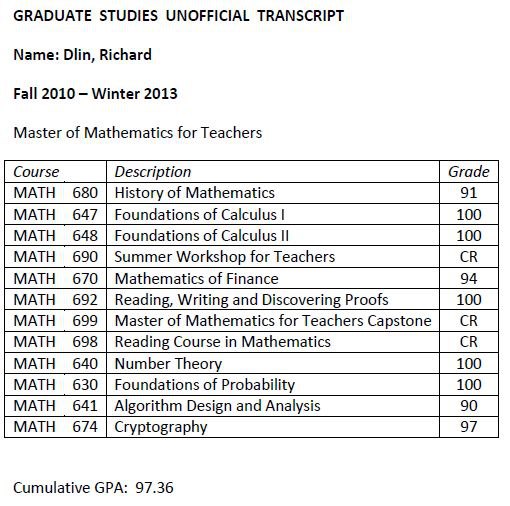
MMT TranscriptHumility aside, my concentration and focus used to be legendary. I could get lost in a process, with intense focus for hours on end. So much so that I would forget to eat or even go to the washroom, until the need for one or both of those became impossible to ignore and I would look at the clock and be shocked at the time. And the things I could do during that time were amazing. It’s how I got through my Masters degree with a GPA of 97%, for example (that and major support from my awesome wife and kids). Lately, my concentration sucks. I find myself looking for distraction only minutes after beginning something. At first, when I noticed this, I blamed my age. It’s no secret that aging can have an impact on brain function. But the truth is I am 48, and there are plenty of people older – even much older – than me who can concentrate on a task for a long period of time with no trouble. On a smartphone, nothing needs concentration, and everything is provided in quick bites. You flit from item to item like a politician moving through a political rally, shaking hands with everyone and meeting nobody. And you can tell yourself that this is behaviour limited to your phone time, but what you miss is that your brain is a learning machine, and it’s learning a behaviour. Your brain wires itself to adapt to your environment, even if that environment is the manufactured barrage of inanity you kill time with on your phone.

Possibly worse, is that we tell ourselves that the phone is a harmless distraction, and we use it at the weirdest times. I’ve used it while watching TV, thinking that surely the TV doesn’t care so no harm done. But while the TV doesn’t care, my brain does. Watching a television show requires focus. Not the same level as calculus mind you – but focus nonetheless. There’s a story unfolding and if you miss something the subsequent bits make less sense. So you are missing an opportunity to focus. To practice what I tell my students is the single most lacking skill in the computer generation: uni-tasking. I have heard many a person brag about their ability to multi-task, which is great, I guess. But smartphones have stolen our ability to focus on one thing for a long time. We can no longer effectively uni-task.

Smartphone Addiction Encourages Mistakes

Yeah, this one took me a while to clue into. I’ve noticed over the past couple of years that I am making more mistakes at things that I should be able to do automatically. Frighteningly, I don’t even notice them when I make them – only once they are pointed out, or long after, do I notice. And when I do notice I have no memory of making the mistake.

Now I hear you say Wait! That’s just a symptom of aging!

Well, yes. It could be. But the thing is, there is a thought groove I find myself in when these things happen – like a road I know I’ve been on because the landmarks are familiar but I can’t quite place it. Then it hit me. Autocorrect. Autocorrect and predictive text. Both of these so-called innovations have made it so that we don’t even have to concentrate on the simple act of typing a text, email, or post. Just type close to what you want and autocorrect will fix it for you. Not always correctly, mind you, but often. So much so that when it gets it wrong we don’t even notice until later, making for some humorous/embarrassing messages getting sent. I actually hated this feature, and turned off autocorrect some time ago, but I kept the predictive text on. And it works so well that I often only have to type the first 1-3 letters of what I want and an entire phrase is suggested to me – correctly. So I select it and don’t check it. And sometimes, my iPhone does the old bait-and-switch on me so that the thing I think I’m selecting changes to something else just before I select it, and I don’t even notice and the wrong thing gets sent.

Like I said before, the brain is a learning machine. And my smartphone addiction has taught my brain that you only have to start a thought to have it completed automatically. And that is what has manifested into these increasingly frequent mistakes. It is NOT age. I can feel it when it happens. It is the same thought groove as typing on my phone.

At Least I Remember When It Wasn’t So

The scariest thought to me is that these things I describe are changes. As in, it wasn’t always so for me. I am actually frightened about the generations that don’t have a comparison to make to a different time. A generation that believes that being able to concentrate on one thing for a long time is an unusual, maybe even useless skill. Or that being able catch every joke in a sitcom is a freakish ability. Or that being able to spell a word correctly on purpose is a worthwhile ability. With respect to the issues I have outlined, I want to go back to the way I was. But for many younger people, this is the way they have always been. There is nothing to go back to.

Quitting May Not Be the Answer

So the fix would seem obvious, wouldn’t it? Just stop. But that’s not realistic, or even really desirable. Many good things come from my smartphone. I have made friends – good friends – who live in different countries from me, and I stay in touch with them using my phone. There are legitimately useful apps, like the medication reminder, the shared grocery list. Or the math puzzle game Euclidea that actually reverses some of the deleterious concentration effects I described above. I use GPS apps all the time and get lost much less often (though sadly, I still manage to get lost sometimes). I listen to so much more music variety than I did in the days when you had to buy records, tapes or CD’s, and it is so much more easy to discover new music now than then. I take a lot of photos with my phone, and some of those are real treasures that I wouldn’t otherwise have. I read some great articles, and have learned a ton of cool things. Chances are super-high you are reading this on a smartphone. I believe these are good things. So I don’t want to quit. And I don’t think anyone has to. We live in a pretty plugged in world, and more and more there are things that are designed to be done on our devices that are actually difficult if not impossible to do otherwise. So modified usage is the key.

Modification Requires Discipline

Or does it? I mean, yeah, it does. Almost always. If you want to modify a behaviour it means breaking a habit, and that is not trivial. You need to be disciplined. And you need to believe that you can do it. Which I think, for many people, is the main obstacle to success. That belief that you can do it. Which leads me to my food addiction:

How I Modified My Eating Behaviour

The first addiction in my life I had to acknowledge was food. Maybe I was genetically doomed to that, or maybe it was my upbringing, but my addiction to food is real either way. It resulted in a max weight of 250 lbs, and an adulthood of gaining-losing-gaining, until my heart attack 3 years ago. The heart attack was actually not caused by my eating, or so the cardiologist says, but rather genetics. My arteries are shaped in a more clog-worthy way than you’d set out to do if you were designing a human from scratch. However there’s no argument that my food addiction wasn’t helping. The heart attack added a new tool to my psyche though – something that’s simultaneously heard and easy to describe: a hard stop. Before the heart attack meals were a negotiation in my head. And I often didn’t come out the winner in the bargain. Now there is no negotiation. I eat clean, all the time. I don’t overeat. I actually can have just one french fry. Truly! French fries are a food I will not allow myself to order or prepare anymore, but on occasion I have had just one from someone else’s meal – even though they were finished and offered me the rest. Just one, for the taste, and I have no desire to eat another. Cardio is now a non-negotiable habit as well. I don’t negotiate whether or not I will do it. I just do.

I am as fit as I’ve ever been and certainly as healthy as I’ve ever been. People often ask me how I did it and I sadly tell them that I wish I could give them the secret, but the secret is I had a heart attack and I don’t want another one.

The picture on the left features my beautiful niece at her first birthday. You may be distracted by her cuteness – I understand. Take your time. But when you are ready, the place to look is my belly protruding under my forearm. The picture on the right is a fun shot I took after a workout a couple of weeks ago. Oh, and by the way – both those photos were taken with my phone.

So. I have managed to find a way to live a healthy life despite a food addiction, even if the way I found was not something I’d wish on anyone. But after all, isn’t it all in my head? This new tool I called the hard stop?

Of course it is. And because it is I believe I can apply that rationale to my phone addiction. I have started to, and will continue to do so.

What I Am Doing to Fix it

I turned off all the features of my phone that try to think for me. Any typos or wrong words I send now are all mine. And there are so much fewer of them now! It takes me longer to compose a message. But it’s worth it.

I will not look at my phone while watching TV. Not even during commercials. Because you can’t force yourself to stop the moment the commercial is over.

If I am in the middle of a legitimate text conversation with someone, I make sure the people in the room with me know it, so they know why I am checked out. And when it is done, I tell them explicitly that I am done and I put my phone away so that they can have my distraction-free attention.

When I sit down to do focus-heavy tasks, like work or drawing, I put my brain in do-not-disturb mode, meaning I don’t check notifications at all, and my phone becomes a music player exclusively. When I do this, I let anyone know who would normally feel like they have 24/7 access to me that I have gone dark. This way if they need to communicate with me they know they need to either do it in person or call. Because as we all know, nobody ever uses their smartphone as a telephone, so when there is an actual call I know I should check to see who it is and probably answer.

It Can Be Done

As they say, no need to throw the baby out with the bath water. You don’t have to quit if you can properly modify. And you can. I believe you don’t need a critical moment to be the catalyst. Just the knowledge that you can do it. And I really, really believe we need to.

I’d love to hear your thoughts and experiences on smartphone addiction, and how it can be addressed. Feel free to share in the comments section.

Thanks for reading,

Rich

On the One Year Anniversary of my Heart Attack

So August 26th of this year marked the one year anniversary of my heart attack. I actually haven’t written a blog since the one I wrote about that day. That’s not as significant as it might sound – I have rough drafts for 3 different ones that I started but I’ve been busy with other things and haven’t devoted as much time to writing as I’d like (something I regret quite a bit). But for the anniversary of H-Day I thought it would be good to write an update on what has happened this past year. I don’t think a chronological narrative would make much sense, and besides, I don’t have that great a memory. So I’ll go with more of a stream of consciousness approach.

As you may know I am a high school math teacher. The heart attack happened exactly one week before the start of the 2014-2015 school year. Although many people couldn’t understand how or why I did it, I actually worked right from the first day of school. I certainly could have taken some more time to recover, but I didn’t feel I needed it that badly and the doctor said that if my job didn’t require heavy lifting and I felt okay there was no reason not to work. My reasoning for starting was that it was easier for everyone involved – students wouldn’t have to adjust to a new teacher twice, the school wouldn’t have to scramble to find someone to cover my classes and my colleagues wouldn’t have to worry about teaching more than their own course load. Now, almost a year later, I can say that the decision to start right away was neither good nor bad. If I had waited things would have been just as fine as if I had not. It’s funny how so many decisions in life seem important when they really are trivial. I took things easy at first and let my body tell me when I could ramp up, always erring on the side of caution. For example I took the elevator instead of the stairs for a couple of weeks, and kept my boardwork lower on the board (so as not to raise my right arm too high after the angio) for about a week.

One thing that I learned from my first follow-up with the cardiologist was that I have no “modifiable risk factors” for heart attack. Basically it’s good old genetics. I don’t drink or smoke. I have low cholesterol and low blood pressure. At the time of the heart attack I was overweight but by no means obese. I was keeping fit with heavy weights and regular though limited cardio. This was disturbing news – I mean it would be nice if I could just stop something I was doing and know I was preventing another heart attack, but as the cardiologist said, at least now I know. I had three partially and one fully blocked arteries, and except for one of the partials they were all stented. The one that was not stented is very small and doesn’t supply a large area, so that other arteries nearby can cover what it doesn’t manage. I am on a cholesterol medication that has been shown to prevent plaque buildup in arteries and even to slightly reduce existing plaque. I am hyper-aware of my heart so if anything does deteriorate I will be on it right away. In the meantime I decided to do everything I could do. As soon as I got the green light to resume exercising I began a cardio regimen of 45 minutes, 5 times per week. As of this moment, I have averaged exactly that. I say averaged because there were three weeks where I didn’t manage to get all 5 sessions in, but always compensated in succeeding weeks by adding sessions. Three different vacations didn’t keep me from my cardio. Some people tell me “Hey, you’re on vacation, give yourself a break.” My response is my heart doesn’t know I’m on vacation, there is no such thing as a break.

I also cleaned up my diet. Not that it was that terribly unclean to begin with. But I did eat a lot of red meat (3-4 times per week, sometimes more), and 2-3 times per week allowed myself cheat meals like KFC or Burger King, or just really decadent meals at restaurants. Now I eat only lean red meat, and only 1-2 times every month. I’d say over the past year I’ve probably had red meat about 15 times. My protein mainly comes from white meat chicken, fish, and some vegetarian sources like beans, quinoa, and nuts or nut butters. I eat very little fat, and almost no saturated fat. What fats I do eat come from the fish or chicken, or light salad dressing, which I use extremely sparingly. I don’t measure my food, but I never eat until I am stuffed. That’s also a change from before. For this entire year I have not felt stuffed even once. And I still eat a lot – probably 7-8 times each day. A lot of fruits, berries, vegetables and nuts fill out my diet.

So what the diet and cardio have done is resulted in fat loss. I spent my entire adult life struggling with fat loss – often successfully but not always. Each time the goal was fat loss. Now the goal is not that at all. The cardio and diet are to keep my heart healthy. The fat loss is a side effect, albeit a pleasant one. When I had the heart attack I weighed 225 lbs (down from an all time high of 245). Because I am a hobby bodybuilder that’s not as heavy as it sounds, but I was certainly carrying too much fat by an obvious margin. My weight this this morning was 189. I won’t lie and say that I’m ambivalent about that – I am overjoyed. But it wasn’t and isn’t the goal.

Speaking of exercise I also resumed lifting weights about 6 weeks after H-Day. This was with the doctor’s blessing. At first I kept things very light and let my body tell me when it was ok to go heavier, again always erring on the side of caution. I don’t remember the exact timeline but I’d say after about 3 months I was more or less back to pre-heart attack form. The weights and the fat loss are visually pleasing to me. Here are a few vanity photos of the impact this has had on my look.

IMG_0160 IMG_0683

IMG_0078  IMG_0159

I’d actually like to include a photo I took when I was 245 lbs but my computer is currently deciding I’m not allowed to look through old photos – thanks Windows 10.

The great news is that after the heart attack the cardiologist who saw me at the hospital said my heart was damaged (on a scale of 1 – 4 where 1 is the best, mine was a 2), but on my six-month follow up visit I had managed to return it to a level 1. The words of the cardiologist were “Except for the presence of the stents you have the heart of a healthy, athletic adult male with no sign of trauma.” And that, ladies and gentlemen, mattered profoundly more to me than how I look, although that is what people see.

Whenever you lose a lot of weight, or otherwise significantly change your look to something more aesthetic, people always want to know how you did it. The truth is I did it by having a heart attack. That flicked a switch in my mind that had never been flicked before. I no longer have a choice about eating well and exercising, which can read differently than I mean it. What I mean to say is that I know all to well what a struggle it is to have to make good decisions about healthy eating and exercise. To choose not to have a sundae and opt instead for the fruit salad. For me, now, the sundae is not a choice. Nobody is forcing me not to have it – it has been removed from the list of options by something outside my control. It’s actually pretty liberating. So my answer when people ask how I did it is to say “Well, step 1 is … you don’t want to do step 1.” Because Step 1 was have a heart attack. I didn’t decide to start looking better and then do something about it. I had a heart attack and this is how I am doing my best to prevent a repeat. I will say that I have had the odd dessert here and there. But each time I have done so it’s literally been a tiny forkful (as in just the tip of the fork) so I could taste it. The forkful concept would have seemed ridiculous to me a year ago. Now it is legitimately enough. I don’t have the forkful and then look longingly at the rest, wishing I could have more. The forkful does what I needed – it gives me the taste and that is enough. Once again this is not a choice I am making, or a philosophy I am forcing myself to embrace. It just is the way my brain works now – I didn’t deliberately activate it. If I did I would write a book about how. Another example is that there have been 4 times (no, I’m not counting I just remember them) when I have eaten one french fry at a meal. Because I wanted the taste.

Emotionally/psychologically it would be a lie to say I have not been affected. The day I had the heart attack one of the reasons I didn’t call an ambulance as soon as I should have is because I didn’t want to scare the kids. There’s no way around the fact that when your dad has a heart attack it’s scary. Same goes for my wife. The very last thing I want to do is scare them or have them worry. That said I am now hyper-aware of what is going on in my body, and especially my chest. And guess what? Chest pain happens, and it’s not generally a heart attack. Gas happens (especially because it is a side effect of some of the medication I am on). The pain can cause anxiety. Anxiety can cause chest pain. It’s a hilarity-filled ride. I can’t specifically recall how the heart attack itself felt – I just know it hurt but was not as intense as you’d think. I feel as though if it were happening again I would be sure. But I’m not sure if that’s true. So there are days when I find myself worrying. However with the cardio regimen I’m on I can always reassure myself that I wouldn’t be able to do 45 minutes of intense cardio without accompanying intense pain if I was actually having another heart attack.

On that note, when I started the cardio after the heart attack I was keeping my pulse rate in the 120’s, although my doctor did say I would be able to push it higher as I healed. As of today I usually use my elliptical machine (I have a gym in my basement although it has evolved since that blog about it), and the heart rate monitor I bought shows I’m keeping my heart rate in the 140-150 zone, which I made sure was ok with the cardiologist. Speaking of heart rate, I also take my blood pressure daily, and it stays in the 115/75 zone, with a resting heart rate of around 60 bpm.

One thing I have found recently (as in, the last 5 weeks or so) is that drawing is great therapy. It is extremely calming and does a great job of centering my thoughts. I highly recommend it. Another thing I’d have said if you’d asked me a year ago was that I can’t draw for beans. I never really believed I had any talent in that regard. But I have watched hours of YouTube tutorials and have been drawing every day. The therapeutic aspect can’t be overstated. It turns out when you practice something you also improve. Here is one of my earliest attempts at a portrait and one of my most recent ones. I’m no pro and may never be one, but the improvement is real and that’s only about a month. Therapeutic, fun, and inexpensive – I highly recommend it.

IMG_0442  IMG_1164

Wow. Ok this really has been stream of consciousness style. My writing is usually more organized than that. Ah well. This one wasn’t about writing, more about an anniversary summary. I admit I didn’t proofread that carefully either – forgive the errors. I am always happy to answer questions or offer assistance if I can. Leave me a comment and I will respond.

Thanks for reading,

Rich

Choose Your Memories

Short blog today based on a conversation I had recently.

I was talking to a graduating student about how he is going to choose a university. He has been accepted into his two top choices and he doesn’t know how he will decide which one to attend. One university is more widely recognized but would mean moving far from home, where none of his friends will go, and has a more difficult program. The other university is closer to home and has a slightly easier program. Both offer the same degree. After discussing that this was a nice problem to have, I gave him the advice I always give myself. Choose your memories.

Choose your memories

The simple truth is that all you are is your memories. The present is a fleeting instant, and the future is unknowable, so your whole life experience – and how you view yourself – is based on your memories of the past. In fact, there is an interesting perspective that points out that since it takes a small amount of time to process what your senses are perceiving, our “present” is in fact already past, which is pretty weird to think about. But that aside, too often people think about a choice like the one my student must make in terms of how the choice will affect their future. The truth is it’s much better to think about how it will affect your past. I asked him which memory he wants.

Which memory do you want?

He didn’t know what I meant by that. I said, picture yourself 10 years down the road. Right now I know that whichever university you attend you will finish the program. So 10 years from now, looking back at your decision, which one will you want to be glad you made? Who would you rather be? The dude with the memory of university A or the one with the memory of university B?

Choices are an opportunity to build the memory you want, which ultimately means to build the person you want. In this way they are very exciting. Every choice is your chance to be more awesome. Take control of your character and choose the memories you’ll be glad to have, so that you can be the person you want to be.

Thanks for reading,

Rich

What the Gym Has Done For Me

Growing up I had a lot of strengths for sure. I did pretty well in school, had a good sense of humour, a loving family and was always blessed with good close friends. But one thing was definitely not a strength: athletics. There was never a team sport where I didn’t get picked last and I certainly never cut that dashing athletic figure that some kids seemed to me to have been born with.

(BIG side note here – the large majority of adults you see that have that dashing athletic physique were NOT born with it … but I learned that little tidbit much later)

As a young child I was sick with asthma, and so I was always very thin. When I hit puberty and my body started demanding more food I began to fill out, but not in any good way. I just got fat. And as I got older it got worse. When my son was a baby in the late 90’s I couldn’t carry him upstairs to his change table to change his diaper without stopping to catch my breath. I have a vivid picture embedded in my mind of him lying on the change table in a dirty diaper and me standing over him huffing and waiting to catch my breath before I could change his diaper. All from carrying a 15 lb baby up a flight of stairs.

I won’t bore you with too many more details. I just wanted to paint a picture of who I was – a smart, funny, happy, fat guy. I experimented with different diets with varying degrees of success. One which I did fairly well with was The Zone diet, which took me from a size 40 waist to a size 32. And that was the beginning of my interest in the gym.

At first, my goals were all about looks. After losing all the weight on The Zone I found I was just skinny. I wanted pecs, shoulders, and abs. I joined a little gym near my house and applied the same dedication to working out that I had applied to adhering to the diet. The owner was a former competitive bodybuilder and a bodybuilding judge at the time. I knew nothing about working out and I was happy to let him design workouts for me. With his background he naturally designed workouts with bodybuilding in mind. Being a tech nerd I typed them into excel and shrank it down so I could tape it to the inside of my logbook. It’s still there though I’ve long since moved on to other plans.

These are the workouts the owner designed for me. I taped them to the inside of my journal so I'd know what to do.
These are the workouts the owner designed for me. I taped them to the inside of my journal so I’d know what to do.

I remember asking him how long it would take for me to actually see results. He said about 3-4 months. Great! I put my nose to the grindstone and did everything he said, and marked it on the calendar. I still have the log book I used when I started.

I did not see results after 3-4 months.

Now that’s not because the gym owner was lying. Most people should see results after that length of time. But I learned that my body is not “most people”. And that revelation may be the single most important thing the gym has done for me. I did not give up. I knew I was working hard and although maybe the mirror didn’t show much of anything, I was enjoying the workouts and loving the feeling of pushing myself past limits. Here are some entries from the very front of my logbook:

Here are some log entries from my first workouts. Back then I did not include the weight of the bar - I didn't know how much it weighed. Seriously!
Here are some log entries from my first workouts. Back then I did not include the weight of the bar – I didn’t know how much it weighed. Seriously!

If you’re having trouble deciphering my handwriting join the club. My students love it. Here’s what it says (I’ll add the weight of the bar in, now that I have that capability)

Deadlift: 95 X 5, 115 X 5, 135 X 5
Leg Press: 90 X 8, 180 X 8, 270 X 8, 320 X 6
Close Grip Bench Press: 65 X 8, 95 X 8, 95 X 7, 95 X 6
Squats: 115 X 12
Bench Press: 95 X 8, 115 X 6, 155 X 8
1-Arm Dumbbell Rows: 40 X 5, 40 X 5, 45 X 5

These were big lifts for me, although looking at other lifters I knew they weren’t big lifts. I had to make a choice pretty quickly: keep comparing myself to others, let the depression set in and give up, or compete with myself and celebrate my victories. It wasn’t an obvious choice, despite what all the self-help and life coaches will tell you. I had gotten through life to that point without being a lifter and I could certainly rejoin the masses and be happy and healthy. Maybe take up running.

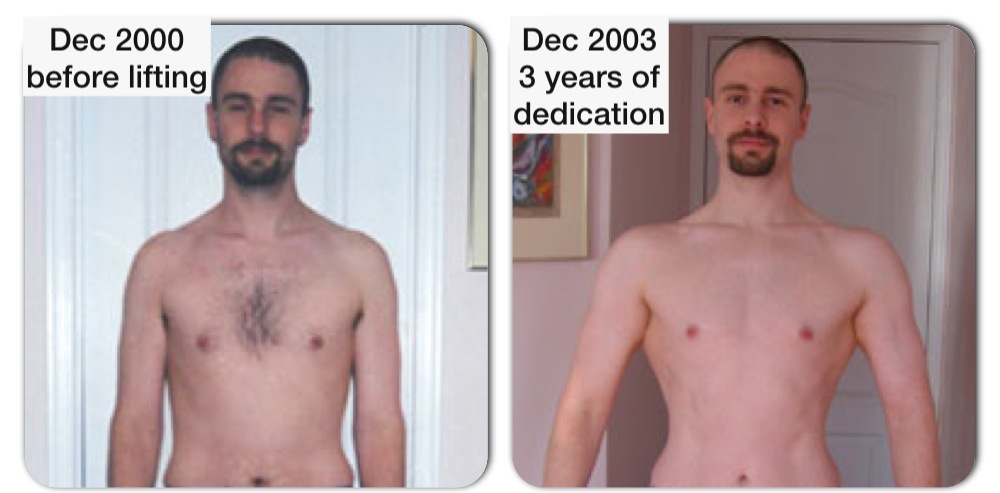
But that was not the choice I made. I wanted to get better. I had to get better. Better and best are two very different words. Better is a journey. Best is a destination. And since living is a journey, I’ve always chosen better. I don’t need to be the best, though I can’t say I mind when it happens. But I always need to be better. I despise stagnation. So I accepted that my body is mine, and I kept at it. I also took lots of progress pics, for which I am very grateful. Here is a comparison of just before I started lifting to how I looked 3 years later:

The difference 3 years of dedicated lifting and good eating made to my physique.

There are changes, but they’re not drastic. If we are being honest most of the difference between the two pictures is how I’m standing and the fact that I shaved my little patch of fur. However there is some delt and tricep development noticeable, although it’s very slight.

I’ve been immersed in the lifting culture for 13 years now. I know that some the people reading this are thinking Dude, if that’s all 3 years got you then you were not doing it right. But here’s the thing, and you can take it or leave it. I was “doing it right”. I was lifting consistently 5 days a week, improving my lifts constantly, eating 5-7 meals a day, making sure to eat 1-1.5 grams of protein per pound of bodyweight, and all those other things one is “supposed” to do. And that’s what I got. Because that is my body. It resists change. But it changes.

Fast forward to today. I’ve had lots of victories and lots of defeats. I’ve been injured a few times, had my motivation ebb and flow, and of course I’m 13 years older. I’ve changed careers, pursued passions and experienced lots of joys and sadness. But this whole time I have been a lifter. And here are some lessons I’ve learned. I like lists so I’ll give you my thoughts in list form.

  • Compete with yourself
    In all areas of my life, I never compete with others anymore. I always compete with myself. When I do something I’ve done before, I always work my hardest to make sure I do it better. Whether it’s academics (I just completed a Masters degree), my career (every time I teach a lesson I use what I learned from previous ones to make it better), my singing, or pretty much anything. I don’t always beat the old me, but I always try to. And when I fail, I learn.
  • Think long term
    It’s very easy to get bogged down in daily routine and get stuck in status quo. But each day should be about advancing yourself in some small way. Make a plan. Stick to the plan. You may not see changes or progress from one day to the next but if your plan is solid you will see progress in the long run. Never forget your plan. When you suffer setbacks acknowledge them as setbacks. There are peaks and valleys but if you zoom out you will see the steady rise.
  • Don’t set artificial boundaries
    You can always decide that you are fated to remain a certain way. But what a shame that is. Always aim high. If you set boundaries on what you can do you’ll live within them. It’s not necessary.

All of these things are things I learned in the gym, and apply to my life. They are not the result of a seminar I went to (or a blog I read…), they are the result of my results in the gym, so I don’t have to convince myself to believe them because I live them. I am so grateful for this.

So now, although I certainly don’t complain about changes to my physique and I do want them, I don’t lift for looks. I stopped lifting for looks a very, very long time ago. I lift because of what it teaches me and how it affects my mindset in life.

Oh, I almost forgot (no I didn’t! ;)). Planning long-term and acting on that plan works. It’s the zoom-out that proves it. After 13 years of lifting, I can zoom out a bit. I have gotten results in my lifts and my physique! Incremental at the time, they sure do add up.

Here are some updated lifts from workouts over the last few months. For most I chose lifts I have video of:

Deadlift: 405 X 4 (here’s video)
Leg Press: 900 X 10 (I don’t have video of this)
Close Grip Bench Press: 265 X 5 (here’s video)
Squats: 365 X 4 (here’s video)
Bench Press: 295 X 4, 315 X 1 (here’s video of the 315 X 1, it’s a personal best)
1-Arm Dumbbell Rows: 140 X 5 (here’s video)

And here’s a progress comparison picture after 10 years of lifting:

What 10 years of lifting has done for my body.

Thanks for reading,

Rich