Rescuing Broken Discourse with Logic

We are in danger. Public discourse is almost dead, with important conversations being shut down by twisted logic resulting in false associations and cancellations. We need to step in and reclaim sanity. This article discusses some of the most glaring logical offenses that are sadly ubiquitous in the global conversation.

Anyone who voted for Trump is a white supremacist.

For many of you, reading that sparked a response charged with negative emotion. Some people probably got so angry they stopped reading and aren’t even here anymore.

Maybe you voted for Trump and took it as an attack. Maybe you hate Trump and got angry because you think the US has been overcome by white supremacists. Maybe you strongly agree with the statement. Maybe you vehemently disagree. There are lots of reactions that statement can instigate. But if it upset you, regardless of why, I offer my sincere apologies.

For the record, I disagree with the statement. In fact, I know it to be false. I’m Canadian, so I didn’t have a vote, but I have more than one personal acquaintance who did vote for Trump, and none of those people are white supremacists. That should be safe for me to say. Yet in many arenas, it isn’t. In many arenas, I would just have caused myself to be written off as a white supremacist too, among many other vile labels – guilt by association with a phantom assumption. And I haven’t even stated who would have gotten my vote if I had one which in any case is irrelevant. What is relevant though is how quickly and completely conversation gets shut down on critically important topics like this one that plague our collective discourse. This phenomenon demonstrates a fundamental lack of understanding, or perhaps worse, a deliberate lack of honouring, some core principles that we study in formal logic, which has roots both in philosophy and in mathematics.

Let’s switch to a less charged example.

Anyone who drinks water is a marathon runner.

It’s silly right? Drinking water does not imply that you run marathons, and to make the claim that it does is clearly ridiculous. What’s less absurd though would be saying that anyone who runs marathons drinks water. But even there, be careful, because there’s an association that many people will make that has nothing to do with why that sentence is true. See, although distance running does require proper hydration, that’s not the reason that marathon runners drink water. A marathon runner is a marathon runner even when they are not running. And they drink water for the same reason non-marathon runners drink water. In fact marathon runners drink water for the same reason all humans, not to mention marine mammals, sea birds and even trees drink water. Because they need it to survive. So if you discover someone drinking water, it’s not likely you would jump to the conclusion that they are a marathon runner. The distinction between “If you are a marathon runner then you drink water” and “If you drink water then you are a marathon runner” highlights the difference between what formal logic calls implications and their converse. It’s important to understand this concept, so let’s work on a short lesson.

First, we need to understand what we mean in formal logic by a statement.

Definition of “Statement

In formal logic, a statement is a sentence that has a definite state of true or false. Some examples:

“Justin Timberlake is older than Justin Bieber.”
(provably TRUE statement)

“5 is an even number.”
(provably FALSE statement)

“‘5 is an even number’ is a statement.”
(humorously constructed TRUE statement)

“There is sentient life on other planets.”
(Definitely either TRUE or FALSE, but although I have a guess, I have no proof that I’m right)

We can not always tell if a statement is true.

Although it’s fairly easy to tell if a sentence is a statement, it’s often difficult or even impossible to tell if it’s true or if it’s false. The statement “There is sentient life on other planets” does have a definite truth value, though we can only guess at what that value might be. And that’s where opinion enters the arena. Now consider this much more highly charged statement: “An unborn fetus is not a living human.” I bet that one sparked some intense emotion in many readers. And I’d also be willing to bet that the emotion it sparked is tied to your opinion about whether or not it is true.

That’s just your opinion

Guessing at the truth value of a statement is my preferred way to define opinion. We can argue over what we think about aliens from other worlds, or when human life begins, but until we have evidence that proves or disproves our position, all we are doing is voicing opinion. Isaac Newton said it well:

(We) may imagine things that are false, but (we) can only understand things that are true, for if the things be false, the apprehension of them is not understanding.

Isaac Newton

So we can apprehend (consider in our thoughts) beliefs and opinions, but false is false, so any belief attached to a false thing is not true understanding. Compounding the problem this highlights is that it is human nature that purging a disproven belief requires a deliberate and often painful reorientation, so often what we see is denial, and a loyalty to a false opinion. It might be human nature, but it’s dangerous.

Consider this thought experiment:
Suppose you are pro-choice, because you indisputably support the right of a human to make decisions about their own body. It would likely (but admittedly not certainly) then be the case that you also believe that the fetus is not a human, and so there is no conflict between the rights of the mother and the rights of another human. Then suppose you learned, conclusively, that a fetus is a human baby, effectively equating abortion with homicide. How would that make you feel? Would it be easy to change your position? In this thought experiment, where the premise is that it has been proven that a fetus is a baby, would you choose to deny that truth?

It’s an extremely difficult thing to think about dispassionately. But beware when asserting opinions as facts, and be prepared to understand that until a fact is known/proven, your opinion will differ from that of others, and arguing with them without establishing that both arguments are predicated on opinion is more of an exercise in charisma than debate.

Opinion Vanishes in the Face of Proof

Once the truth value of a statement is established via proof, opinions are rendered irrelevant, and they only persist as the result of deliberate obstinacy, miseducation/delusion, or in many cases, indoctrination. Interestingly, this applies even if your opinion happens to align with the truth. If it is your opinion that there is sentient life on other planets because you believe Star Trek is a documentary, then even if there is sentient life on other planets your opinion is based on delusion, and the fact that you are correct is coincidental. Think of it this way: If you’ve been maintaining that there is life on other planets because Captain Kirk fought a Gorn, and one day life is discovered on another planet, you would look pretty foolish proclaiming that you were right all along. So whether “correct” or not, opinions are just opinions. It is interesting to consider the ramifications of using miseducation to deliberately delude uneducated people into having an opinion that aligns with the truth, but maybe that’s a topic for a different article.

Ok, so hopefully we understand now that a statement is either true or false, and that we can’t always know which it is. Furthermore, if we guess, then we are forming opinions. This gets even more interesting (if that is the word for it) when we create compound statements by linking statements conditionally. Like saying “If you voted for Trump then you are a Nazi.” Using If/then to link statements is called implication. We use them a lot.

Definition of “Implication

“If you are reading this article, then you understand English.”

Is that true? I think so. In any case, that statement is an example of an implication – a compound statement that conditionally links two statements. Implications claim that if we know that one statement (called the predicate) is true, then we can conclude that a second statement (called the conclusion) is also true. Even though implications don’t always present the same way, they can always be formulated using “if/then”.

Because implications are statements, they will either be true or false. For example:

Predicate: I was born before 1970
Conclusion: I am older than 30
“If I was born before 1970 then I am older than 30”
True – based on arithmetic

Predicate: A person is wearing pants
Conclusion: That person is hungry
“If a person is wearing pants, then that person is hungry”
False – a person who was wearing pants and was hungry, who has just eaten their fill, will still be wearing pants (though they may have unbuttoned them!)

Any statement that can take the form “If A, then B“, which is to say “A implies B“, is an implication. For example:

“All football players use steroids”

can be reformulated as

“If you are a football player then you use steroids.”

It is worth noting that the above statement about football players is an example of a false implication, even though it is the opinion of many. Unlike opinion, truth is not ascertained or even swayed by consensus.

It’s also important to distinguish between the truth of an implication, and the truth of the conclusion. For example, “If I win a hundred million dollars in the lottery then I will buy a Lear Jet.” is a true implication (ask my wife – we’ve discussed it), but it does not mean I am going to be buying a Lear Jet. When “A implies B” is true, it doesn’t mean B is true, or even that B could ever be true. It just means that if you observe that A is true, then you can conclude that B is also true. This connection actually has a cool Latin name in formal logic. It’s called Modus Ponens.

Modus Ponens

Modus Ponens is a special implication that we use to make deductions by citing established implications. It says “If A implies B, and A is true, then B must also be true.” A very common error is when people pervert modus ponens into “If A implies B, and B is true, then A must be true.” This is faulty. Consider this example:

“If you stick your hand into a toaster while it’s on, you will burn your hand.”
This is true.

Now consider these two arguments:

Modus Ponens
“I see you stuck your hand into a toaster while it was on. You must have burned your hand.”

Faulty Deduction (perverted Modus Ponens)
“I see you burned your hand. You must have stuck it into a toaster that was on.”

This perversion of modus ponens can also be dangerous. Imagine the implication “If you are racist then you supported Trump” is true. Now consider this faulty deduction: “I see you supported Trump. You must be a racist.” This is precisely the sort of perverted logic that divides and fragments society, potentially irreparably.

This leads us to the notion of the converse of an implication, and the contrapositive.

“Converse” and “Contrapositive”

Every implication has a converse and a contrapositive. The converse switches the predicate and the conclusion, so the converse of “A implies B” is “B implies A“. On the other hand, the contrapositive of “A implies B” is “not B implies not A“. The contrapositive means that if you know the conclusion is false, then you can conclude that the predicate is false. It’s essentially saying the same thing as the implication, in a different way. That argument has another cool Latin name: Modus Tollens:

Modus Tollens

Like Modus Ponens, Modus Tollens is used to make deductions using established implications. It says “If A implies B, and B is not true, then A must also not be true.”

Consider this example, which demonstrates the ideas of implication, contrapositive, and converse. Suppose you took a Spanish course where students who fail earn a grade of F:

Implication:
“If I got a C, then I passed the course.”
(True – A credit is awarded for any grade other than F)
Modus Ponens: ” I see that you got a C, so you must have passed the course”

Contrapositive:
“If I didn’t pass the course, then I didn’t get a C.”
(True – not passing – i.e., failing the course, means you got an F)
Modus Tollens: “I see that you failed the course, so there’s no way you got a C.”

Converse:
“If I passed the course, then I got a C.”
(False – You may have gotten an A, B, C or D.)
Faulty logic: “I see you passed the course, so you must have gotten a C.”

Notice that the implication is true, the contrapositive is also true, but the converse is false.

Sometimes the converse is true, and sometimes it is false

For true implications sometimes the converse is true:

“If we have a common biological parent then we are biological siblings.”
has the converse
“If we are biological siblings then we have a common biological parent.”

and sometimes it isn’t:

“If our fathers are brothers then we are cousins.”
has the converse
“If we are cousins then our fathers are brothers.”

So knowing an implication is true does absolutely nothing to tell you if the converse is true – or false. Yet there is a strange insistence in public discourse that true implications always have true converses. This is glaringly demonstrated in political discourse.

How would anti-immigration voters have voted?

Consider this implication, which may or may not be true (probably is), but many readers will definitely have an opinion about it:

“If you are racist then you will not hire a black candidate.”

Now consider the converse:

“If you did not hire a black candidate then you are racist.”

I have heard this claimed countless times. And there’s no logical foundation for it. This highlights another common error people make. Implications create links (being racist links to not hiring black people), and people then use those links to try and reverse-engineer a converse (not hiring a black person links to being racist). This can be attributed to the notion of ruling out. Suppose that all immigrant-haters voted for Trump, and that you did not vote for Trump. Then using Modus Tollens I can rule you out as an immigrant-hater (you did not vote for Trump, so you must not hate immigrants).

However if you did vote for Trump, then I can’t use Modus Tollens or Modus Ponens to disprove (rule out) the possibility that you hate immigrants, because in the implication we are citing, hating immigrants is the predicate, not the conclusion, and all I have observed is the conclusion. So your position on immigrants is something I’d have to look at other factors to determine.

Not being able to disprove a statement does not mean it’s true

True: “If you get a D in Spanish, then you earn a credit.”

Suppose you believe that I got a D in Spanish. Now suppose that in an attempt to prove that you are correct, you do some digging into the school records and discover that I did take Spanish, and that I earned a credit. Does that mean I got a D? You can’t tell. All you know for certain is that I am in the group of people who earned a credit. You hopefully also know that anyone who earned an A is in that group. Me being in the same group of people who earned a D is not proof that I earned a D, because all the credit-earners are in that group, and they did not all earn D’s. You could say that you have gathered some evidence that I earned a D, but you can not say that you have proven it. So you have neither proven nor disproven your belief. On the other hand, if your digging showed that I took the course but did not earn the credit, Modus Tollens rules out the possibility that I got a D, and your opinion is false. Which is to say, “You did not earn a credit, therefore you did not get a D”.

So then if it’s true to say that immigrant-haters voted for Trump, and you know your coworker voted for Trump, then all you know is that your coworker is in the same group as immigrant-haters. Now even though you can’t rule it out, you can not conclude that your coworker hates immigrants. So if you start a conversation with them by accusing them of hating immigrants, that’s bound to go poorly.

Implication does not imply causation

We also need to think about a common misconception, which is that true implications are therefore causations. That’s the false belief that if we know that “A implies B” is true, it must mean that “A causes B”. This is actually just another example of mistakenly believing a converse:

“If A causes B then A implies B” is an implication where the conclusion is also an implication, and it’s true.

The converse, “If A implies B then A causes B” is false.

Consider this example, which has embedded causation:

Let A be the statement “Your car has no fuel” and
Let B be the statement “Your car won’t start.”

So:
not A is the statement “Your car has fuel” and
not B is the statement “Your car will start.”

Implication (If A then B):
“If your car has no fuel then it won’t start.”
(True – Cars with no fuel won’t start, and even if there are other things wrong with the car that we don’t know about, knowing it has no fuel allows us to invoke causation to conclude it won’t start)

Contrapositive (If not B then not A):
“If your car will start then it has fuel.”
(True – You can’t start a car if it has no fuel)

Converse (If B then A):
“If your car won’t start then it has no fuel.”
(False – there are lots of reasons why a car won’t start and being out of fuel is only one of them)

… which brings me to strength-training.

What Does This Have To Do With Strength Training?

The car example shows that even when causation is the reason an implication is true, we still don’t get the converse. But sometimes the example in question is less clear, and people jump to conclusions.

For example:

Truth Due to Causation:
“If I participate in a strength-training regimen at the gym, then I will get stronger”
(True because of the causal relationship between strength-training and getting stronger)

So we have an implication that is true because of causation. The converse is “If I got stronger, then I participated in strength-training at the gym”. That’s a conclusion people jump to all the time. “Oh, you have gotten stronger – you must have been working out!” False. Lifting weights in the gym is not the only way to get stronger. Someone who gets a job that requires heavy lifting will also get stronger. Children get stronger just by growing. So if you find someone who has “gotten stronger” you cannot automatically conclude that they started a strength-training program at the gym. Again, even when there is causation, a true implication is not proof that we have a true converse.

It’s time to bring this back to public discourse. It’s crazy-making to see how many people seem to think that the converse is always true. Or if not, they pretend they do, to fool others into buying an argument. Let’s look at an extremely charged example: rape.

All rapists are men

This isn’t technically true, but while a very small percentage of rapes are not perpetrated by men, the vast majority are. This is a horrible truth. One that has troubled me since I was old enough to have learned it. As a thought experiment, let’s simplify this and for a moment assume that all rapes are committed by men. So then we would have this implication:

“If you are a rapist, then you are male.”

But consider the converse:

“If you are male, then you are a rapist.”

I hope we can clearly see that the converse is false. Sadly, I have heard this converse claimed (or implied) many times, and it does nothing at all to help the real issue of rape. Good people want to eradicate rape, because rape is monstrous, and good people want to reduce suffering. Taking good men and lumping them in with bad ones by claiming masculinity as the driving force behind the desire to rape, creates extra suffering. It makes no sense.

There are many other places where we see the converse invoked dangerously. One chilling example is when someone asserts that an implication is true, but then get accused of having supported the converse. This then changes the conversation about a potentially difficult issue into one of accusation and defense.

I will list some examples of implications I have heard claimed, where an immediate switch to the converse then changes conversation to the wrong topic. As an exercise, in each case, state the converse of the implication in your mind and ask yourself what trouble that might cause, and how it would poison the (potentially difficult) conversation. As I said, these are heavily charged statements. In many, if not all cases, the reason they are heavily charged is probably not the implication, but what the converse would mean, if it were true.

I feel that I have to repeat that I am not claiming the implications in the examples are true, though I know they are the opinion of many. But if they are true, it’s because they are, and if they are not, it’s because they are not. Opinion vanishes in the face of knowledge. Still, arguing about the converse has nothing to do with either of those cases and changes the dialogue into something irrelevant. It’s important, as you read, to keep the dispassion of viewing claims through the lens of formal logic. For each implication, consider what it would mean if it were true, and whether the converse would then also apply.

Do you think any of these are true?
Do you think their converse is true?

  • If a person is a white supremacist, then that person would have supported Trump over Harris.
  • If a person is a mass killer, then that person is a gun owner.
  • If a person is a member of Hamas, then that person is Muslim.
  • If a person is misogynist, then that person is male.
  • If a person is a stalker, then they will like all your photos on Instagram.
  • If someone wants to rob you, then they will walk behind you at night.

Do you think any of these are true? If so, do you also think the converse is true? If you think the converse is true, is your evidence of this that the original claim is true? If so, you have no foundation to back the claim to the converse. Seriously. None. Hopefully this article has made that clear.

Just because an implication is true, it does not mean its converse is also true.

And yet there seem to be a huge number of people out there who think that it is impossible to hold to a claim and not hold to the converse. For example they think that if you talk about mass killers being gun owners then you want to paint all gun owners as mass killers – which is a ridiculous notion on so many levels, perhaps the most obvious being the staggering number of gun owners who are not killing anyone with them – and they label you as ignorant, or as a fear-mongering anti-freedom fanatic with a hidden agenda. But there is simply no logical foundation for this connection. What they are doing, from a logical perspective, is saying that since you believe an implication is true, you also believe the converse, and so you are pushing a hidden agenda. And I just can’t say how many ways this is wrong, and dangerous.

“But wait!” some say, “fear-mongering anti-freedom fanatics pushing a hidden agenda DO say that most mass killers are gun owners! So by saying that aren’t you one of them?”

Once again, they are invoking the converse of an implication, possibly without realizing it – though I suspect in some cases fully realizing it and doing so anyway to redirect away from rational discourse. “If you have a hidden agenda then you will say that most mass killers are gun owners” is not the same as “If you say that most mass killers are gun owners then you have a hidden agenda”.

To illustrate just how silly all of this is, I’ll talk a little about probability, using Venn Diagrams. This time we’ll talk about serial killers.

Most Serial Killers Eat Breakfast

This is an implication, but what’s not immediately obvious is that it invokes a probability statement due to the word “most”. It means that if you encounter a serial killer, then they probably eat breakfast.

Because of how we use the word most, it arguably means anywhere between 50% and 100%, so for the sake of argument, let’s suppose that 80% of serial killers eat breakfast. I’m sure that number is low, but I’m thinking that if I attempt to consult studies on the eating habits of sociopathic murderers, I may find limited data has been collected. In any case, assuming 80%, a visual representation might look like this:

Venn Diagram 1

So if you want to bet on whether a particular serial killer eats breakfast, and you don’t know ahead of time, you should make the bet, because you will probably win.

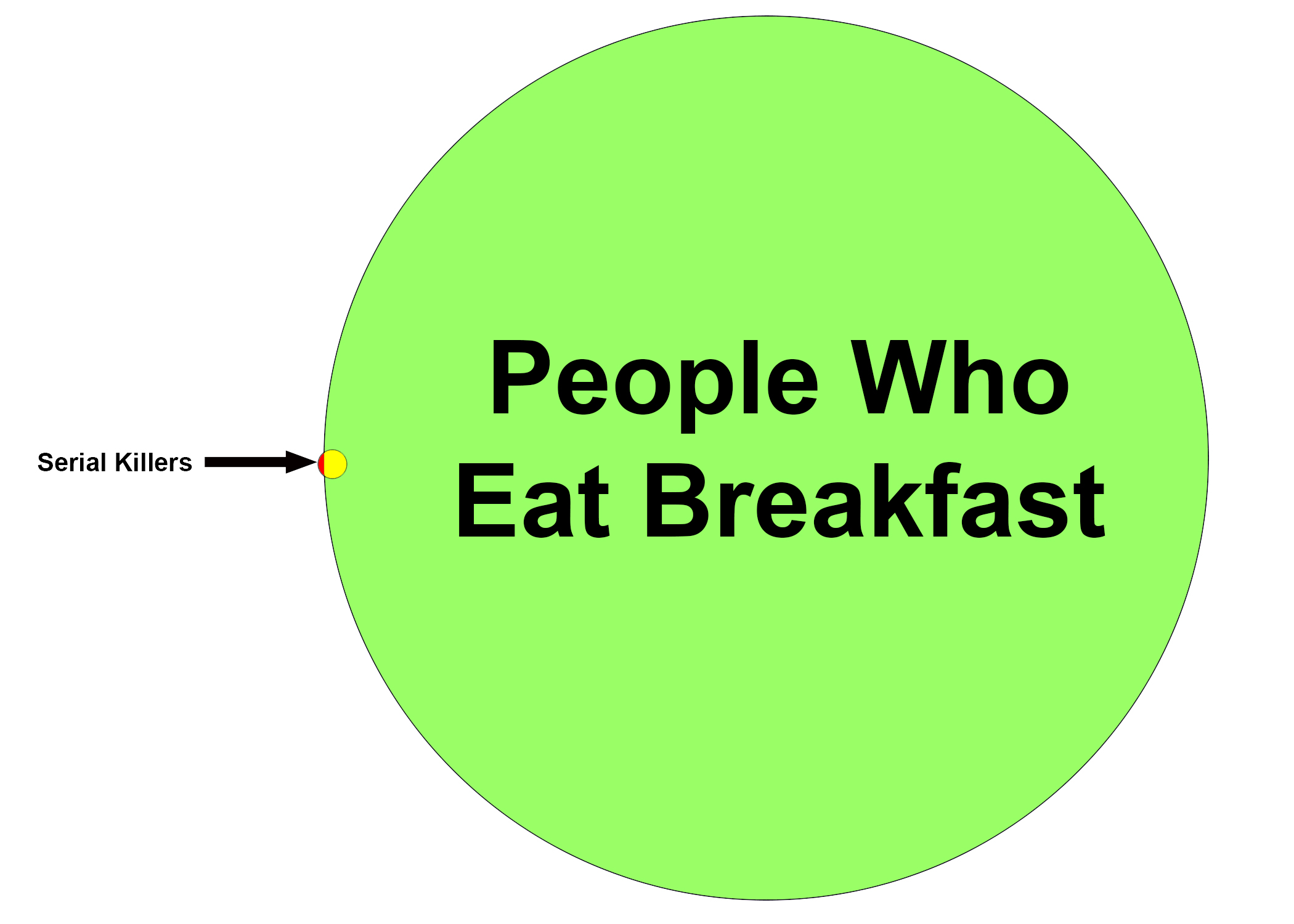
Now consider this Venn Diagram:
Venn 2.jpg
Even though the green circle isn’t nearly large enough (if it were, we wouldn’t even see the yellow part), this still demonstrates that most people who eat breakfast are not serial killers. Think about how much green there is compared to how much yellow. So if you came upon someone eating breakfast, you should be pretty confident that they are not a serial killer, keeping in mind that it doesn’t constitute proof that they are or that they are not. I’m thinking that is probably the case for you – that you don’t consider breakfast-eating to be compelling evidence of evil.

Being in the same group as someone does not mean you share all the same qualities

When someone says or does something that a serial killer, (or a racist, a rapist, a transphobe, a misogynist …) might do, it is false and dangerous to conclude that that person is one of those evil things. Notice the italics on the word might. That’s a probability word. A rapist might have eaten breakfast today. So might a non-rapist. And there are way more of those. To call someone a rapist, you would hopefully be using evidence they had raped someone, not evidence that they had eaten breakfast.

Or evidence that they are male.

Bad People Can Say True Things

It’s true. Truth is not the sole domain of the virtuous. Truth, in fact, like justice (purportedly) is blind. And it’s critical that we do not devalue the truth of a statement just because it aligns with the opinion of someone nefarious.

For example, someone who hates Muslims would be willing to assert that most suicide bombers have been Muslim, because it would further their agenda of hate, especially for those who immediately jump on the converse, which is clearly absurd. But if the claim is true, then a rational thinking non-racist could also say it. To then say “well islamaphobes say that, therefore you are islamaphobic” is to claim a converse that isn’t true. What’s far worse is that the label shuts down conversation. And if we can’t talk about things that are problematic, like racism, mass shootings, terrorism, sexual assault, or a myriad of other difficulties we face in modern society, how can we make things better? We can’t.

Good People Should Say True Things

Especially when it is hard, and even if it coincidentally aligns with the opinions of assholes, it is critical to acknowledge true things as true. Good people want to reduce misery in the world. Good people want to increase happiness in the world. Please don’t use the trick of claiming the converse to stand in their way. Let’s allow honest discussion to flow.

Thanks for reading,

Rich

“How Does it Feel to be Jewish?”

I’m Canadian. I was born in Montreal, spent time living in Calgary, and now reside in Toronto. My first language is English, which I speak with a weird fusion of Montreal and Calgarian accents. I’m white. I don’t “look Jewish”.

But I am.

I went to Hebrew school until the end of grade 9, when I entered the public school system. The public high school I went to was in a neighbourhood that had a high density of Jewish families, so even though I was no longer in Hebrew school, there were still plenty of Jewish kids around, though we were not the majority at the school. My friend group in high school was about 50% Jewish. We were all very close. It was a good time. We shared holidays. We experienced teenage angst. We learned to drive and we learned to derive (calculus joke – not sorry). We would not have said we were “tolerant” of each other. That would have made no sense to us. We were friends. We enjoyed our friendships. We enjoyed sharing our experience. I didn’t know how rare that was for a Jew in the diaspora because it’s all I had known. Then I went to university.

I studied mathematics at The University of Waterloo. It was, and still is, a great program. A lot of my Jewish friends chose to go to universities based on the Jewish population there, but I did not. Waterloo had the best math program, and math was my thing, so that’s where I went. Waterloo had almost no Jewish students. In all my time there I only met 3 others. And in my specific program, the Math Teaching Option, I was the only one. It didn’t bother me. I made a lot of great friends. I actually thought it was cool to experience a world outside the Jewish bubble I’d grown up in. It felt more real, because it was.

For better and for worse.

This was the first time in my life I would hold the designation “the Jewish person I know” in the eyes of many of my friends and acquaintances. Definitely not the last though. As a Jew living in Canada, you learn that’s very often what you are. You become the representative for an entire religion which has many sects, exists in many cultures, and has that country in the middle east that is in trouble all the time. People don’t generally discover that I’m Jewish right away because my Judaism is not discernible by my looks, demeanour, or dress, and I don’t lead with my name and religion anymore than anyone else does. But once they do find out, the questions start. Here are some of the questions I’ve been asked. I know you are going to think some of these are not true. I assure you they are.

“Is it true Jews love money?”

“So what’s the whole story of Israel and the Palestinians anyway? Why don’t they want peace?”

“Your nose looks normal. Did you have a nose job?”

“Do Jews really have horns and a tail? Do you shave your horns down?”

“Do Jews really use Christian blood to make the bread they eat on Passover?”

Crazy, right? But you get used to it. Sometimes I answer patiently. Sometimes I play it off as a joke. Sometimes I use sarcasm. It depends on who is asking and how I am feeling. But of all the questions I’ve been asked, the one that I always think of first when this comes up, and the one whose answer I’ve thought about most often, came from a fellow student in the Teaching Option at Waterloo. I think she was waiting for a moment when she could ask the burning question she was trying to wrap her head around. We were at a barbecue with a large group, and found ourselves sitting next to each other. She looked at me with a kind of confused wonder and asked

“So how does it feel to be Jewish? Like, to not have the love of Christ in your heart? That must feel so weird.”

I was struck right away with the understanding that to her, I was an alien. More than that, that I was an alien who knew it and knew what it would be like to be a native, was choosing not to be, and could therefore explain how it “felt” to not be something I had never experienced being. We had both grown up in Canada. We both spoke the same language and were both interested in becoming high school math teachers. We took the same classes and had occasionally worked together on the same assignments. My perspective to that moment had been that we were peers. It shifted immediately when I realized what her perspective was.

My answer at the time was to play it as a joke. I said something like “Feels amazing. Like a party in your head that never stops.”

But I wish I could go back in time and answer her properly. Here’s what I’d say.

When you’re young, it feels beautiful. You learn songs and prayers that children all over the world are learning. Every Friday night you have dinner with your extended family at your grandparents house and the food is amazing and there is so much love.

When you get a little older, you learn that there are a lot of people who will assume you’re Christian and wish you a Merry Christmas, and you should say “Thanks! Merry Christmas to you too!”

When you get a little older still, you learn that there are times when you should deliberately hide your Judaism, because even though we are proud Jews, you don’t have to advertise. You also develop an instinct for when to hide it. It’s a gut feeling. Sometimes you get it wrong though, and then you get blindsided by a visceral hate you can barely comprehend. The day I got beaten up by two kids who wanted to see my tail is a particularly painful example. I had zero clue what they were talking about. I didn’t know there were people who believed Jews had horns and a tail. I was so bewildered and scared, that if I could have shown them a tail to make them stop, I likely would have. I was 12 years old. I never told anyone.

As you get older you begin to understand that there is a significant segment of the world population that hates you. They never met you, but they hate you. They hate you so much they want to kill you. They believe once Jews are dead their problems will go away. You learn about the holocaust. You learn that’s why your uncle never talks and has a number tattooed on his arm. You learn that’s why your father has no cousins, and so you have no second cousins on your father’s side. Because even though his father was one of ten children, he was the only survivor of Hitler’s drive to exterminate Jews. You learn that during the holocaust, most non-Jews did nothing to protect their Jewish neighbours, and often betrayed them. You learn that during the holocaust, nations denied Jewish refugees entry. You learn that Canada was one of those nations. You learn that it’s history, but a history that we should never forget.

Then you learn that there are organizations whose charter it is to kill all Jews. And although they are in the Middle East, you learn that they have visible support in this endeavour all over North America. You learn to live with the low thrum of fear that someone will target you, or an institution you frequent, because of this hatred of Jews. You see it happen regularly. You learn that over the last few years in Canada, religiously motivated hate crimes have declined overall, but hate crimes against Jews have been increasing. According to Statistics Canada, they have increased by 52% since 2020.

Suddenly being the “only Jew someone knows” becomes complicated. You have a responsibility to represent all Jews. To explain Israel. To show that we’re human. I’ll say that one again: In interactions where you are the only Jew, you consciously make efforts to demonstrate that you – and by extension all Jews – are human. It’s a heavy responsibility. But you take it on. You have no choice. It’s literally about survival.

Then one day, in 2023, over 1400 Jews are massacred in a single day. Babies are murdered in front of parents. Parents are murdered in front of children. Families are burned. Woman are gang-raped and taken prisoner. It is all filmed by the people doing it so that they can share their victory with the world on social media and news sites. And in the days that follow, you watch people celebrating that it happened. You see further calls for death to Jews. You see this in Canada. Friends tell you to be balanced. Celebrities cheer the murderers. Elected politicians in North America call an event during which a terrorist is filmed cutting a Jewish child out of its mother’s womb, thus killing them both, a heroic act of resistance.

And next, the world starts accusing Jews of genocide.

That’s how it feels to be Jewish. I wish I’d told her. Though I doubt she’d have understood.

Gracefully Honest

In this blog I will talk about honesty – something I think many well-intentioned people struggle with. This is because sometimes it seems like lying is the right thing to do – and in some rare cases, it is. To paraphrase Sam Harris, when Nazis came looking for Anne Frank and her family, anyone lying about them not being hidden in the building was certainly doing the right thing.

That said, in all but the most extreme cases, people choose dishonesty for misguided reasons. This happens because sometimes the truth hurts. In fact, sometimes, truth is used as a weapon.

The confusion is, in part, because while honesty can be a good thing, there is no guarantee that it always is. Honesty must be wielded virtuously, which is not automatic. In fact on its own, honesty is not a virtue.

Honesty is not a virtue

In classical antiquity, there are the four cardinal virtues. In brief, here they are (these definitions are mine – for more formal details, check this link):

  • Prudence: The ability to judge the appropriateness of a possible course of action.
  • Courage: The strength to act in the presence of fear.
  • Temperance: The exercise of restraint in feeding an appetite.
  • Justice: The purest form of fairness, in a righteous sense.

So honesty is not a cardinal virtue. Now over the centuries, philosophers and theologians have added more virtues to the cardinal four. Of these there are three that I think are moral necessities. These are “love”, “charity” and “kindness”.

Still, on it’s own, honesty is not there. This is because honesty can be used morally (specifically in the context of love, charity and kindness), but it can also inflict pain – intentionally or not. Let’s have a look at that second situation first – the “brutal” honesty.

Brutal honesty

“I am going to be brutally honest with you.”

How many times have you encountered that sentiment? How many times have you said it? Let’s stop to consider what it prefaces: that the person is about to lay some bit of perspective on you that they know is going to hurt.

This is usually justified by the idea that you are deluded somehow, and need to “snap” out of it. Or you need a “hard” dose of reality. Or any other number of violent paradigm shifts the perpetrator feels they are uniquely prepared to impose. Because, after all, the world is full of people willing to coddle you, creating the need for someone righteous enough to tell you the truth, even though it will hurt.

This is bullshit.

This “brutal” honesty is really an attempted behaviour modification through punishment. The shock it is expected to impose is designed to somehow shine light on a deficiency in perception, so that you cease your persistence in pursuing some vision. A vision which, according to the person with the flashlight, is a fantasy. It tends to come from a place of anger and – make no mistake – is meant to make you suffer for whatever pain your apparent delusion has been causing them.

People who use this phrase like to project pride in their willingness to use it. You may hear them boast such claims as “Hey, I call it like I see it”, or “I’m a straight-shooter”. It comes with admonishments like “The truth hurts”, or “If you don’t want to hear the truth then you don’t want to be around me”. They may be offering honest assessments, but they are nested in dishonest motivation, even though the motivation is sitting right there in the phrase. Brutal is not a nice word.

Definition of brutal
“Brutal.” Merriam-Webster.com, Merriam-Webster, http://www.merriam-webster.com/dictionary/brutal. Accessed Mar. 2017.

Check out that definition. There is nothing in there that speaks to any kind of morality or good intention, and certainly nothing virtuous. Even the entry about brutal truth contains no compassion. Accurate? Yes. But unpleasantly and incisively so.

So then someone who prefaces the delivery of truth with “I am going to be brutally honest” is – by their own admission – embarking on a non-virtuous wielding of honesty as a weapon to deliver misery. I propose that in the vast majority of situations, the fundamental reason for this is that even though they are using the word, they are not being honest about their own motivation – the desire to be brutal.

But I don’t want to be brutal!

It’s okay – I know. This notion of brutal honesty leads to a concern from good people who don’t want to be brutal. There is a perception that if the truth is brutal, or perhaps unsavoury, then a lie would be better. Keep in mind though that lies come with a heightened anxiety of their being discovered. This often leads to uncomfortable situations, where additional and more elaborate lies are needed to maintain the facade of truth.

It doesn’t have to be this way. There is a way to be honest and virtuous. I call it “graceful honesty”.

Honesty with grace

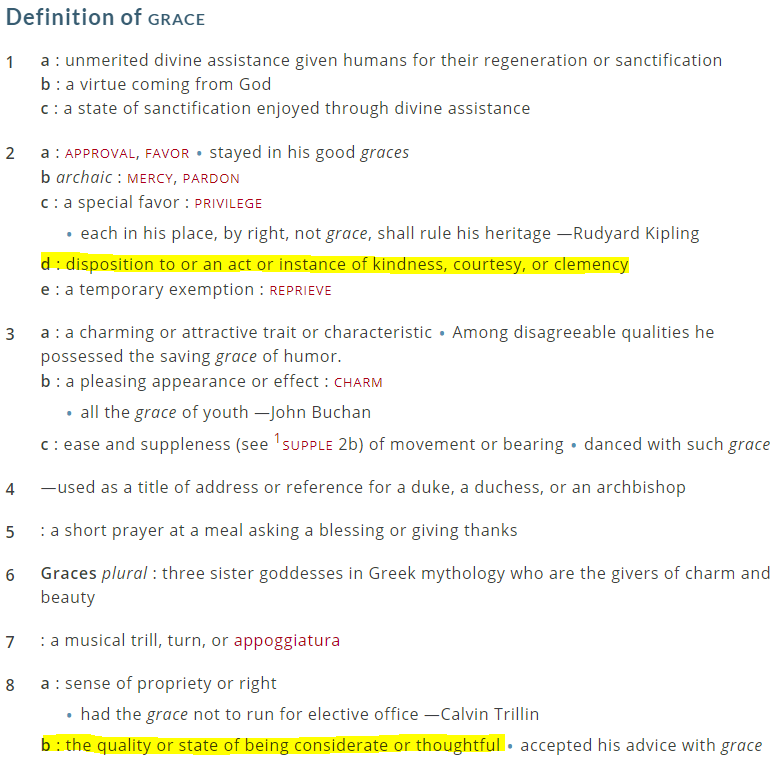
First, let’s have a look at the definition of grace, so that you can understand why I chose that word. Grace has many meanings, so I have highlighted the ones I am applying in this context:

Definition of grace
“Grace.” Merriam-Webster.com, Merriam-Webster, http://www.merriam-webster.com/dictionary/grace. Accessed Mar. 2017.

Recall earlier, when I spoke about the three virtues of “love”, “charity” and “kindness”. In many ways, the word grace encapsulates these, and so I choose it to describe the type of honesty I mean.

First, be honest with yourself

Graceful honesty isn’t difficult, but it does require some practice if you are not in the habit. The key to it is when you find yourself either tempted to be dishonest, or about to be brutally honest, you stop and spend some time being honest with yourself first. If your motivations are virtuous, then there will be a way to communicate honestly with grace. Conversely, if your intentions are nefarious, then hopefully you will be honest with yourself about that and choose some other course, having recognized the toxicity of your initial instinct. The key then, is to use self-reflection to uncover and put words to your motivation. I don’t want to use too many specific examples here, because it is easy to make arguments about the inaccuracy of an example as it applies to yourself, and then decide the concept is flawed, but I’ll indulge in one in the hope that it will be a good springboard.

Dinner at Kelly’s

Suppose you have been invited to dinner at your friend Kelly’s house, and you just don’t feel like going. The likelihood is that if you decide not to go, you will fabricate an excuse. Further, the excuse probably has a half-life greater than a few hours. What I mean by that is that it’s probably a concocted scenario that will likely be referred to at a later date. For example, you may claim “my kid is sick”, which you can bet Kelly will ask about in the next day or two, and may even ask your child. In this case you will have to remember the excuse so that you don’t accidentally contradict it later, and you may even have to recruit your family to perpetuate the dishonesty – something they are more likely to forget about, since they are not vested in the lie. Result? Anxiety.

Instead, consider this. You really do value your friendship with Kelly. You also don’t feel like going. Before choosing to be dishonest, you can spend some time in honest self-reflection. Why don’t you want to go? Be super analytical about that. You may discover that you actually do want to go, or you will confirm that you don’t. If you truthfully don’t want to go, you will now be better able to put into words what the real reason is, which will of necessity consist of the factors that are outweighing your legitimate desire to spend time with Kelly.

If you tell Kelly exactly that reason, and if Kelly is a good human, she will understand, because you have been fully honest and presented the reason in full context of how you struggled with the decision. She will appreciate the conflict, and understand the conclusion, even if she is disappointed.

But wait you say! I know Kelly! She would never understand! She would just be insulted! Well, I’m not foolish. I know this is also a possibility. But here’s the thing: this is only the current state of your relationship because of a history of implicit dishonesty about motivation. Which means there is room for more honesty – on her part and on yours. See, if at the core you both value each other and the friendship, then you mean no insult, and so how can she be insulted? And the core is all that actually matters – because it is impossible that either of you wants the other to be upset. That core exists, and honesty will land you there. Graceful honesty.

Graceful honesty doesn’t mean everyone is happy

In the example above, Kelly is probably going to be disappointed. You might also. That may seem contrary to virtue, but it isn’t. Not if you were honest about the factors that outweighed your desire to go. Disappointment isn’t a monster to be avoided at all costs. It’s a natural consequence of not being able to implement more than one choice at a time.

One of the great contributors to dishonesty is a desire to keep everyone happy – or at least not miserable. But it’s a trap. Lying by definition creates a false narrative. Perpetuating this to maintain a state of happiness, in fact maintains a state of delusion. One from which the participants (barring tragedy) must eventually emerge, and who’s discovery is unlikely to legitimize the illusion of peace they were enjoying. Put simply, the lie just sets everyone up for a bigger fall.

But life isn’t about being happy all the time! We all know this. We all experience negative emotions like sadness, anger, and disappointment. For the most part we don’t let these things impact the zoomed-out graph of our lives. Yet we find ourselves willing to skirt honesty with others to somehow shield them from these normal experiences.

Have you ever said something to someone in anger that you later regret? I’m betting you have. I’m betting some if it was pretty damn poisonous, and required a lot of apology, replete with the sentiment “I didn’t mean it”. But is that really true? More specifically, does “I didn’t mean it” mean the same thing as “it wasn’t true”?

My experience tells me that what we are really trying to say is “I regret using honesty to hurt you – it isn’t consistent with how I feel about you.” This can be about something you’ve been holding in for a while, or it can be about an emotion that was real in that moment, instigated by the anger. For example, “I hate you!” during an argument isn’t totally untrue, just imprecise: it really means “I hate this feeling I’m having right now that you are causing”, and it is 100% true. It is also 100% forgivable, because it is 100% understandable.

If you think about this for a while, you will see that the real mistake is not being honest earlier, when graceful honesty would have worked: “I love you, and I’m in it for the long haul, but I do get irritated when you don’t put the cap on the toothpaste. I do not equate this behaviour with you, and my irritation is therefore not aimed at you, but the behaviour.”

That last quote is wordy and annoying, I know. But it’s the idea I am trying to communicate, not a recipe for how to tell your husband to put the damn cap on the toothpaste. Very often we don’t disclose little irritants like that because we are concerned it will be taken as criticism of a loved one we don’t want to hurt, as opposed to observation of a behaviour that is independent of the reasons we care about the person exhibiting it. Graceful honesty would disclose all of that, and keep the barbs from growing onto a club that could be wielded in anger.

See, hiding the truth is silly. We are all in this reality together. We should share it. All of it.

Honesty is the sharing of reality.

Think about it. How can honesty be anything else? But as I said earlier, to do it with grace requires a deeper searching of our own motives than we normally do. So the next time you feel like a lie is warranted (or if you are tempted to inflict pain with truth), ask yourself why. What is motivating you? Who are you trying to protect? Who are you trying to help? When you feel the truth needs to be hidden, put away the issue whose truth is troubling you for a moment and look at the feeling itself – it will be the source of the honesty you should embrace. The reality you should share. It is the only way to build and maintain relationships that have value.

Thanks for reading,

Rich

Open-Mindedness

Recently I have been thinking a lot about why so many people seem inconvincible of certain things which I hold to be true. And while I could certainly make a list of some of these things, that is not the intention of this blog entry. Instead, I have been reflecting on open-mindedness and wanted to share.

Many people – myself included – often enter into discourse with someone of a differing opinion with the intention of convincing them to change their mind. For example, maybe your friend Paul thinks all trees in your neighborhood that are taller than 12 feet should be pruned to 12 feet or less, so as not to obstruct anyone’s view of the lakefront. You know that he’s clearly wrong! You get into a discussion. Only it’s not really a discussion – it’s an argument each of you is trying to win. Maybe out of frustration you start incorporating personal attacks. Maybe you get so angry at Paul’s refusal to capitulate, as well as the horrible things he is saying about you, that it ends your friendship. Maybe in the middle of the night, Paul prunes all of your tall trees. Maybe the next night you erect a 30 foot statue on your lawn directly in Paul’s line of sight to the lake … and so on.

It’s sad, and you don’t even like the statue, but what choice is there? Paul must be taught a lesson.

I wish this was hyperbole. Sadly, it is not. And the conclusion is clearly suboptimal.

Well … let me construct a basis for discussion with some (hopefully) fair assumptions. In doing so I’m going to have to use a little bit of math terminology, and it occurs to me that some people might not know precisely what I mean, or even be put-off by some of my more mathematical references. If you think this might be the case, I ask you to bear with me. The concepts and symbols I use are the best way for me to illustrate my point, and I’ve included here a bit of a math lesson, in case it is not something you’ve encountered in your life – it will clarify some of the words and concepts I use for the rest of this article. Of course, if you feel there’s no need for you to read this section, by all means scroll past it and keep reading (I won’t feel bad).


Some Math concepts

Sets
Mathematicians like to talk about collections of values that are somehow related, and when they do, they use the word set. We use curly brackets to list the objects (known as elements) of a set. So for example the set F=\{apple, orange, banana, kiwi, peach, nectarine\} is a set I have named F, and just so you know, it is the set containing all the fruits I might bring to work with me in my lunch. A subset of a set S is another set that only contains elements from S. So for example M=\{apple, kiwi\} is the set of fruits I brought to work in my lunch on Monday, and is a subset of F. On the other hand, A=\{apple, pineapple, banana\} is not a subset of F.

A Little Bit of Algebra (Apologies to the Arithmophobic)
Consider this simple algebra equation:
\displaystyle 3x+4y=7
The x and y are understood to be symbolic of numbers, but the use of symbols mean that they vary – which is to say, they are variable. The equation is a statement. In this particular statement,

x = 1, y=1
would be a valid solution (i.e., the equation becomes true), since
3\times 1 + 4\times 1=7.
So would
x = 5, y=-2,
since
3\times 5 + 4\times (-2)=7.
However
x = 5, y=2
would not be a solution (i.e., the equation becomes false), since
3\times 5 + 4\times 2=23,
which is not 7.

Statements
In math and philosophy, a statement is a sentence that must either be true or false (but not both, and not maybe). Very often the truth value (i.e., “true” or “false”) of the statement depends on values for variables contained in the statement. The algebra equation above is a statement. Another example is the statement “I like cheese”, which contains two variables: “I”, and “cheese”. If the “I” refers to “Rich Dlin” (i.e., it is me speaking and not you), and the “cheese” refers to “Havarti”, then the statement is true. If the “I” is “Rich Dlin”, and the “cheese” is “Cambozola”, the statement (I promise you) is false. Notice that if the “cheese” were to refer to “gingerbread cookie” the statement would be nonsense, since “gingerbread cookie” is not a cheese – even though it is true that I like gingerbread cookies, it is irrelevant in the context of this statement. A mathematician would say “gingerbread cookie” is not an element of the set of all cheeses. Going back to the algebra example, {(1,1),(3,-2)} is a subset of the set of solutions to the equation given. The actual set has an infinite number of solutions in it, but that’s more than I need to talk about here. What I will say is that the truth value of the statement “Three times John’s favorite number plus four times Gail’s favorite number will yield seven” is:

True if (“John’s favorite number“, “Gail’s favorite number“) belongs to the set of solutions of 3x + 4y = 7,

False if (“John’s favorite number“, “Gail’s favorite number“) does not belong to the set of solutions of 3x + 4y = 7, and

Nonsense if, for example, John claims his favorite number is “cinnamon“. Be on the lookout for nonsense – it is surprisingly common.


The Assumptions

Ok. Welcome back. Here are the assumptions I was talking about:

All questions have a right answer
… when the answer is justified properly with a well framed statement.
The truth value of the statement may be subject to variables that change which answer is correct, but with a fixed set of values for the variables, there is a right answer. For example, the question “Should all trees taller than 12 feet in our neighborhood be pruned?” could be answered “Yes”, justified with the statement “It is unacceptable for some trees in our neighborhood to block sight lines to the lakefront”. Note that here the answer to the question is “yes” if the statement is true, and “no” if the statement is false, and may reasonably depend on whether or not the tree is also so wide, or part of a grove, as to make it impossible for a resident to see the lakefront from a different angle standing on the same property. It may also depend on whether 12 feet is a reasonable height with respect to whether or not sight lines get blocked. In this case these variables need to be introduced into the statement, or else agreed upon as not being variable.

The right answer may well not be knowable
 … even with the variable values fixed – which doesn’t mean there is no right answer!
As an example, consider the question “How many humans are alive on Earth right now?”

  • The number changes many times in a short span of time. So the truth value of the answer depends on what time it is indexed to.
  • The answer is subject to a definition of “alive”, and the answers to whether or not some organisms are living humans are in dispute.
  • “On” Earth needs to be defined. If I am in an airplane, am I on Earth? What if I am in low orbit?
  • However there is an answer, if we fix the variables.
  • There is currently no way, even with the variables fixed, to know the answer.

Knowing the truth is inherently valuable.
This is a big one. Many people demonstrate by their behavior that they do not adhere to this assumption. A simple example is the person who refuses to go to the doctor about a problem because they are afraid of what they might find out. In some ways, not wanting to know the truth is a human quality, especially in situations where a false belief has spawned an entire tree of values and beliefs we have been living by. If the root belief is false, what happens to the tree?

When it Comes to Truth, What We Want Doesn’t Matter
So with these assumptions, my position is that for any belief I hold, I am either right or wrong, and that I may not be able to tell. So then what am I to make of someone who disagrees? Can I immediately conclude that they are wrong? Clearly not. However I freely admit I want them to be wrong, so that I don’t have to be. After all, being wrong has some negative implications. On a fairly benign end it means I have been somehow deluded, which injures my pride. On an extreme end it may mean I have to discard an entire tree of conclusions that were premised on my error, leaving behind a buzzing hive of uncomfortable questions and observations about my previous behavior. But if the root belief is actually wrong, what choice do I really have? Since it is rooted in falsehood, the whole tree is an illusion anyway.

Here is a hard truth: What we want has nothing to do with what is true. I want there to be peace in the Middle East. But there is not peace in the Middle East, and no amount of wishing on my part, no matter how fervent, can alter the truth value of this or any other statement. On the other hand, what is true can and should definitely impact what I want. What we all want.

Ok. Here is another statement that is tautologically true: In the set of things I hold to be true, some might be false. And from a probability perspective, I am also comfortable saying that in the set of things I hold to be true, some are true, and some are false. I want to say “most are true and some are false”, but I am honestly not sure I have a reasonable argument to claim that, so we’ll leave it there as a desire more than a fact.

Shades of Gray
Now I will focus on statements where the truth depends on fixing values for the variables in the statement., which to me is the core of the shades of gray argument: In cases where there is a continuum of possibilities between true and false, almost everything in the set of things I hold to be true lies somewhere within the boundaries of the continuum, rather than on one of the ends.

Here a philosopher or mathematician might (and should!) argue that there can be no continuum between true and false, since those are binary options. My response is that I am talking about a sphere of reasonable answers centered on the truth, where anything outside the sphere is easily demonstrated to be false (or worse, nonsense), but things get a little more touchy inside the sphere. This is a consequence of my point about the truth of a statement depending on fixing values for variables the statement depends upon. To elaborate on this, I am going to define something called an assumption set.

Assumption Set
Suppose a statement depends on a set of variables. For example, consider the statement “Running is good for you.” The truth of this is not absolute. It depends on some variables:

  • How much running (the quantity of the running)?
  • How intense (the quality of the running)?
  • What preconditions do you have that running would exacerbate (e.g, bad knees, asthma, heart problems)?
  • Where do you plan to do your running (road, track, beach)?
  • and many more.

So before we could discuss whether the statement is true, we would have to fix values for these variables. I call these fixed values the assumption set. So for example an assumption set for this statement could be
R=\{45 minutes per day, at 80\% of maximum heart rate, \{sensitive to sunlight, plantar fasciitis\}, track\}.
Notice that one of the elements (the preconditions) in this assumption set is itself a set – that’s completely acceptable. On the whole, I would judge this assumption set to be a reasonable one – which is to say, the elements of the set have a probability associated with them that makes them not unexpected in the context of discussing the claim that “Running is good for you.”
Another assumption set could be
S=\{15 hours per day, at 120\% of maximum heart rate, \{multiple hip replacements, torn Achilles tendon\}, Interstate Highways\}.
On the whole, I would judge this assumption set to be very unreasonable – which is to say, it is highly improbable that this would be an assumption set on which the claim “Running is good for you” would be a relevant discussion.

Reasonable Answers (Approximately True?)
A reasonable answer to a question can be defined as a statement that is true when evaluated with a plausible assumption set. That is to say, the assumption set is comprised of elements that have probabilities high enough that if we observed them we would not be surprised. In situations where the variables are in constant flux, the approximate truth value of a statement may be argued as the one that holds given the most likely assumption set. In cases like this, we may generalize a statement as true, while being willing to challenge it in the face of a game-changing assumption set. We maybe won’t talk about who gets to define “plausible”, even though there are times when that becomes the most relevant thing.

Arguing(?) With an Open Mind
Here I have chosen to use the word “arguing”, even though in truth I prefer the word “discussing”. That’s because most people seem to think that discussions between people in disagreement need to be arguments. I disagree. Remember the assumption that we are not right about everything? And remember the assumption that knowing the truth is inherently valuable? These two should premise every discussion we enter into. So when discussing the answers to questions, or the truth about statements, we need to do our best to remember that what we are trying to do is get as close to the center of the sphere as possible, because that is a good thing to do, and because we may not be there yet.

Of course, we all think we are closer than an opponent. If not, we wouldn’t be having the discussion in the first place. But keeping in mind that if two people are in disagreement, one of them must be wrong, a productive conversation is one where at the end of it the parties have converged on something they both hold to be as close to true as they can see getting. When this happens, the world gets a win. I’ll list some techniques for true open-mindedness.

Discussing With an Open Mind

  1. Remember that you might be wrong.
    Put another way, be willing to change your mind, or adjust the approximate truth of what you believe.
    See, you believe that you are probably right. You may even believe that you are certainly right (although for the truly reflective, certainty is a pretty difficult thing to attain). But your opponent has the same thoughts. Both of you probably have many reasons for these. And they probably have a lot to do with assumption sets, and which one of you is applying the most plausible set. Sometimes the discussion is not about the truth of the statement but on the plausibility of the assumption set. Keep that in mind. Yours may be the less plausible. Or maybe both assumption sets are equally plausible, in which case the statement can be split into two (or more) more detailed statements that include some of the differing assumptions explicitly. But keep in mind that emotional attachment to an assumption set can and will blind you to the plausibility of an alternate set, and ultimately cause you to refute a statement with unreasonable (even fanatical) obstinacy.
  2. Have higher expectations for yourself than you do for your opponent.
    This means you need to challenge yourself to inspect the assumptions and claims of yourself and your opponent objectively, even if they are not doing the same thing. When you do this – and do it out loud – they hear that. Look at elements of the assumption sets and objectively evaluate their probability. Also evaluate whether they change the truth value of the statement or not. And be prepared to evaluate whether or not they render the statement as nonsense – this happens surprisingly often but it’s not obvious until it is isolated. Discussing things this way models a behavior that is necessary for the two of you to converge on a conclusion you both agree with. And if you are consistent with it, your opponent will often adopt the same style, if only because they think this is the way to convince you they are right.
  3. Thank your opponent, regardless of the outcome.
    I don’t mean this as a politeness. I mean this in the most sincere sense. Any opportunity we get to reflect on our set of beliefs is valuable. Sometimes your opponent and you will converge. Sometimes you will not, and they leave the exchange completely unmoved, perhaps even claiming “victory”. This is sad, since the only true victory would be a convergence of opinion, but ultimately it is not relevant to your own experience. Make it so that if you have moved on a topic, it is because you discovered something you were not considering, or were considering incorrectly, and now you are closer to the center of the sphere of truth. If you do not move, make it because you were not presented with any strong evidence that you needed to. In either case your beliefs will have been strengthened in some way, either because you changed to something as a result of new insight, or because you were challenged in some way, and it was unsuccessful. For this you have your opponent to thank.

How to Spot Real Open-Mindedness
Many people claim to be open-minded. It may be true, or it may be a trick (some people say it so that when you fail to convince them of something it will prove they were right). True open-mindedness doesn’t mean you are ready to believe anything. It means you are willing to change your mind when presented with evidence that objectively compels you to do so. If you know of (or are) someone who has changed their mind in the moment, during rational discourse, but who was fairly slow to do so, they are probably the type of person I am describing. This goes back to my point that we are probably not right about everything we believe. Which means mind-changing can occur. Which means if you’ve seen it occur, it occurred in someone with an open mind.

Thanks for reading,

Rich