Rescuing Broken Discourse with Logic

We are in danger. Public discourse is almost dead, with important conversations being shut down by twisted logic resulting in false associations and cancellations. We need to step in and reclaim sanity. This article discusses some of the most glaring logical offenses that are sadly ubiquitous in the global conversation.

Anyone who voted for Trump is a white supremacist.

For many of you, reading that sparked a response charged with negative emotion. Some people probably got so angry they stopped reading and aren’t even here anymore.

Maybe you voted for Trump and took it as an attack. Maybe you hate Trump and got angry because you think the US has been overcome by white supremacists. Maybe you strongly agree with the statement. Maybe you vehemently disagree. There are lots of reactions that statement can instigate. But if it upset you, regardless of why, I offer my sincere apologies.

For the record, I disagree with the statement. In fact, I know it to be false. I’m Canadian, so I didn’t have a vote, but I have more than one personal acquaintance who did vote for Trump, and none of those people are white supremacists. That should be safe for me to say. Yet in many arenas, it isn’t. In many arenas, I would just have caused myself to be written off as a white supremacist too, among many other vile labels – guilt by association with a phantom assumption. And I haven’t even stated who would have gotten my vote if I had one which in any case is irrelevant. What is relevant though is how quickly and completely conversation gets shut down on critically important topics like this one that plague our collective discourse. This phenomenon demonstrates a fundamental lack of understanding, or perhaps worse, a deliberate lack of honouring, some core principles that we study in formal logic, which has roots both in philosophy and in mathematics.

Let’s switch to a less charged example.

Anyone who drinks water is a marathon runner.

It’s silly right? Drinking water does not imply that you run marathons, and to make the claim that it does is clearly ridiculous. What’s less absurd though would be saying that anyone who runs marathons drinks water. But even there, be careful, because there’s an association that many people will make that has nothing to do with why that sentence is true. See, although distance running does require proper hydration, that’s not the reason that marathon runners drink water. A marathon runner is a marathon runner even when they are not running. And they drink water for the same reason non-marathon runners drink water. In fact marathon runners drink water for the same reason all humans, not to mention marine mammals, sea birds and even trees drink water. Because they need it to survive. So if you discover someone drinking water, it’s not likely you would jump to the conclusion that they are a marathon runner. The distinction between “If you are a marathon runner then you drink water” and “If you drink water then you are a marathon runner” highlights the difference between what formal logic calls implications and their converse. It’s important to understand this concept, so let’s work on a short lesson.

First, we need to understand what we mean in formal logic by a statement.

Definition of “Statement

In formal logic, a statement is a sentence that has a definite state of true or false. Some examples:

“Justin Timberlake is older than Justin Bieber.”
(provably TRUE statement)

“5 is an even number.”
(provably FALSE statement)

“‘5 is an even number’ is a statement.”
(humorously constructed TRUE statement)

“There is sentient life on other planets.”
(Definitely either TRUE or FALSE, but although I have a guess, I have no proof that I’m right)

We can not always tell if a statement is true.

Although it’s fairly easy to tell if a sentence is a statement, it’s often difficult or even impossible to tell if it’s true or if it’s false. The statement “There is sentient life on other planets” does have a definite truth value, though we can only guess at what that value might be. And that’s where opinion enters the arena. Now consider this much more highly charged statement: “An unborn fetus is not a living human.” I bet that one sparked some intense emotion in many readers. And I’d also be willing to bet that the emotion it sparked is tied to your opinion about whether or not it is true.

That’s just your opinion

Guessing at the truth value of a statement is my preferred way to define opinion. We can argue over what we think about aliens from other worlds, or when human life begins, but until we have evidence that proves or disproves our position, all we are doing is voicing opinion. Isaac Newton said it well:

(We) may imagine things that are false, but (we) can only understand things that are true, for if the things be false, the apprehension of them is not understanding.

Isaac Newton

So we can apprehend (consider in our thoughts) beliefs and opinions, but false is false, so any belief attached to a false thing is not true understanding. Compounding the problem this highlights is that it is human nature that purging a disproven belief requires a deliberate and often painful reorientation, so often what we see is denial, and a loyalty to a false opinion. It might be human nature, but it’s dangerous.

Consider this thought experiment:
Suppose you are pro-choice, because you indisputably support the right of a human to make decisions about their own body. It would likely (but admittedly not certainly) then be the case that you also believe that the fetus is not a human, and so there is no conflict between the rights of the mother and the rights of another human. Then suppose you learned, conclusively, that a fetus is a human baby, effectively equating abortion with homicide. How would that make you feel? Would it be easy to change your position? In this thought experiment, where the premise is that it has been proven that a fetus is a baby, would you choose to deny that truth?

It’s an extremely difficult thing to think about dispassionately. But beware when asserting opinions as facts, and be prepared to understand that until a fact is known/proven, your opinion will differ from that of others, and arguing with them without establishing that both arguments are predicated on opinion is more of an exercise in charisma than debate.

Opinion Vanishes in the Face of Proof

Once the truth value of a statement is established via proof, opinions are rendered irrelevant, and they only persist as the result of deliberate obstinacy, miseducation/delusion, or in many cases, indoctrination. Interestingly, this applies even if your opinion happens to align with the truth. If it is your opinion that there is sentient life on other planets because you believe Star Trek is a documentary, then even if there is sentient life on other planets your opinion is based on delusion, and the fact that you are correct is coincidental. Think of it this way: If you’ve been maintaining that there is life on other planets because Captain Kirk fought a Gorn, and one day life is discovered on another planet, you would look pretty foolish proclaiming that you were right all along. So whether “correct” or not, opinions are just opinions. It is interesting to consider the ramifications of using miseducation to deliberately delude uneducated people into having an opinion that aligns with the truth, but maybe that’s a topic for a different article.

Ok, so hopefully we understand now that a statement is either true or false, and that we can’t always know which it is. Furthermore, if we guess, then we are forming opinions. This gets even more interesting (if that is the word for it) when we create compound statements by linking statements conditionally. Like saying “If you voted for Trump then you are a Nazi.” Using If/then to link statements is called implication. We use them a lot.

Definition of “Implication

“If you are reading this article, then you understand English.”

Is that true? I think so. In any case, that statement is an example of an implication – a compound statement that conditionally links two statements. Implications claim that if we know that one statement (called the predicate) is true, then we can conclude that a second statement (called the conclusion) is also true. Even though implications don’t always present the same way, they can always be formulated using “if/then”.

Because implications are statements, they will either be true or false. For example:

Predicate: I was born before 1970
Conclusion: I am older than 30
“If I was born before 1970 then I am older than 30”
True – based on arithmetic

Predicate: A person is wearing pants
Conclusion: That person is hungry
“If a person is wearing pants, then that person is hungry”
False – a person who was wearing pants and was hungry, who has just eaten their fill, will still be wearing pants (though they may have unbuttoned them!)

Any statement that can take the form “If A, then B“, which is to say “A implies B“, is an implication. For example:

“All football players use steroids”

can be reformulated as

“If you are a football player then you use steroids.”

It is worth noting that the above statement about football players is an example of a false implication, even though it is the opinion of many. Unlike opinion, truth is not ascertained or even swayed by consensus.

It’s also important to distinguish between the truth of an implication, and the truth of the conclusion. For example, “If I win a hundred million dollars in the lottery then I will buy a Lear Jet.” is a true implication (ask my wife – we’ve discussed it), but it does not mean I am going to be buying a Lear Jet. When “A implies B” is true, it doesn’t mean B is true, or even that B could ever be true. It just means that if you observe that A is true, then you can conclude that B is also true. This connection actually has a cool Latin name in formal logic. It’s called Modus Ponens.

Modus Ponens

Modus Ponens is a special implication that we use to make deductions by citing established implications. It says “If A implies B, and A is true, then B must also be true.” A very common error is when people pervert modus ponens into “If A implies B, and B is true, then A must be true.” This is faulty. Consider this example:

“If you stick your hand into a toaster while it’s on, you will burn your hand.”
This is true.

Now consider these two arguments:

Modus Ponens
“I see you stuck your hand into a toaster while it was on. You must have burned your hand.”

Faulty Deduction (perverted Modus Ponens)
“I see you burned your hand. You must have stuck it into a toaster that was on.”

This perversion of modus ponens can also be dangerous. Imagine the implication “If you are racist then you supported Trump” is true. Now consider this faulty deduction: “I see you supported Trump. You must be a racist.” This is precisely the sort of perverted logic that divides and fragments society, potentially irreparably.

This leads us to the notion of the converse of an implication, and the contrapositive.

“Converse” and “Contrapositive”

Every implication has a converse and a contrapositive. The converse switches the predicate and the conclusion, so the converse of “A implies B” is “B implies A“. On the other hand, the contrapositive of “A implies B” is “not B implies not A“. The contrapositive means that if you know the conclusion is false, then you can conclude that the predicate is false. It’s essentially saying the same thing as the implication, in a different way. That argument has another cool Latin name: Modus Tollens:

Modus Tollens

Like Modus Ponens, Modus Tollens is used to make deductions using established implications. It says “If A implies B, and B is not true, then A must also not be true.”

Consider this example, which demonstrates the ideas of implication, contrapositive, and converse. Suppose you took a Spanish course where students who fail earn a grade of F:

Implication:
“If I got a C, then I passed the course.”
(True – A credit is awarded for any grade other than F)
Modus Ponens: ” I see that you got a C, so you must have passed the course”

Contrapositive:
“If I didn’t pass the course, then I didn’t get a C.”
(True – not passing – i.e., failing the course, means you got an F)
Modus Tollens: “I see that you failed the course, so there’s no way you got a C.”

Converse:
“If I passed the course, then I got a C.”
(False – You may have gotten an A, B, C or D.)
Faulty logic: “I see you passed the course, so you must have gotten a C.”

Notice that the implication is true, the contrapositive is also true, but the converse is false.

Sometimes the converse is true, and sometimes it is false

For true implications sometimes the converse is true:

“If we have a common biological parent then we are biological siblings.”
has the converse
“If we are biological siblings then we have a common biological parent.”

and sometimes it isn’t:

“If our fathers are brothers then we are cousins.”
has the converse
“If we are cousins then our fathers are brothers.”

So knowing an implication is true does absolutely nothing to tell you if the converse is true – or false. Yet there is a strange insistence in public discourse that true implications always have true converses. This is glaringly demonstrated in political discourse.

How would anti-immigration voters have voted?

Consider this implication, which may or may not be true (probably is), but many readers will definitely have an opinion about it:

“If you are racist then you will not hire a black candidate.”

Now consider the converse:

“If you did not hire a black candidate then you are racist.”

I have heard this claimed countless times. And there’s no logical foundation for it. This highlights another common error people make. Implications create links (being racist links to not hiring black people), and people then use those links to try and reverse-engineer a converse (not hiring a black person links to being racist). This can be attributed to the notion of ruling out. Suppose that all immigrant-haters voted for Trump, and that you did not vote for Trump. Then using Modus Tollens I can rule you out as an immigrant-hater (you did not vote for Trump, so you must not hate immigrants).

However if you did vote for Trump, then I can’t use Modus Tollens or Modus Ponens to disprove (rule out) the possibility that you hate immigrants, because in the implication we are citing, hating immigrants is the predicate, not the conclusion, and all I have observed is the conclusion. So your position on immigrants is something I’d have to look at other factors to determine.

Not being able to disprove a statement does not mean it’s true

True: “If you get a D in Spanish, then you earn a credit.”

Suppose you believe that I got a D in Spanish. Now suppose that in an attempt to prove that you are correct, you do some digging into the school records and discover that I did take Spanish, and that I earned a credit. Does that mean I got a D? You can’t tell. All you know for certain is that I am in the group of people who earned a credit. You hopefully also know that anyone who earned an A is in that group. Me being in the same group of people who earned a D is not proof that I earned a D, because all the credit-earners are in that group, and they did not all earn D’s. You could say that you have gathered some evidence that I earned a D, but you can not say that you have proven it. So you have neither proven nor disproven your belief. On the other hand, if your digging showed that I took the course but did not earn the credit, Modus Tollens rules out the possibility that I got a D, and your opinion is false. Which is to say, “You did not earn a credit, therefore you did not get a D”.

So then if it’s true to say that immigrant-haters voted for Trump, and you know your coworker voted for Trump, then all you know is that your coworker is in the same group as immigrant-haters. Now even though you can’t rule it out, you can not conclude that your coworker hates immigrants. So if you start a conversation with them by accusing them of hating immigrants, that’s bound to go poorly.

Implication does not imply causation

We also need to think about a common misconception, which is that true implications are therefore causations. That’s the false belief that if we know that “A implies B” is true, it must mean that “A causes B”. This is actually just another example of mistakenly believing a converse:

“If A causes B then A implies B” is an implication where the conclusion is also an implication, and it’s true.

The converse, “If A implies B then A causes B” is false.

Consider this example, which has embedded causation:

Let A be the statement “Your car has no fuel” and
Let B be the statement “Your car won’t start.”

So:
not A is the statement “Your car has fuel” and
not B is the statement “Your car will start.”

Implication (If A then B):
“If your car has no fuel then it won’t start.”
(True – Cars with no fuel won’t start, and even if there are other things wrong with the car that we don’t know about, knowing it has no fuel allows us to invoke causation to conclude it won’t start)

Contrapositive (If not B then not A):
“If your car will start then it has fuel.”
(True – You can’t start a car if it has no fuel)

Converse (If B then A):
“If your car won’t start then it has no fuel.”
(False – there are lots of reasons why a car won’t start and being out of fuel is only one of them)

… which brings me to strength-training.

What Does This Have To Do With Strength Training?

The car example shows that even when causation is the reason an implication is true, we still don’t get the converse. But sometimes the example in question is less clear, and people jump to conclusions.

For example:

Truth Due to Causation:
“If I participate in a strength-training regimen at the gym, then I will get stronger”
(True because of the causal relationship between strength-training and getting stronger)

So we have an implication that is true because of causation. The converse is “If I got stronger, then I participated in strength-training at the gym”. That’s a conclusion people jump to all the time. “Oh, you have gotten stronger – you must have been working out!” False. Lifting weights in the gym is not the only way to get stronger. Someone who gets a job that requires heavy lifting will also get stronger. Children get stronger just by growing. So if you find someone who has “gotten stronger” you cannot automatically conclude that they started a strength-training program at the gym. Again, even when there is causation, a true implication is not proof that we have a true converse.

It’s time to bring this back to public discourse. It’s crazy-making to see how many people seem to think that the converse is always true. Or if not, they pretend they do, to fool others into buying an argument. Let’s look at an extremely charged example: rape.

All rapists are men

This isn’t technically true, but while a very small percentage of rapes are not perpetrated by men, the vast majority are. This is a horrible truth. One that has troubled me since I was old enough to have learned it. As a thought experiment, let’s simplify this and for a moment assume that all rapes are committed by men. So then we would have this implication:

“If you are a rapist, then you are male.”

But consider the converse:

“If you are male, then you are a rapist.”

I hope we can clearly see that the converse is false. Sadly, I have heard this converse claimed (or implied) many times, and it does nothing at all to help the real issue of rape. Good people want to eradicate rape, because rape is monstrous, and good people want to reduce suffering. Taking good men and lumping them in with bad ones by claiming masculinity as the driving force behind the desire to rape, creates extra suffering. It makes no sense.

There are many other places where we see the converse invoked dangerously. One chilling example is when someone asserts that an implication is true, but then get accused of having supported the converse. This then changes the conversation about a potentially difficult issue into one of accusation and defense.

I will list some examples of implications I have heard claimed, where an immediate switch to the converse then changes conversation to the wrong topic. As an exercise, in each case, state the converse of the implication in your mind and ask yourself what trouble that might cause, and how it would poison the (potentially difficult) conversation. As I said, these are heavily charged statements. In many, if not all cases, the reason they are heavily charged is probably not the implication, but what the converse would mean, if it were true.

I feel that I have to repeat that I am not claiming the implications in the examples are true, though I know they are the opinion of many. But if they are true, it’s because they are, and if they are not, it’s because they are not. Opinion vanishes in the face of knowledge. Still, arguing about the converse has nothing to do with either of those cases and changes the dialogue into something irrelevant. It’s important, as you read, to keep the dispassion of viewing claims through the lens of formal logic. For each implication, consider what it would mean if it were true, and whether the converse would then also apply.

Do you think any of these are true?
Do you think their converse is true?

  • If a person is a white supremacist, then that person would have supported Trump over Harris.
  • If a person is a mass killer, then that person is a gun owner.
  • If a person is a member of Hamas, then that person is Muslim.
  • If a person is misogynist, then that person is male.
  • If a person is a stalker, then they will like all your photos on Instagram.
  • If someone wants to rob you, then they will walk behind you at night.

Do you think any of these are true? If so, do you also think the converse is true? If you think the converse is true, is your evidence of this that the original claim is true? If so, you have no foundation to back the claim to the converse. Seriously. None. Hopefully this article has made that clear.

Just because an implication is true, it does not mean its converse is also true.

And yet there seem to be a huge number of people out there who think that it is impossible to hold to a claim and not hold to the converse. For example they think that if you talk about mass killers being gun owners then you want to paint all gun owners as mass killers – which is a ridiculous notion on so many levels, perhaps the most obvious being the staggering number of gun owners who are not killing anyone with them – and they label you as ignorant, or as a fear-mongering anti-freedom fanatic with a hidden agenda. But there is simply no logical foundation for this connection. What they are doing, from a logical perspective, is saying that since you believe an implication is true, you also believe the converse, and so you are pushing a hidden agenda. And I just can’t say how many ways this is wrong, and dangerous.

“But wait!” some say, “fear-mongering anti-freedom fanatics pushing a hidden agenda DO say that most mass killers are gun owners! So by saying that aren’t you one of them?”

Once again, they are invoking the converse of an implication, possibly without realizing it – though I suspect in some cases fully realizing it and doing so anyway to redirect away from rational discourse. “If you have a hidden agenda then you will say that most mass killers are gun owners” is not the same as “If you say that most mass killers are gun owners then you have a hidden agenda”.

To illustrate just how silly all of this is, I’ll talk a little about probability, using Venn Diagrams. This time we’ll talk about serial killers.

Most Serial Killers Eat Breakfast

This is an implication, but what’s not immediately obvious is that it invokes a probability statement due to the word “most”. It means that if you encounter a serial killer, then they probably eat breakfast.

Because of how we use the word most, it arguably means anywhere between 50% and 100%, so for the sake of argument, let’s suppose that 80% of serial killers eat breakfast. I’m sure that number is low, but I’m thinking that if I attempt to consult studies on the eating habits of sociopathic murderers, I may find limited data has been collected. In any case, assuming 80%, a visual representation might look like this:

Venn Diagram 1

So if you want to bet on whether a particular serial killer eats breakfast, and you don’t know ahead of time, you should make the bet, because you will probably win.

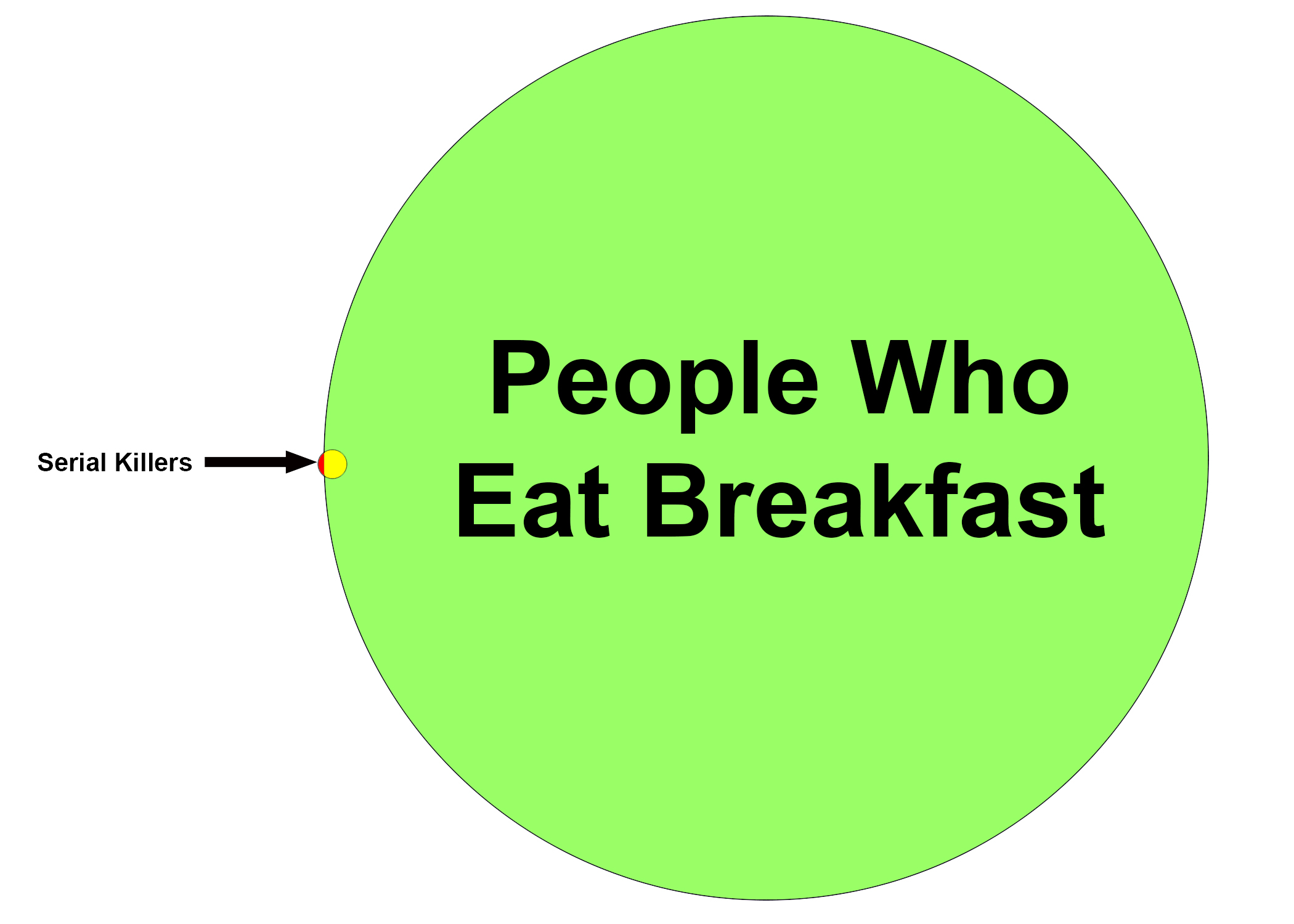
Now consider this Venn Diagram:
Venn 2.jpg
Even though the green circle isn’t nearly large enough (if it were, we wouldn’t even see the yellow part), this still demonstrates that most people who eat breakfast are not serial killers. Think about how much green there is compared to how much yellow. So if you came upon someone eating breakfast, you should be pretty confident that they are not a serial killer, keeping in mind that it doesn’t constitute proof that they are or that they are not. I’m thinking that is probably the case for you – that you don’t consider breakfast-eating to be compelling evidence of evil.

Being in the same group as someone does not mean you share all the same qualities

When someone says or does something that a serial killer, (or a racist, a rapist, a transphobe, a misogynist …) might do, it is false and dangerous to conclude that that person is one of those evil things. Notice the italics on the word might. That’s a probability word. A rapist might have eaten breakfast today. So might a non-rapist. And there are way more of those. To call someone a rapist, you would hopefully be using evidence they had raped someone, not evidence that they had eaten breakfast.

Or evidence that they are male.

Bad People Can Say True Things

It’s true. Truth is not the sole domain of the virtuous. Truth, in fact, like justice (purportedly) is blind. And it’s critical that we do not devalue the truth of a statement just because it aligns with the opinion of someone nefarious.

For example, someone who hates Muslims would be willing to assert that most suicide bombers have been Muslim, because it would further their agenda of hate, especially for those who immediately jump on the converse, which is clearly absurd. But if the claim is true, then a rational thinking non-racist could also say it. To then say “well islamaphobes say that, therefore you are islamaphobic” is to claim a converse that isn’t true. What’s far worse is that the label shuts down conversation. And if we can’t talk about things that are problematic, like racism, mass shootings, terrorism, sexual assault, or a myriad of other difficulties we face in modern society, how can we make things better? We can’t.

Good People Should Say True Things

Especially when it is hard, and even if it coincidentally aligns with the opinions of assholes, it is critical to acknowledge true things as true. Good people want to reduce misery in the world. Good people want to increase happiness in the world. Please don’t use the trick of claiming the converse to stand in their way. Let’s allow honest discussion to flow.

Thanks for reading,

Rich

Jewish Identity and Excellence: The Challenge of Impossible Standards

On the first two nights of Passover (or just the first night in Israel) Jewish people gather for a ceremonial dinner called a Seder, where the story of Exodus is retold. The centerpiece of the Seder table is a special plate, on which is placed six symbolic foods, each meant to represent an aspect of the Jewish people’s suffering as slaves in Egypt, and the way they gained their freedom. One of the items on the plate is an egg, and oddly, the egg is not a formal part of the dinner, so the symbolism of it is not directly addressed as part of the stages of the Seder. As a child, I always wondered what the egg was about, and asked a teacher of mine about it. Even though I learned later that his answer is not the official explanation, it resonated with me.

What he said is that the egg is not like other foods. When you heat an egg, it gets harder, and stronger. He said that this represents the Jewish people who were slaves in Egypt. I see now that his explanation was a variation of the saying “The same boiling water than softens the potato hardens the egg.” Pharaoh thought to soften the potato by working the Jewish slaves harder, and subjecting them to increasingly more cruel and harsh conditions. It didn’t soften them though. Like the egg, it made them stronger.

Another fixture on the Seder table is a bowl of saltwater, and in many families the egg is dipped in it prior to eating. The saltwater symbolism is pretty direct, representing tears. The symbolism, my teacher explained, is that the oppression-hardened egg is not the final lesson. Enduring slavery and Pharaoh’s hell would not be anyone’s choice as a way to become strong. Under the weight of this misery, the tears of suffering are the salt that layers over all aspects of life.

The metaphor applies just as well today as it did in biblical times. It has been said that many in the world apply impossible standards to the modern state of Israel, and that this is by design. It’s meant to trap Israel into an unwinnable game with eradication as the price of losing, said eradication being the clearly stated endgame of those who have opposed her existence since the beginning. It’s not hard to see the parallel to Pharaoh’s strategy here. Apply increasing pressure on Israel – pressure not applied to any other country – and eventually, she must break. We are seeing it in real time, right now.

As a consequence, by extension this increasingly impossible standard is then applied to all Jewish people across the globe. All 0.2% of us. This is not a new phenomenon. Jewish people have been subjected to impossible standards for thousands of years. With respect to anti-Jewish sentiment, the current situation in the middle east is the latest excuse. But what the people who do this don’t understand is the actual impact that has on people who are born Jewish. They don’t understand why that forces us to excel, which must certainly be maddening to those that wish to see Jewish people suffer. Before I explain my thoughts on why this happens, I want to make clear that I don’t think it’s Judaism as religion that does this, per se, although it is difficult to measure and potentially unweave from Jewish culture the effects of being held to impossible standards over millennia. Rather this drive to excel is the effect on a group of human beings born into a world that continually ups the ante on what will be tolerated. A world that from the outset seems to never afford them the same tolerance for humanity afforded to others. For context, let me give you some personal background.

I have been a high school math teacher for almost 25 years, with the exception of two years I spent on secondment, lecturing mathematics at The University of Waterloo. At the start of my career I worked in three different public schools in in the Greater Toronto Area, in neighborhoods with very different demographics from each other. Then I transitioned to teaching at a Jewish high school. As part of my ongoing work with Waterloo, I also have had the pleasure of working with thousands of students across Canada, as well as internationally in India, Singapore, Malaysia, China, and Ghana. These days I do a great deal of tutoring and mentoring, so I have the opportunity to work one-on-one with hundreds of high school and university students. As a result of these experiences, I’ve encountered students from a wide spectrum of countries, cultures, races, religions, and financial backgrounds. And there is one comforting and beautiful lesson I’ve learned:

Teenagers are fundamentally awesome people.

Despite cultural, geopolitical, and socioeconomic differences, the brilliance, goofiness, and awkwardness is universal. So too are occasional bouts of acting like an idiot. And the ability to be able to turn these characteristics on and off when the situation really warrants it is also universal. They’re ultra cool adults-in-training who still have the little kid in them but are learning how to manifest the grown-ups they will become. All while learning about and exercising their inevitable independence from older generations. They score huge victories. They make huge mistakes. If the child is the raw material, then the adolescent is the forge from which the ultimate adult emerges, tempered into that special alloy of perfection and flaws that we experienced adults all know we are. Witnessing this blossoming is an honour, and is what makes me so grateful to be an educator. For a teacher, students are like your kids, and when I witness them just being teens, I feel legitimate happiness. Even when they’re acting like idiots.

Take for example, school excursions like field trips and sporting events. Any teacher will tell you what a mixed blessing it is to supervise these, especially overnight trips. Those overnighters! There’s nothing quite as stressful as being responsible for dozens or even hundred of other people’s children out in the wild. Responsible for their safety, and also for their behaviour. The blessing is to be there to watch them experience and interact with the world outside the classroom. You see them behave respectfully to strangers. You see their curiosity. You see their enjoyment of each other. You also sometimes see them act like fools, and these are the times when you have to intervene. I have supervised more excursions than I can count, and many of them were multi-day trips to a different country. It’s stressful, but it is incredibly worth it.

So when I prepare a group of teens for an excursion I always tell them that I want them to have the best experience. I tell them how much I love that I get to be a part of it. And I make sure they understand the behaviours we expect, even while knowing that they often have slightly different plans of their own. But when I’m preparing a group of Jewish students, my presentation always has an extra request:

Hold yourselves to a higher standard.

See, if a stranger sees a large group of teens outside of school, they often have certain ideas about what they can expect, and some of that is negative. For example, if a large group of teens was eating lunch in a public space, and left a lot of litter, many people would disgustedly react with a thought more or less like damn teenagers – don’t their parents teach them to pick up after themselves? If the teens are being overly boisterous, you will often see strangers shaking their heads or looking at them angrily. In these situations, you will even sometimes see strangers intervene and try to modify the behaviour. Hopefully it doesn’t get to that stage, and as a chaperone you always do your best to make sure you are the one intervening, but people will be people. This is all normal.

It all changes though, if the group of teens is identifiably Jewish, say, because the boys are wearing kippot (aka yarmulkes or skullcaps). When it’s Jewish kids, the perception is no longer that it’s a group of annoying teenagers. It’s now a group of annoying Jews. The mutterings change from damn teenagers to damn Jews. Their Jewishness trumps their adolescence as the attributable factor for their unwelcome – albeit normal – behaviour. It’s not fair, but it is true.

That’s why I always tell my Jewish students that they must hold themselves to a higher standard. Not because of me, or because of arbitrary rules, and certainly not because it’s fair, but because whether they like it or not, they are ambassadors for all Jewish people. So be extra respectful, extra courteous, and keep that adult switch flicked to the on position. Because the world might cut you some slack knowing that you’re a teenager, but that slack gets gathered right up if you’re a Jewish teenager. And you know what? The kids always do it. They do hold themselves to a higher standard. We inevitably get comments from bus drivers, tour guides, other coaches, and even just regular people interacting with the group that the kids are so polite and respectful, and so nice to deal with – much more so than most groups of teens. This ability to live up to impossibly high standards has nothing to do with being Jewish, but the need to tap into that ability – and thus discover that you can – has everything to do with it.

Being judged more harshly than other teens because you’re Jewish isn’t fair. It’s not a choice anyone would make or a preferred strategy to learn how to rise above. It’s just reality. The reality that says to the sports teams from Jewish high schools that when you are playing at non-Jewish schools, kids will throw pennies at you. And if one of your basketball players commits a foul, the spectators will shout about dirty jews and their dirty play, so keep the fouls to the barest minimum. It’s an impossible standard.

The lesson in this runs deep and lasts a lifetime. First, it teaches the kids that they have the inherent power to be better – better than they even need to be. It teaches them that to be Jewish often means not giving bigotry and hatred an excuse, even and especially when that means behaving better than others. It teaches them that as much as we might wish otherwise, the world is not a fair place, and never will be, so play the hand you’ve been dealt instead of the one you wish you had. It teaches them that the best way to fight antisemitism is to act with honour, grace, and excellence. It also teaches them that you can let down that guard and be “normal”, but only when you’re amongst your own, and that breeds a strong sense of community. Ultimately, this lesson remains with the kids as they grow in to adults. They learn that they have the power to hold themselves to impossibly high standards. They achieve greatness as a result.

It’s ironic really. That impossible standards can make you impossibly great. But there it is.

Thanks for reading,

Rich

There Is (No) Fire

There is no fire
he said
They just want you to think there is so you will be afraid

But there is smoke coming out of the vents
I am afraid.
Shouldn’t we leave?

That’s not smoke
he said
It’s vapour from the air conditioning

But those people over there are dying from smoke inhalation
I am afraid.
We should leave.

They are not dying because of the smoke
he said
(wasn’t it vapour?)
They are dying because people die

But the door is hot to touch, and there is smoke coming from underneath it
I am afraid.
Can we leave?

The smoke is because the door is burning
he said
(wasn’t there no fire?)
But it’s just the door, not the room we are in

But there are people screaming in the next room that they are burning
I am afraid.
I’m leaving.

The fire is in the house around us
he said, blocking the windows
(wasn’t it just the door burning?)
This room is not on fire, so we are safe here

But I am getting very hot, and the air is getting hard to breathe
I am afraid.
I wish we had left

The fire in the room is your imagination
he coughed
(did my imagination make you cough?)
The w

Revolutionizing Social Media Interaction for a Brighter Future

As we get closer to the American elections, and then moving into the Canadian elections next year, I find it more and more imperative that we work to effect a fundamental change in the way we interact with social media and, by extension, how we interact in real life. Over the last ten years or so my concern over the culture has grown from mild alarm at some people’s online behaviour, to something approaching real fear that we are at a tipping point into another real-world dark age, specifically with respect to intellectual and cultural decline. And violence.

It’s not all bleak though. Thanks to many private conversations, I know I am not alone in my concern, and I do see signs that there are public figures with a legitimate desire to change this trajectory, as opposed to leveraging the culture for their own personal gain. And considering the magnitude of people who, exclusively through social media, get their news, form their opinions, and – maybe most troubling – learn how to communicate, social media is where it has to start.

If we can do it, it won’t be through any kind of censorship or similar attempts to control how people use their favourite platform though. It has to be you and me. We have to change the nature of our posts. And so I had this idea of a filter, or sieve, that we can apply to our more meaningful posts to both increase their effectiveness, and also combat the culture that is propelling us toward a precipice.

Consider this. If you want to engage in political posts on social media, that is your choice, and I support it. Keep in mind though that these posts are, by nature, argumentative, in that political posts always argue for or against some candidate or issue. Which on its own is not a problem. Argument (or debate) is not a fight. The idea that arguing equals fighting is something that’s manifested because people like getting attention and scoring points. True argument is not a contest, but a means to pursue truth and, conducted properly, is how we progress. Because the acquisition of truth can never be considered a loss, proper arguments have no losers, and in that sense they have no winners either, because to win an argument someone would have to lose.

But many people argue poorly, because they argue for points.

In the philosophical study of argument there are many identified fallacies. If you’re not familiar with the idea of a logical fallacy, think of these as techniques or strategies that falsely trick you into thinking they are effective. When you employ them you or your audience may think you’re “winning” but you have not made a true case. To avoid this, and hopefully steer us away from the precipice, I ask that you apply what I’m calling an effectiveness sieve to your words before you click that post button.

Run your post through the following sieve. If you can’t answer yes to all three sieve questions, refine your thoughts until it passes them all, then go ahead and put it out there.

  1. Do my words avoid belittling, shaming, or otherwise personally attacking someone who doesn’t agree with my position?
  2. Does my post allow for (and even maybe invite) respectful discourse with someone who disagrees with it?
  3. Does my post offer information/education that someone who disagrees with me might not have considered?

You can actually stop reading here, if you like. The value of each question is probably self-explanatory. But if you want to dive a little deeper into the reasoning behind these criteria and their relationship to common fallacies, or to reflect a little more deeply on whether or not your own posts are effective, read on.

(A word of warning though: I use examples below to illustrate the points and a lot of them are, by design, inflammatory in concept and language. I am not expressing my views in any of them – I am parroting posts I have seen in my social media feeds.)


Sieve Question One
Do my words avoid belittling, shaming, or otherwise personally attacking someone who doesn’t agree with my position?

Fallacy This Helps Avoid: Ad Hominem (Attacking the person)
This occurs when instead of challenging an idea or position, you irrelevantly attack the person or some aspect of the person who is making the argument. The fallacious attack can also be aimed at a person’s membership in a group or institution.1

How to tell
Imagine that someone who holds an opposite position made a post worded like yours. Would you take it as a personal attack, or would you view it as someone simply supporting ideas that you disagree with? Keep in mind that we can challenge ideas without attacking the people who embrace them. In fact, this is the only way to dismantle dangerous ideologies. In democratic societies where change essentially requires consensus, attacking opponents instead of ideas is possibly the worst way to stimulate progress. Consider this example:

Example 1
“Considering the unbelievable depths of stupidity you display in believing that climate change is a hoax, it would obviously be a waste of time explaining the facts to your fascist republican ass.”

Example 2
“You have been duped by the lamestream media, so I will leave you to your weak-minded, sheeple liberal delusions about how solar power will ‘save the planet'”

Example 3
“I read conflicting views on whether climate change is real, if it is a concern, and if it is totally caused by human factors. I am not an expert, and it’s not always easy to filter out the real experts from the ones who claim to be. And even then, it’s not always easy to filter out which experts, if any, are twisting their analyses to suit some underlying agenda. However, the scientific consensus points at climate change being a real danger, and being attributable to human factors. The recommendations to address it seem to be a net good, even if the premise that we are the problem isn’t totally correct.”

It should be obvious what’s happening in the first two examples. There is no attempt to change anyone’s mind. It’s just mud-slinging peppered with tired insults engineered to pump up the audience members who agree. Neither post does anything to address the issue of climate change itself, and just drives a wedge between people who hold opposing views.

Meanwhile, if I’ve crafted the third example well enough, hopefully you can see that there is no evidence of ad hominem at all, and even though the poster is leaning toward one “side”, they have not shut down engagement.


Sieve Question Two
Does my post allow for (and even maybe invite) respectful discourse with someone who disagrees with it?

Fallacy This Helps Avoid: Straw Person
This occurs when, in refuting an argument or idea, you address only a weak or distorted version of it. It is characterized by the misrepresentation of an opponent’s position to make yours superior. The tactic involves attacking the weakest version of an argument while ignoring stronger ones.2

How to Tell
This is often used in conjunction with the ad hominem fallacy because it adds even more punch. After all, only moron would believe a weak argument. Most people have no desire to engage in discourse with someone who starts off with the premise that “Your position is weak, because it supports x so I am right and you are wrong and unless you can see that you are an idiot.” Consider the contentious example of abortion:

Example 1
“Pro-choice? So you think that murdering babies is ok!?! I guess you don’t care about the lives of the babies who get killed.”

Example 2
“Pro-life? So women should have no say over what happens to their own bodies?!? I guess you don’t care about the 13-year old girl who was brutally raped and is now forced to carry and give birth to the child of the man who scarred her forever.”

Example 3
“I struggle with the abortion issue. I believe it is a clear and terrible breach of fundamental human rights to tell someone else what they can or can’t do with their own bodies, regardless of the circumstances but especially when there is physical/psychological trauma involved that can be addressed with an abortion. But I am also really troubled by the fact that I am in no position to decide whether a viable fetus, at any stage of development, is a human life, and I don’t see how anyone could be, really. The issue feels like being offered only two choices where each choice is loaded with ethical downsides, and there is no option to not choose. I worry that in order to alleviate the moral weight of each choice, people downplay or even outright lie about the consequences of their position. So although I land on the side of pro-choice, I do not do so lightly, and I am aware that it feels like I have made a moral choice to prioritize the essential rights of the mother over the potential rights of the unborn child. I hope this choice is correct.”

Consider the first two examples. Will a pro-choice person who just got told they murder babies want to engage in anything other than hurling insults with this person? Will a pro-life person who just got told they don’t care about the effects of rape on a 13 year-old girl want to engage in anything other than hurling insults with this person? By attacking a weak/distorted version of the other side, each has set it up so that any engagement by someone with an opposing view will manifest as some level of support for the weak/distorted claim.

Meanwhile, in the third example, the author has ultimately stated a position. Would a pro-x person be open to understanding the author’s struggle? Would a pro-life person feel safe to engage in discourse? Does it seem that there is the possibility that anyone who engages – including the author – might change their minds about anything surrounding the issue, including about people themselves who hold the opposite position?


Sieve Question Three
Does my post offer information/education that someone who disagrees with me might not have considered?

Fallacy This Helps Avoid: Irrelevant Authority
This is committed when you accept, without proper support for an alleged authority, a person’s claim or proposition as true (and that alleged authority is often the person employing the fallacy). Alleged authorities should only be referenced when:

  • the authority is reporting on their field of expertise,
  • the authority is reporting on facts about which there is some agreement in their field, and
  • you have reason to believe they can be trusted.

Alleged authorities can be individuals or groups. The attempt to appeal to the majority or the masses is a form of irrelevant authority. The attempt to appeal to an elite or select group is also a form of irrelevant authority.3

How to Tell
Are you claiming that some position is wrong? If so, have you explained how you know this? What authority are you citing? Or are you claiming expertise and asserting “Thinking x is wrong!”

Example 1
“Jordan Peterson says switching to a meat-only diet literally saved his life. Vegans are slowly killing themselves.”

Example 2
“I lost 30 pounds when I went vegan and feel so much better. Eating meat is asking for heart disease and dementia.”

Example 3
“It makes sense to at least consider evolution when determining what a ‘healthy’ diet looks like. Before humans had access to foods not native to our geography, the only people that would have survived would be the ones who thrived on what was available. So if your ancestors evolved in warmer climates, it would make sense that your constitution would welcome more grains and vegetables, whereas ancestors in colder climates would have evolved to thrive off meats.”

Consider the first two examples. Jordan Peterson is not an authority on nutrition (he actually takes great pains to make that clear whenever he talks about his diet). So while he has said that a carnivore diet works for him, it is not evidence that the carnivore diet is better than others. In the second example, the author is actually setting themselves as the authority. Neither example offers any warranted expertise or education and are strictly anecdotal claims.

In the third example the author poses an idea that promotes questioning and further research. They are not claiming any personal authority, or even choosing a side, even though they may have a preference. They are presenting an hypothesis that can be (and probably has been) analyzed by experts.


If you’d like to read more about informal fallacies often used in argument, I recommend this link from Texas State University. It lists the common ones and provides explanations and examples. One of my favourites is Begging the Question, which I always laugh about because it’s a phrase that gets used so often, and almost always incorrectly, while at the same time the real fallacy gets used regularly in arguments.

In any case, I hope we can all change the way we interact on social media and beyond. I really do believe we need that flavour of revolution.

Thanks for reading,
Rich

  1. https://www.txst.edu/philosophy/resources/fallacy-definitions/ad-hominem.html ↩︎
  2. https://www.txst.edu/philosophy/resources/fallacy-definitions/straw-person.html ↩︎
  3. https://www.txst.edu/philosophy/resources/fallacy-definitions/irrelevant-authority.html ↩︎

The Power of the Parental Promotional Campaign

Wow. An alliterative title that I didn’t even plan. I feel so clever. Which is ironic…

I’m 55 years old. By all accounts an adult. 55 is to human age as medium-well is to steak doneness, so I guess I’m the right side of middle-aged. Yet it seems nobody has informed my psyche. The child never left, and I don’t imagine it ever will – nor do I want it to. The only thing I can claim as I’ve aged is that I recognize the child in me, and I have no desire to evict that element of my psychological makeup. I simply want to work to understand its complexities and nuances, and see when my behaviour is more strongly guided by its influence. One aspect of this, and perhaps the only aspect that matters, if you dig deep enough, is the lasting effects of what I call Parental Promotion.

I have come to realize more and more clearly that my path in life has been strongly guided by what I think of as my parents’ promotional campaign, specifically about me. My parents, my mother primarily, never missed an opportunity to tell me and anyone who would listen that I was amazing. For example, according to my mother I was, among many other things:

  • The smartest kid.
  • A true mensch (this is a Yiddish word that essentially means a decent person).
  • The most talented singer. This is minor but illustrative, as I will discuss shortly.

They were also able to find ways to go on about my amazing “deficiencies” too, as though they were miraculous. I was, for example, among many other things:

  • The most intensely shy kid anyone ever met.
  • Exquisitely careful. I would come home from a day of playing outside with my friends and my clothes would be as clean as when they came out of the dryer.
  • Deeply quiet. While other kids would be talking, shouting and making noise, I’d be silently observing.

I believed all of it. Not “believed” as in they had to convince me away from a different opinion. Believed at my very core, without even the thought of questioning. I took it all as generally accepted fact. I was the smartest. I was the best singer. I was intensely shy. To be explicitly clear here, I’m not listing these as my own evaluations. They were not observations I made about myself. I didn’t decide these were true based on judgment or comparison. I am saying that because my parents told me they were true it meant they were axiomatic, and thus everyone would know it. It was my childlike perspective that if a fact is a fact then it must be universally known. Like the sky being blue. You don’t have to talk about it – it’s given. You assume everyone knows it. And if it comes up in any context, you don’t consider that it might be contentious or a matter of opinion because, well, look at the sky. It’s blue. Certainly, you don’t stop to consider how it will make you look to others when you act like it’s true.

From my earliest memories, and stretching even until today, this had objectively interesting effects on my interactions with people. Here are just a few (possibly obvious) results.

One, believing I was great (again, I stress, this was not a judgment of myself but taken as fact since it was what my parents told me), and believing that everyone knew this, and also believing that I was quiet and shy and that everyone knew that, I was most commonly seen by others to be snobby and aloof. As I aged this morphed into snobby, aloof and intimidating. Because none of these are internally true about me, and not remotely what motivated my behaviours, I was constantly taken by surprise by people’s reactions to me, which were consistent with their perception of me but so totally dissonant with my inner thoughts and motivations. I really never understood how I could be so misunderstood.

One immediate and persistent impact this had was to make me even more quiet and withdrawn, socially. That may have amplified some incorrect assumptions, but at least it didn’t create openings for discordant reactions to me, which I never learned how to reconcile.

To this point, I grant that I’ve certainly painted an unpleasant picture of the effects of my parents promotional campaign. But it’s not as simple as that. For example, believing that I was smart, I just assumed I could always figure something out. That if I was confused, or frustrated, then it was temporary and just meant I wasn’t thinking hard enough, or more likely was approaching a problem from the wrong direction. This attitude is self-fulfilling. It’s not news to anyone that confidence is a key – maybe even the most important – ingredient to success. Taking your innate ability as axiomatically true is a clear manifestation of confidence. It has led me to success professionally as a math teacher, and in many side pursuits such as visual arts, weightlifting, and sometimes, writing.

That’s not ego, although it can be perceived that way. I am reminded of a Bruce Lee quote: “If I tell you I’m good, probably you will say I’m boasting. But if I tell you I’m not good, you’ll know I’m lying.”

In any event, what I mean is that it’s just an understanding of your own capability and what that means you can do. For my whole life, to this very moment, I have always believed that I can excel at something if I want to. And often, but not always, I prove myself right. I no longer believe this is simply how I was born though. Now I recognize that my parents made me believe it was, and that is enough. When I don’t succeed, I have also realized that my confusion about that was a result of it being in conflict with the notion that it could never happen. I will illustrate with an example that often comes to my mind often. It was the first time I auditioned for a part in a musical.

For background, I was about 40 years old. I hadn’t been on a stage since school plays. Through a friend I discovered a local theatre program that put on amateur musical productions. The way it worked was you paid a fee for the program, and anyone could join. It was a way for adults to experience the fun of performing in musical theatre. Rehearsals happened once a week, and for the first two rehearsals parts were not yet assigned, although you can bet that everyone was assessing everyone else, and how they stacked up against the others, and people were making it clear which parts they were aiming for. The third rehearsal was auditions, and everyone would audition in front of everyone else. The director would let you sing whatever song from the show that you wanted to sing, and then usually ask you to sing and perform a few other numbers. Later that week he would send out the casting, and from then on the rehearsals were more focused. The experience culminated in two performances that were always well attended by family and friends. It was a lot of fun. I did many plays with this company, but that first one was Les Misérables.

After the first two rehearsals, it was clear (to me) that I was one of the best males in the room. It is clear to me now that I was not. But even at 40, that belief that I was great still guided much of my self-evaluation. I was hoping that I would get the part of Javert. And after the audition, I felt sure that I would. There were other cast members who told me they thought I had done well, and the feedback I was getting after each of my songs seemed to confirm that too. What I wasn’t able to filter though, was that people in that environment, wanting to be nice and supportive, compliment everything. Which incidentally is something I have learned not to do, because then the genuine, deserved compliments get lost in the sea of politeness, but that’s another story.

The point of this example is to tell you that I did not get cast as Javert, or any male lead. I was cast as sailor #3, prisoner #1, policeman #2, and a few other similar roles. I wasn’t devastated when we got the casting. I was confused. I also never resented any of the other cast members, because why would I? They didn’t make any mistakes, the director did, although because my parents emphasized being a mensch, I wasn’t angry with him, only grateful for the process he had created. However throughout the rest of the rehearsals, and for a very long time afterwards, I wondered what went wrong. And I started to realize this was a manifestation of the long-term impact of my parents’ promotional campaign. Eventually, after many, many more shows, I developed a more realistic understanding of my abilities as a singer. I am decent. That’s it. No more, no less. Nobody is going to think I have a great voice, but they won’t complain about it either, and that’s fine. But it took a while to see through the filter of the lens of my parents’ praise.

If I can simplify a very complicated concept, what I’ve learned is that believing what my parents told me has been at times a good thing, and at other times a difficult thing. It has led me to excel in many ways, and also led me to confusion and hurt when it conflicted with a more austere reality. But truly, the lasting gift is that at my core, I always believe I’m worthy.

It has been said, by people wiser than me, that the way we talk to our children becomes their inner voice (a quick google search tells me that this sentence may have originated with Becky Mansfield). My parents’ campaign became my inner voice, and my inner voice is kind. That’s powerful. It has brought me great things, and hard things. In my case, it’s been a net good, and I am grateful for it. But I have seen the results of more destructive campaigns on many of my adult friends, and on many of my students (as I alluded to above, I am a high school teacher and tutor). So my final message is this:

To children (and that means all of us). Reflect on how your parents’ campaign has guided your path. Try to see it clearly. Tease out the good it has brought, and work to understand the bad. The process is very healing.

To parents. Think deeply about your campaign. Remember that your children do not have the context of a lived life to apply to what you tell them about themselves. They may believe high praise, or they may wonder why what seems ordinary to them is generating high praise. They will believe harsh criticism. Tearing them down does not “build character”. It builds a cruel inner voice that it will take them years (if ever) to understand is not their own, and does not speak truth.

Campaign honestly. Campaign proudly. Campaign positively.

Thanks for reading,
Rich

The Shiva Friend

In the Jewish faith when a person dies, there is a formal grieving process that includes something called sitting shiva. The general idea is that the immediate family of the deceased ((children, spouse, siblings, parents) gather in one place and mourn intensely for seven days. The ritual comes from the Hebrew word for seven, which is sheva. During this time the mourners are visited by anyone who wishes to pay respects. Mourners are expected to be uncomfortable in their grief, so you will often see them sitting on low chairs. You will also often see them wearing torn clothing (or symbols of torn clothing), and in order to avoid vanity, you will often see reflective surfaces in the shiva house obscured somehow. Sitting shiva is not hosting, so mourners are also not expected to entertain, clean the house in preparation, or arrange for any food/refreshments for themselves or others. They are not really even supposed to get up when someone arrives, so you will often see the door unlocked or even slightly open, as people arriving are meant to let themselves in. I am not an expert in the strict rules regarding shiva, so I will not attempt to explain it further than that, and I apologize if even in that short explanation I have gotten something wrong. If you want to learn more, this link has some good articles: https://www.shiva.com/learning-center/sitting-shiva.

I will add that the observance of shiva varies quite a bit, from number of days to how many hours/day visitors are expected, but the theme of it is consistent: mourners gather to grieve, and the community gathers to support them. The grief and shock of losing someone so close to you that you are in a position of having to sit shiva is more than disorienting. It can be completely destabilizing. You don’t even know what you need, and you’re often not in a position to take care of even the smallest details. Your world is splintered, and there is a sort of terrible tide that carries you forward that you are helpless to resist. It’s awful. But sitting shiva is a very deep and meaningful way to begin the healing process. Personally, having lost both my parents, I have sat shiva twice. And I found that it was like that trust exercise where you close your eyes and fall backwards. When you sit shiva, it is like falling backwards into the arms of the community. And right there standing at the front of them all, is the person (or persons) I call the Shiva Friend.

At my age, in addition to the times I have sat, there have been quite a few shiva houses for me to visit. In almost all cases – definitely mine – I have seen a Shiva Friend at work. It is one of the most beautiful and selfless acts of friendship that manifests. I was moved to try and write about this at a recent shiva of some close friends of ours, whose mother had passed away.

In Jewish tradition the funeral is supposed to happen within 24 hours of the death, although sometimes it takes a bit longer, and shiva starts right after the funeral, so there is not much time. The Shiva Friend doesn’t ask if there’s something they can do. They don’t say “if you need anything, anything at all, call me,” although there’s nothing wrong with those sentiments. The Shiva Friend is next-level though, and it takes a very special kind of heart.

The Shiva Friend shows up at the shiva house as soon as they find out someone has passed. They know that soon there will be many people coming and going, and even though the mourners are not supposed to be hosts, everyone knows that you want the place to look nice. I have witnessed these friends cleaning houses so thoroughly that they were dusting baseboards in the bathroom, and cleaning the crumbs out of the toaster. But that’s just the first stage. They also know that it is tradition for there to be food for the mourners and the visitors, and that the community will also want to show their support by providing meals. The Shiva Friend will usually arrange for the food on the first night, and make sure it is all set up before people arrive. They will coordinate with people who want to contribute a meal to make sure that it is organized and that food arrives and is ready on time. They are at the shiva every day, supervising, cleaning, making sure the mourners are comfortable and not troubled by the things that would normally trouble a person who has crowds of people arriving at their home. They stay at night after everyone has gone and make sure the leftovers (and there are so many leftovers!) are wrapped up and refrigerated, and that the place is clean.

Nobody asks them to do this. It is not an occupation. They simply take that burden. They don’t even think about whether they should. They just do it. And what’s even more special, is that it’s often not the person you would think of as your closest friend. But when you see it happening, you realize just how special of a friend they are, and how you need to make sure they understand how much it means to you.

You don’t have to be Jewish to be a Shiva Friend. I have often seen this act performed by non-Jewish friends. In fact, you don’t even need a shiva to be a Shiva Friend. It’s a manifestation of friendship that says:

“You don’t have to ask. You don’t have to repay me. There is no ledger to be balanced. I see your need. I am in a position to help. And I will help. That is all.”

I don’t think everyone is capable of this, and I think that’s ok. But I do know that if you have someone like that in your life, you know how blessed you are. And if you are that person, I see you. I appreciate you. I thank you.

Thanks for reading,
Rich

A Different Kind of Ceasefire

If you scream long enough into a canyon, your throat will burn, and the echoes of your anger will wash back on you. But the canyon stays the same.

This is what it’s like to argue on social media, and yet so many of us feel somehow compelled to do it anyway. Myself included.

Example: During the 2008 war in Gaza, I made a lot of noise on social media in support of Israel’s right to defend her citizens from attacks originating within Gaza. Then, as today, so many people and institutions globally disagreed. In one particularly strange interaction I had at the time, the person who was arguing with me said that because Israel has military superiority, they should take no action whatsoever, and simply allow Hamas to continue to fire rockets. And if some Israeli citizens should die, well, that’s better than what happens in Gaza when Israel tries to take out rocket installations. The argument is more or less the following: You know how businesses just have to accept some amount of theft as a cost of doing business? This is like that. Israel has to accept the death of her citizens as the cost of doing life. After days of trying to highlight the ludicrousness of the argument, I let it go. The only thing that changed was my blood pressure. Lesson learned. Social media is no place for reasoned debate, and it’s certainly not as though any Facebook post or argument is going to swing the Middle East to peace. In general, people don’t want truth, they just want to win. And they keep score by how many people are on their side. By engaging, you give them an opponent, an audience, and a scoreboard to erect. So I decided that I would never again engage this way on social media. Then October 7th happened.

You didn’t need to consult Nostradamus to know what was going to happen next on social media, and I said to my wife “I will not scream into the canyon again. I know how that goes.” And I didn’t. At first.

Now, regarding the conflict, my support for or feelings about Israel are not important for the purposes of this article. I am not interested in arguing about the Israeli-Palestinian conflict. For one, while I have studied the history of the region and have learned a lot, I am not a scholar of it, and so I am not qualified. But more importantly, the people you end up arguing with are even less qualified, as we see almost every time. In fact, it seems the less they have studied the history, the more qualified they feel to make righteous proclamations. This is not a new phenomenon, but we have social media largely to thank for highlighting, amplifying, and ultimately weaponizing this endearing quality of the keyboard zealot.

So, against this backdrop of my perspective, let me paint a picture.

In the days immediately following October 7, a social media friend of mine who I respect started posting about Palestine. The first inkling I had that there was something odd there was when he said that he found himself having to remind himself that not all Jews are Israel. How, I wondered, have we come to a place where a good person has to engage conscious effort to remember that a Jewish human is separate from Israel, lest he attribute all the evil he feels is perpetrated by Israel to any Jew he meets? I don’t understand this need to consciously humanize someone by distinguishing them from a country. There is a lot to consider there, and I am not a psychologist, but it’s very telling. Because that seems to be a fairly pervasive perspective, whether perpetrated purposely, or adopted subconsciously. The notion that if you hate Israel, you must therefore hate Jews is a deliberately propagated idea, as well as a sadly seductive one for essentially good people to embrace, since statistically most people have not met, or are not aware they have met, any Jewish people in their day-to-day life.

I gave a lot of thought to this from my own perspective. When Russia attacked Ukraine, I didn’t have to remind myself that not all Russians are Russia. When al-Qaeda flew airplanes into the World Trade Center and the Pentagon, I didn’t have to remind myself that not all Muslims are al-Qaeda. I have read about the Chinese treatment of Uyghurs, and let me be very transparent here – I know almost nothing about this situation except for a few articles I’ve read, which does not remotely make me an expert or qualified to have an opinion. Still, even if I believe the worst, I don’t have to remind myself that not all Chinese people are China.

Why then, did my friend feel that he had to consciously separate Jews from Israel? It sat in my thoughts for a while. In the meantime, he started posting in support of Palestine. Which is okay. I support the Palestinian’s right to a state as well. But his support was manifesting as an attack on Israel. As we’ve seen, there is this sentiment that in order to support Palestine, you must demonize Israel, because according to this narrative, it must be Israel that is standing in the way of a Palestinian state. There is a clear and large contingent that believes that you can not be pro-Palestinian without being anti-Israel. You know what? Even though I strongly disagree with that mutually-exclusive ideology, even that doesn’t bother me on the surface of it. What frightens me is what this viewpoint implicitly permits and promotes.

My friend’s first post on this topic following October 7th was not a condemnation of the massacre. It was that meme that is a collage of four maps, that many of us have seen, that paints the picture that since 1947 Palestine has slowly disappeared to be replaced by Israel. He posted the image with the quote “Free Palestine”. I know him to be a good and caring person, so I responded with a link to an article that shows how that meme is insidiously misleading and does not tell the story accurately, and serves mostly to fuel righteous rage in the hearts of people only cursorily familiar with the history of the region and the resulting conflict. My assumption in posting the link being that he would read it and at the very least admit that there is room for doubting the “Israel-as-conquerors” narrative. Aside from a like, nothing much came of my response. Still, I took the like as a good sign.

A few days later, he posted again. This time it was an image of a google search for Palestine, with a corresponding map that does not show Palestine on it. This time his quote included the plea “How do you erase a country?”, along with wondering why the world cares so much when Russia attacks Ukraine but seems to support Israel wiping Palestine from the map. No mention made of the Hamas massacre, and what the world’s reaction should be to that. This was very hard for me to read and reconcile with who I know he is. And that’s when I really broke my rule of not engaging. I responded with “Was Palestine ever a country?”

It was not an appropriate response. Although it was intended to determine if, in his understanding, Palestine had ever been a country, it was poorly timed, not totally well-phrased, and not appropriate to the sentiment he was displaying, so it landed badly with him. He took it as me not sympathizing with Palestinians in Gaza (I do), and being insensitive to their misery (their misery eats at my gut in more ways than I can articulate here). That said, my question, taken simply as it is written, is valid. Was Palestine ever a country? I have researched the answer. If you’re reading this, please research it as well. I am not trying to answer that question here, only point out that given the history of the region and the current accusations, it is a question whose answer matters, just as the answer to the question of who can claim to be indigenous to the region also matters. What happened as a result of me asking was very telling. There were two interactions of note.

One was very positive. My friend and I had a days long, mutually respectful conversation over private message, that resulted in a deeper understanding of each other as humans. We could agree that we support Israel’s right to exist, and that we condemn Hamas’s terrorism unequivocally. We agree that Israel is not evil, and specifically that the rights of women, the full citizenship rights of all non-Jews in Israel, and the celebration of Israel’s LGBTQ+ community is to be applauded, especially in contrast to the same issues in Gaza under Hamas rule. We agree that Hamas’s October 7th attacks and stated desire to continue them paints Israel into a moral corner from which there is no painless exit. We could not come to a complete agreement on how Israel should handle and respond to Hamas’s aggression and terrorism. And since neither of us is a military strategist, political science expert, or clairvoyant able to look into the future and then look back at whether or not current decisions played out optimally, our failure to agree is not objectively important. He also subsequently made two posts that I appreciated more deeply than he probably knows. One showing an understanding of the difficulties faced by Israel in the ongoing conflict, where he even quoted Golda Meir, and one where he shared my “How Does it Feel to be Jewish” article, and cautioning people who are passionate in their support of Palestinians not to conflate their feelings about Israel with anti-Jewish sentiment. This kind of interaction and outcome is proof that long-form, respectful discussion can bring progress.

The second interaction I want to highlight was with another Facebook friend of his, who decided that my response asking if Palestine was ever a country was his chance to vomit his hatred of Israel, Israelis, the entire western world, and, if I had let him continue by continuing to engage, very likely his therefore justified hatred of Jews. I will summarize the brief exchange.

First, he told me that I should read up on all the lies that “Israel and its colonial allies have flooded the mainstream media with”. The classic “do your research” response of the instant-expert. My response was to ask him how he, personally, knows these are lies, and could he please cite sources. His response was then to list all the tired claims and rants, with no sources. The idea being I guess that because he says so, it must be true, especially if he uses exclamation marks. But maybe my favourite part of his rant was when he told me that “Jews who survived the Holocaust condemn Zionism, which is what Israeli extremists follow.” Dear reader, I have three holocaust survivors in my family alone, and have met dozens more. I didn’t ask him how many he knows personally, or has met, but I would be surprised if the number is greater than zero. His speaking on their behalf, attributing the exact opposite of their sentiments regarding Israel to them, left me without words, but seemed most likely attributable to his reliance on memes and TikTok for his worldview. It was clear there was going to be no way to have this conversation productively, but I persisted a little longer as a sad kind of experiment. I once again asked him to cite his sources for this, since it was clear that he himself was not a primary source. And how many of us are? He finally did. His source … wait for it … was three TikTok videos of caricatured Israelis (perhaps you thought I was being facetious above), and, of course, Roger Waters, the knower of all things.

At this point I could see where this was headed, although it really was clear from the outset. A kaleidoscopic chaos of memes and assertions based on his beliefs, quotes or perspectives from single anecdotal sources that bolster his position, with no interest in actual research or fact-finding. I disengaged, with the sentiment which I hold sincerely: “I hope in our lifetimes we witness a peace we can both live with”. His response was “Good luck finding your sense of history and humanity”.

And that’s how it’s done by the keyboard warrior. When all you have informing your outrage is programmed vitriol and hate, the classic way out is to accuse any opponent of precisely what it is you are guilty of. It’s the grown-up evolution of “I know you are but what am I?”

So what does all this have to do with the title of this blog entry? What ceasefire am I talking about? Well, consider what have we seen since October 7th, from a wide range of people and institutions. Immediately on learning about the massacre, the posts began: “Free Palestine!”; “Israel is genocidal!”; “I am not antisemitic, just anti-Zionist!”

To many of these theoretically well-meaning people, the terror attacks were not a call to condemn terrorism, or to acknowledge the pain of knowing that a terrorist organization is now holding Jewish babies hostage. Nope. They were a call to break their own social media ceasefire and renew their own brand of attacks on Israel. And you know what? If you really feel there is evil being done, and you want to stand and show your opposition to it, I can’t fault you for that, even if I can rightfully expect you to research it diligently and see if it jibes with reality.

No, what I question is your timing. Many – I’d dare to say most – people in this category, believing their calls to be righteous and just, don’t have a personal stake in the conflict. They are not Palestinian. They are not Israeli. They are not Muslim. They are not Jewish. They have never been to a country in the Middle East. They can launch grenades from their keyboard and not worry about the shrapnel tearing into their own skin, or the skin of their families. They are simply swept up in the tide of anti-Israel rhetoric. A tsunami of hate catalyzed by the seismic act of burning Jewish babies, gang-raping Jewish grandmothers to death, and capturing babies to take as hostage (I can’t believe I am using the word “capture” and “baby” in a sentence).

Many of the people carried on this tide are openly and aggressively antisemitic, but that’s not even my point today. My point has to do with the ones who are not. And I believe, or maybe it’s better to say I want to believe, that these are the majority. This meteoric rise in righteous indignation, nominally against Israel, is not coincidentally correlating with the meteoric rise of hate crimes against Jewish people and property, large public rallies calling for the extermination of Jews, and the consequent DEFCON 1 feeling that is permeating every Jewish person I know. There are Jewish students on campus just wanting to get to class who are being verbally and physically harassed by protestors. There are Jewish students on campus who had to lock themselves in a library to stay safe from the mob. There is now a stronger need for security presence at Jewish simchas. “Simcha” is the Hebrew word for a celebration, and in fact derives from the word for happiness. And now we need armed, visible security to experience that happiness safely. Taking down mezuzahs and hiding other outward symbols of our faith is becoming common. I’m guessing you don’t realize it, but it is your attacks on Israel that are lending support and legitimization to this open hatred of Jewish people. Even if you feel like Israel and Jews are completely separate entities in your mind, this is not the case for most people on either side of the conflict. So you are lending strength to the people who really just hate Jews. Who want to kill us. They are using your attacks to justify and fortify their hate speech, to fuel their violence, and to further their agenda to exterminate Jews. You are making them feel safe to broadcast their hatred. Think about that. You are turning dials that increase the feeling of safety for people who want to finish Hitler’s holocaust, thus simultaneously reducing the safety of Jewish people. By being complicit in equating Jewish humans with a country, you are literally dehumanizing us. And is it helping a single Palestinian in Gaza?

If this is you, your attacks on Israel aren’t making anything better for anyone whose plight you seek to remedy, only making life terrible for us. Please consider a humanitarian ceasefire, so that we can find some room to breathe, and reevaluate where our safety lies.

Because right now, it feels like nowhere is safe.

I Have Never Felt More Jewish

On October 16, which was about three and a half weeks ago, I wrote a poem titled That’s Our Daughter, and a few days later I wrote a piece titled “How Does it Feel to be Jewish”. I posted both here, in my blog.

Prior to this, I hadn’t written anything in my blog for three years. If you’ve read either of those then it’s no mystery what led me to write and post. October 7 shook us in a way that we are all still trying to metabolize. I wish we didn’t have to. But no matter how much our souls try to reject the poison, there it is. And there is no antidote. We just need to learn to function with it pulsing through our veins. Even as the world seems determined to pump more of it in.

Unlike other major events I’ve lived through in my life, I can’t tell you exactly where I was when I learned about what happened. I thought that might just be me, but I’ve read this sentiment from other Jewish people as well. I can tell you where I was when I heard about the first plane flying into the WTC tower on 9/11. I can tell you where I was when I learned that my best friend’s eight year-old son had died suddenly. Hell I can even tell you where I was when I heard that Gretzky got traded from the Oilers. But this one … nope. No idea. And I think that’s because I am still finding out. In fact, I didn’t know right away that there had been a massacre. The way news reaches me, personally, I first heard that Hamas was firing rockets into Israel again. The news of what they had done on October 7th snaked into my awareness later, very slowly. And I still wasn’t processing it. Then I saw a video of a young woman being dragged from a jeep by Hamas terrorists. She had clearly been raped. She was bleeding from her head and her crotch. And the whole thing slammed into me in that moment. She could have been my daughter. She is our daughter. I am still haunted by her reality, and the reality of her parents and family. It sent me into a depressive state I had no way to navigate, and so I did what I often do, which is to start writing.

I wrote “How Does it Feel to be Jewish” to articulate to myself how it felt. When I was finished, I was not thinking about whether it was any good. And I wasn’t sure if I wanted to click submit, and in fact almost did not. I wasn’t expecting the response it got. My Facebook post about it was shared almost a thousand times. Here on the blog site it has been viewed just under two hundred thousand times. It even got picked up by The National Post, which is surreal. Although I believe these facts, I still don’t really understand them. I have been overwhelmed by the response. I’ve received comments, private messages, texts, and even had people from my past or my family’s past reach out to tell me they read it and it touched them, and to share their own experiences. And I keep thinking, But I’m not special! But it slowly dawned on me. The response isn’t even remotely about me. It is about us. I am not special. WE ARE. Jewish people are special.

I know, I know. You want to respond with “All people are special!”. I will tell you right away – I agree. I agree with all my heart. All people are special. All of us are born with potential for profound humanity. Even now, my faith in humanity has not been shaken, even in the face of the recent cementing of my understanding of humans. Most people are good. My claim that Jewish people are special is, in fact, a result of the fact that all people are special. Any human could be born Jewish. And any human that is born Jewish will then live a life as a Jewish person. This is not a statement about religion, belief in God, observance or nationality. It’s just true. If you are born Jewish then the life you lead will be led as someone who was born Jewish. That can take you in many directions. But it can’t take you away from the fact of your birth. With rare exception, this means you become aware over time that there aren’t very many of us. In Canada we make up one percent of the population. Worldwide, it’s about two tenths of a percent. This has the effect of isolating you locally, while promoting a sense of community globally. Many of us tend to feel connected to each other precisely because there are so few. And if you are a Jewish person living today, then Israel as a modern Jewish state has been around for most and likely all of your life. No matter where you stand on the conflict, this is true. You may love Israel. You may hate Israel. You may support Israel fully or you may have criticism. But Israel has been there. October 7 was a massacre of Jews. It was deliberate murder, torture, and rape. What it has done to pretty much every Jewish person I know is manifest as an attack on our global community. And while it is deeply heartening to receive support from outside that community – and there has been plenty – we also see the hate that has been freed. We see how quickly the rape of our daughters, mothers and grandmothers has been brushed aside. We see how it catalyzed renewed calls for our extermination. The sentiment “Hitler was right” trends. Hitler didn’t try to erase Israel. It wasn’t even a country at that time. Hitler meant to erase Jews. We know what “Hitler was right” means.

We also see, as Mayim Bialik put it, the mysterious struggle some prominent institutions seem to have to find the words to condemn the terrorist acts of October 7. Or as she also said, the swiftness with which the very meaning of terrorism has been redefined by many so that it does not include the beheading of our babies. We see that clear hate speech is being tolerated under the nominal umbrella of nuance. And believe it or not, for us, it’s not even about blaming anyone, although there are plenty of institutions and even people we can blame. It’s a collective understanding that we get it. Again. The only community we can count on without reservation is ourselves.

Now, when we talk to each other, even when it has nothing to do with current events, there is a deeper connection. When we read each other’s posts and stories, from people who never had much presence on social media before, we understand. We’re like any other group of people. Some of us get along in our day-to-day and some of us don’t. We disagree with each other on many things and we agree with each other on many. But all of that has been put aside, because we understand our world in a way that I am glad others do not. We didn’t ask to be a group for whose extermination open calls can be made, without repercussion, in our home countries. We just are. So now the deepness of our connections is made manifest. A deepness many of us probably weren’t aware of.

I was at a Bat Mitzvah recently, and at the end of the service, the congregation sang Hatikvah. I went to Hebrew school for twelve years. I know the words and can sing them without conscious thought. In the thousands of times I’ve heard it or sung it, I have never been impacted by it the way I was this time. It brought me to tears. And it was not because of a connection to Israel, although anyone reading this would find that the most obvious explanation. What was in my heart at that moment was a connection to Jewish people. All of them. Everywhere.

I have never felt more Jewish.

“How Does it Feel to be Jewish?”

I’m Canadian. I was born in Montreal, spent time living in Calgary, and now reside in Toronto. My first language is English, which I speak with a weird fusion of Montreal and Calgarian accents. I’m white. I don’t “look Jewish”.

But I am.

I went to Hebrew school until the end of grade 9, when I entered the public school system. The public high school I went to was in a neighbourhood that had a high density of Jewish families, so even though I was no longer in Hebrew school, there were still plenty of Jewish kids around, though we were not the majority at the school. My friend group in high school was about 50% Jewish. We were all very close. It was a good time. We shared holidays. We experienced teenage angst. We learned to drive and we learned to derive (calculus joke – not sorry). We would not have said we were “tolerant” of each other. That would have made no sense to us. We were friends. We enjoyed our friendships. We enjoyed sharing our experience. I didn’t know how rare that was for a Jew in the diaspora because it’s all I had known. Then I went to university.

I studied mathematics at The University of Waterloo. It was, and still is, a great program. A lot of my Jewish friends chose to go to universities based on the Jewish population there, but I did not. Waterloo had the best math program, and math was my thing, so that’s where I went. Waterloo had almost no Jewish students. In all my time there I only met 3 others. And in my specific program, the Math Teaching Option, I was the only one. It didn’t bother me. I made a lot of great friends. I actually thought it was cool to experience a world outside the Jewish bubble I’d grown up in. It felt more real, because it was.

For better and for worse.

This was the first time in my life I would hold the designation “the Jewish person I know” in the eyes of many of my friends and acquaintances. Definitely not the last though. As a Jew living in Canada, you learn that’s very often what you are. You become the representative for an entire religion which has many sects, exists in many cultures, and has that country in the middle east that is in trouble all the time. People don’t generally discover that I’m Jewish right away because my Judaism is not discernible by my looks, demeanour, or dress, and I don’t lead with my name and religion anymore than anyone else does. But once they do find out, the questions start. Here are some of the questions I’ve been asked. I know you are going to think some of these are not true. I assure you they are.

“Is it true Jews love money?”

“So what’s the whole story of Israel and the Palestinians anyway? Why don’t they want peace?”

“Your nose looks normal. Did you have a nose job?”

“Do Jews really have horns and a tail? Do you shave your horns down?”

“Do Jews really use Christian blood to make the bread they eat on Passover?”

Crazy, right? But you get used to it. Sometimes I answer patiently. Sometimes I play it off as a joke. Sometimes I use sarcasm. It depends on who is asking and how I am feeling. But of all the questions I’ve been asked, the one that I always think of first when this comes up, and the one whose answer I’ve thought about most often, came from a fellow student in the Teaching Option at Waterloo. I think she was waiting for a moment when she could ask the burning question she was trying to wrap her head around. We were at a barbecue with a large group, and found ourselves sitting next to each other. She looked at me with a kind of confused wonder and asked

“So how does it feel to be Jewish? Like, to not have the love of Christ in your heart? That must feel so weird.”

I was struck right away with the understanding that to her, I was an alien. More than that, that I was an alien who knew it and knew what it would be like to be a native, was choosing not to be, and could therefore explain how it “felt” to not be something I had never experienced being. We had both grown up in Canada. We both spoke the same language and were both interested in becoming high school math teachers. We took the same classes and had occasionally worked together on the same assignments. My perspective to that moment had been that we were peers. It shifted immediately when I realized what her perspective was.

My answer at the time was to play it as a joke. I said something like “Feels amazing. Like a party in your head that never stops.”

But I wish I could go back in time and answer her properly. Here’s what I’d say.

When you’re young, it feels beautiful. You learn songs and prayers that children all over the world are learning. Every Friday night you have dinner with your extended family at your grandparents house and the food is amazing and there is so much love.

When you get a little older, you learn that there are a lot of people who will assume you’re Christian and wish you a Merry Christmas, and you should say “Thanks! Merry Christmas to you too!”

When you get a little older still, you learn that there are times when you should deliberately hide your Judaism, because even though we are proud Jews, you don’t have to advertise. You also develop an instinct for when to hide it. It’s a gut feeling. Sometimes you get it wrong though, and then you get blindsided by a visceral hate you can barely comprehend. The day I got beaten up by two kids who wanted to see my tail is a particularly painful example. I had zero clue what they were talking about. I didn’t know there were people who believed Jews had horns and a tail. I was so bewildered and scared, that if I could have shown them a tail to make them stop, I likely would have. I was 12 years old. I never told anyone.

As you get older you begin to understand that there is a significant segment of the world population that hates you. They never met you, but they hate you. They hate you so much they want to kill you. They believe once Jews are dead their problems will go away. You learn about the holocaust. You learn that’s why your uncle never talks and has a number tattooed on his arm. You learn that’s why your father has no cousins, and so you have no second cousins on your father’s side. Because even though his father was one of ten children, he was the only survivor of Hitler’s drive to exterminate Jews. You learn that during the holocaust, most non-Jews did nothing to protect their Jewish neighbours, and often betrayed them. You learn that during the holocaust, nations denied Jewish refugees entry. You learn that Canada was one of those nations. You learn that it’s history, but a history that we should never forget.

Then you learn that there are organizations whose charter it is to kill all Jews. And although they are in the Middle East, you learn that they have visible support in this endeavour all over North America. You learn to live with the low thrum of fear that someone will target you, or an institution you frequent, because of this hatred of Jews. You see it happen regularly. You learn that over the last few years in Canada, religiously motivated hate crimes have declined overall, but hate crimes against Jews have been increasing. According to Statistics Canada, they have increased by 52% since 2020.

Suddenly being the “only Jew someone knows” becomes complicated. You have a responsibility to represent all Jews. To explain Israel. To show that we’re human. I’ll say that one again: In interactions where you are the only Jew, you consciously make efforts to demonstrate that you – and by extension all Jews – are human. It’s a heavy responsibility. But you take it on. You have no choice. It’s literally about survival.

Then one day, in 2023, over 1400 Jews are massacred in a single day. Babies are murdered in front of parents. Parents are murdered in front of children. Families are burned. Woman are gang-raped and taken prisoner. It is all filmed by the people doing it so that they can share their victory with the world on social media and news sites. And in the days that follow, you watch people celebrating that it happened. You see further calls for death to Jews. You see this in Canada. Friends tell you to be balanced. Celebrities cheer the murderers. Elected politicians in North America call an event during which a terrorist is filmed cutting a Jewish child out of its mother’s womb, thus killing them both, a heroic act of resistance.

And next, the world starts accusing Jews of genocide.

That’s how it feels to be Jewish. I wish I’d told her. Though I doubt she’d have understood.

That’s Our Daughter

That girl who did the diaper waddle-run to greet me at the door when I got home.
The one who I caught and pulled up into a hug.
Who smelled like baby and joy.

That’s our daughter.

That girl who carefully arranged all the stuffed animals on her bed.
The one who gave a name to each one, and a backstory to explain their relationships.
Who cried when the dog ripped the arm off one but forgave the dog immediately.

That’s our daughter.

That girl who agonized over the dress she would wear to her grade 8 graduation dance.
The one who wore her grandmother’s earrings, even though they didn’t quite match.
Who said that it’s more important to have a piece of family with her than to be perfect.

That’s our daughter.

That girl who was so excited to go the concert with her friends.
The one who danced to the music with her eyes closed and her heart open.
Who heard the trucks approach but didn’t understand the sound.

That’s our daughter.

That girl we watched pulled by terrorists from a jeep, shirtless, with her head bent low.
The one who had blood running down her arms, and pants soaked in blood at the crotch.
Who stumbled numbly as she was herded away to choruses of “God is great”.

That’s our daughter.

That girl whose capture and rape is being celebrated as some kind of victory.
The one with family that had to watch that video.
Who we may never see again, except in our nightmares.

She has parents. She is their daughter. She is a daughter to us all.