The Power of the Parental Promotional Campaign

Wow. An alliterative title that I didn’t even plan. I feel so clever. Which is ironic…

I’m 55 years old. By all accounts an adult. 55 is to human age as medium-well is to steak doneness, so I guess I’m the right side of middle-aged. Yet it seems nobody has informed my psyche. The child never left, and I don’t imagine it ever will – nor do I want it to. The only thing I can claim as I’ve aged is that I recognize the child in me, and I have no desire to evict that element of my psychological makeup. I simply want to work to understand its complexities and nuances, and see when my behaviour is more strongly guided by its influence. One aspect of this, and perhaps the only aspect that matters, if you dig deep enough, is the lasting effects of what I call Parental Promotion.

I have come to realize more and more clearly that my path in life has been strongly guided by what I think of as my parents’ promotional campaign, specifically about me. My parents, my mother primarily, never missed an opportunity to tell me and anyone who would listen that I was amazing. For example, according to my mother I was, among many other things:

  • The smartest kid.
  • A true mensch (this is a Yiddish word that essentially means a decent person).
  • The most talented singer. This is minor but illustrative, as I will discuss shortly.

They were also able to find ways to go on about my amazing “deficiencies” too, as though they were miraculous. I was, for example, among many other things:

  • The most intensely shy kid anyone ever met.
  • Exquisitely careful. I would come home from a day of playing outside with my friends and my clothes would be as clean as when they came out of the dryer.
  • Deeply quiet. While other kids would be talking, shouting and making noise, I’d be silently observing.

I believed all of it. Not “believed” as in they had to convince me away from a different opinion. Believed at my very core, without even the thought of questioning. I took it all as generally accepted fact. I was the smartest. I was the best singer. I was intensely shy. To be explicitly clear here, I’m not listing these as my own evaluations. They were not observations I made about myself. I didn’t decide these were true based on judgment or comparison. I am saying that because my parents told me they were true it meant they were axiomatic, and thus everyone would know it. It was my childlike perspective that if a fact is a fact then it must be universally known. Like the sky being blue. You don’t have to talk about it – it’s given. You assume everyone knows it. And if it comes up in any context, you don’t consider that it might be contentious or a matter of opinion because, well, look at the sky. It’s blue. Certainly, you don’t stop to consider how it will make you look to others when you act like it’s true.

From my earliest memories, and stretching even until today, this had objectively interesting effects on my interactions with people. Here are just a few (possibly obvious) results.

One, believing I was great (again, I stress, this was not a judgment of myself but taken as fact since it was what my parents told me), and believing that everyone knew this, and also believing that I was quiet and shy and that everyone knew that, I was most commonly seen by others to be snobby and aloof. As I aged this morphed into snobby, aloof and intimidating. Because none of these are internally true about me, and not remotely what motivated my behaviours, I was constantly taken by surprise by people’s reactions to me, which were consistent with their perception of me but so totally dissonant with my inner thoughts and motivations. I really never understood how I could be so misunderstood.

One immediate and persistent impact this had was to make me even more quiet and withdrawn, socially. That may have amplified some incorrect assumptions, but at least it didn’t create openings for discordant reactions to me, which I never learned how to reconcile.

To this point, I grant that I’ve certainly painted an unpleasant picture of the effects of my parents promotional campaign. But it’s not as simple as that. For example, believing that I was smart, I just assumed I could always figure something out. That if I was confused, or frustrated, then it was temporary and just meant I wasn’t thinking hard enough, or more likely was approaching a problem from the wrong direction. This attitude is self-fulfilling. It’s not news to anyone that confidence is a key – maybe even the most important – ingredient to success. Taking your innate ability as axiomatically true is a clear manifestation of confidence. It has led me to success professionally as a math teacher, and in many side pursuits such as visual arts, weightlifting, and sometimes, writing.

That’s not ego, although it can be perceived that way. I am reminded of a Bruce Lee quote: “If I tell you I’m good, probably you will say I’m boasting. But if I tell you I’m not good, you’ll know I’m lying.”

In any event, what I mean is that it’s just an understanding of your own capability and what that means you can do. For my whole life, to this very moment, I have always believed that I can excel at something if I want to. And often, but not always, I prove myself right. I no longer believe this is simply how I was born though. Now I recognize that my parents made me believe it was, and that is enough. When I don’t succeed, I have also realized that my confusion about that was a result of it being in conflict with the notion that it could never happen. I will illustrate with an example that often comes to my mind often. It was the first time I auditioned for a part in a musical.

For background, I was about 40 years old. I hadn’t been on a stage since school plays. Through a friend I discovered a local theatre program that put on amateur musical productions. The way it worked was you paid a fee for the program, and anyone could join. It was a way for adults to experience the fun of performing in musical theatre. Rehearsals happened once a week, and for the first two rehearsals parts were not yet assigned, although you can bet that everyone was assessing everyone else, and how they stacked up against the others, and people were making it clear which parts they were aiming for. The third rehearsal was auditions, and everyone would audition in front of everyone else. The director would let you sing whatever song from the show that you wanted to sing, and then usually ask you to sing and perform a few other numbers. Later that week he would send out the casting, and from then on the rehearsals were more focused. The experience culminated in two performances that were always well attended by family and friends. It was a lot of fun. I did many plays with this company, but that first one was Les Misérables.

After the first two rehearsals, it was clear (to me) that I was one of the best males in the room. It is clear to me now that I was not. But even at 40, that belief that I was great still guided much of my self-evaluation. I was hoping that I would get the part of Javert. And after the audition, I felt sure that I would. There were other cast members who told me they thought I had done well, and the feedback I was getting after each of my songs seemed to confirm that too. What I wasn’t able to filter though, was that people in that environment, wanting to be nice and supportive, compliment everything. Which incidentally is something I have learned not to do, because then the genuine, deserved compliments get lost in the sea of politeness, but that’s another story.

The point of this example is to tell you that I did not get cast as Javert, or any male lead. I was cast as sailor #3, prisoner #1, policeman #2, and a few other similar roles. I wasn’t devastated when we got the casting. I was confused. I also never resented any of the other cast members, because why would I? They didn’t make any mistakes, the director did, although because my parents emphasized being a mensch, I wasn’t angry with him, only grateful for the process he had created. However throughout the rest of the rehearsals, and for a very long time afterwards, I wondered what went wrong. And I started to realize this was a manifestation of the long-term impact of my parents’ promotional campaign. Eventually, after many, many more shows, I developed a more realistic understanding of my abilities as a singer. I am decent. That’s it. No more, no less. Nobody is going to think I have a great voice, but they won’t complain about it either, and that’s fine. But it took a while to see through the filter of the lens of my parents’ praise.

If I can simplify a very complicated concept, what I’ve learned is that believing what my parents told me has been at times a good thing, and at other times a difficult thing. It has led me to excel in many ways, and also led me to confusion and hurt when it conflicted with a more austere reality. But truly, the lasting gift is that at my core, I always believe I’m worthy.

It has been said, by people wiser than me, that the way we talk to our children becomes their inner voice (a quick google search tells me that this sentence may have originated with Becky Mansfield). My parents’ campaign became my inner voice, and my inner voice is kind. That’s powerful. It has brought me great things, and hard things. In my case, it’s been a net good, and I am grateful for it. But I have seen the results of more destructive campaigns on many of my adult friends, and on many of my students (as I alluded to above, I am a high school teacher and tutor). So my final message is this:

To children (and that means all of us). Reflect on how your parents’ campaign has guided your path. Try to see it clearly. Tease out the good it has brought, and work to understand the bad. The process is very healing.

To parents. Think deeply about your campaign. Remember that your children do not have the context of a lived life to apply to what you tell them about themselves. They may believe high praise, or they may wonder why what seems ordinary to them is generating high praise. They will believe harsh criticism. Tearing them down does not “build character”. It builds a cruel inner voice that it will take them years (if ever) to understand is not their own, and does not speak truth.

Campaign honestly. Campaign proudly. Campaign positively.

Thanks for reading,
Rich

The Shiva Friend

In the Jewish faith when a person dies, there is a formal grieving process that includes something called sitting shiva. The general idea is that the immediate family of the deceased ((children, spouse, siblings, parents) gather in one place and mourn intensely for seven days. The ritual comes from the Hebrew word for seven, which is sheva. During this time the mourners are visited by anyone who wishes to pay respects. Mourners are expected to be uncomfortable in their grief, so you will often see them sitting on low chairs. You will also often see them wearing torn clothing (or symbols of torn clothing), and in order to avoid vanity, you will often see reflective surfaces in the shiva house obscured somehow. Sitting shiva is not hosting, so mourners are also not expected to entertain, clean the house in preparation, or arrange for any food/refreshments for themselves or others. They are not really even supposed to get up when someone arrives, so you will often see the door unlocked or even slightly open, as people arriving are meant to let themselves in. I am not an expert in the strict rules regarding shiva, so I will not attempt to explain it further than that, and I apologize if even in that short explanation I have gotten something wrong. If you want to learn more, this link has some good articles: https://www.shiva.com/learning-center/sitting-shiva.

I will add that the observance of shiva varies quite a bit, from number of days to how many hours/day visitors are expected, but the theme of it is consistent: mourners gather to grieve, and the community gathers to support them. The grief and shock of losing someone so close to you that you are in a position of having to sit shiva is more than disorienting. It can be completely destabilizing. You don’t even know what you need, and you’re often not in a position to take care of even the smallest details. Your world is splintered, and there is a sort of terrible tide that carries you forward that you are helpless to resist. It’s awful. But sitting shiva is a very deep and meaningful way to begin the healing process. Personally, having lost both my parents, I have sat shiva twice. And I found that it was like that trust exercise where you close your eyes and fall backwards. When you sit shiva, it is like falling backwards into the arms of the community. And right there standing at the front of them all, is the person (or persons) I call the Shiva Friend.

At my age, in addition to the times I have sat, there have been quite a few shiva houses for me to visit. In almost all cases – definitely mine – I have seen a Shiva Friend at work. It is one of the most beautiful and selfless acts of friendship that manifests. I was moved to try and write about this at a recent shiva of some close friends of ours, whose mother had passed away.

In Jewish tradition the funeral is supposed to happen within 24 hours of the death, although sometimes it takes a bit longer, and shiva starts right after the funeral, so there is not much time. The Shiva Friend doesn’t ask if there’s something they can do. They don’t say “if you need anything, anything at all, call me,” although there’s nothing wrong with those sentiments. The Shiva Friend is next-level though, and it takes a very special kind of heart.

The Shiva Friend shows up at the shiva house as soon as they find out someone has passed. They know that soon there will be many people coming and going, and even though the mourners are not supposed to be hosts, everyone knows that you want the place to look nice. I have witnessed these friends cleaning houses so thoroughly that they were dusting baseboards in the bathroom, and cleaning the crumbs out of the toaster. But that’s just the first stage. They also know that it is tradition for there to be food for the mourners and the visitors, and that the community will also want to show their support by providing meals. The Shiva Friend will usually arrange for the food on the first night, and make sure it is all set up before people arrive. They will coordinate with people who want to contribute a meal to make sure that it is organized and that food arrives and is ready on time. They are at the shiva every day, supervising, cleaning, making sure the mourners are comfortable and not troubled by the things that would normally trouble a person who has crowds of people arriving at their home. They stay at night after everyone has gone and make sure the leftovers (and there are so many leftovers!) are wrapped up and refrigerated, and that the place is clean.

Nobody asks them to do this. It is not an occupation. They simply take that burden. They don’t even think about whether they should. They just do it. And what’s even more special, is that it’s often not the person you would think of as your closest friend. But when you see it happening, you realize just how special of a friend they are, and how you need to make sure they understand how much it means to you.

You don’t have to be Jewish to be a Shiva Friend. I have often seen this act performed by non-Jewish friends. In fact, you don’t even need a shiva to be a Shiva Friend. It’s a manifestation of friendship that says:

“You don’t have to ask. You don’t have to repay me. There is no ledger to be balanced. I see your need. I am in a position to help. And I will help. That is all.”

I don’t think everyone is capable of this, and I think that’s ok. But I do know that if you have someone like that in your life, you know how blessed you are. And if you are that person, I see you. I appreciate you. I thank you.

Thanks for reading,
Rich

A Different Kind of Ceasefire

If you scream long enough into a canyon, your throat will burn, and the echoes of your anger will wash back on you. But the canyon stays the same.

This is what it’s like to argue on social media, and yet so many of us feel somehow compelled to do it anyway. Myself included.

Example: During the 2008 war in Gaza, I made a lot of noise on social media in support of Israel’s right to defend her citizens from attacks originating within Gaza. Then, as today, so many people and institutions globally disagreed. In one particularly strange interaction I had at the time, the person who was arguing with me said that because Israel has military superiority, they should take no action whatsoever, and simply allow Hamas to continue to fire rockets. And if some Israeli citizens should die, well, that’s better than what happens in Gaza when Israel tries to take out rocket installations. The argument is more or less the following: You know how businesses just have to accept some amount of theft as a cost of doing business? This is like that. Israel has to accept the death of her citizens as the cost of doing life. After days of trying to highlight the ludicrousness of the argument, I let it go. The only thing that changed was my blood pressure. Lesson learned. Social media is no place for reasoned debate, and it’s certainly not as though any Facebook post or argument is going to swing the Middle East to peace. In general, people don’t want truth, they just want to win. And they keep score by how many people are on their side. By engaging, you give them an opponent, an audience, and a scoreboard to erect. So I decided that I would never again engage this way on social media. Then October 7th happened.

You didn’t need to consult Nostradamus to know what was going to happen next on social media, and I said to my wife “I will not scream into the canyon again. I know how that goes.” And I didn’t. At first.

Now, regarding the conflict, my support for or feelings about Israel are not important for the purposes of this article. I am not interested in arguing about the Israeli-Palestinian conflict. For one, while I have studied the history of the region and have learned a lot, I am not a scholar of it, and so I am not qualified. But more importantly, the people you end up arguing with are even less qualified, as we see almost every time. In fact, it seems the less they have studied the history, the more qualified they feel to make righteous proclamations. This is not a new phenomenon, but we have social media largely to thank for highlighting, amplifying, and ultimately weaponizing this endearing quality of the keyboard zealot.

So, against this backdrop of my perspective, let me paint a picture.

In the days immediately following October 7, a social media friend of mine who I respect started posting about Palestine. The first inkling I had that there was something odd there was when he said that he found himself having to remind himself that not all Jews are Israel. How, I wondered, have we come to a place where a good person has to engage conscious effort to remember that a Jewish human is separate from Israel, lest he attribute all the evil he feels is perpetrated by Israel to any Jew he meets? I don’t understand this need to consciously humanize someone by distinguishing them from a country. There is a lot to consider there, and I am not a psychologist, but it’s very telling. Because that seems to be a fairly pervasive perspective, whether perpetrated purposely, or adopted subconsciously. The notion that if you hate Israel, you must therefore hate Jews is a deliberately propagated idea, as well as a sadly seductive one for essentially good people to embrace, since statistically most people have not met, or are not aware they have met, any Jewish people in their day-to-day life.

I gave a lot of thought to this from my own perspective. When Russia attacked Ukraine, I didn’t have to remind myself that not all Russians are Russia. When al-Qaeda flew airplanes into the World Trade Center and the Pentagon, I didn’t have to remind myself that not all Muslims are al-Qaeda. I have read about the Chinese treatment of Uyghurs, and let me be very transparent here – I know almost nothing about this situation except for a few articles I’ve read, which does not remotely make me an expert or qualified to have an opinion. Still, even if I believe the worst, I don’t have to remind myself that not all Chinese people are China.

Why then, did my friend feel that he had to consciously separate Jews from Israel? It sat in my thoughts for a while. In the meantime, he started posting in support of Palestine. Which is okay. I support the Palestinian’s right to a state as well. But his support was manifesting as an attack on Israel. As we’ve seen, there is this sentiment that in order to support Palestine, you must demonize Israel, because according to this narrative, it must be Israel that is standing in the way of a Palestinian state. There is a clear and large contingent that believes that you can not be pro-Palestinian without being anti-Israel. You know what? Even though I strongly disagree with that mutually-exclusive ideology, even that doesn’t bother me on the surface of it. What frightens me is what this viewpoint implicitly permits and promotes.

My friend’s first post on this topic following October 7th was not a condemnation of the massacre. It was that meme that is a collage of four maps, that many of us have seen, that paints the picture that since 1947 Palestine has slowly disappeared to be replaced by Israel. He posted the image with the quote “Free Palestine”. I know him to be a good and caring person, so I responded with a link to an article that shows how that meme is insidiously misleading and does not tell the story accurately, and serves mostly to fuel righteous rage in the hearts of people only cursorily familiar with the history of the region and the resulting conflict. My assumption in posting the link being that he would read it and at the very least admit that there is room for doubting the “Israel-as-conquerors” narrative. Aside from a like, nothing much came of my response. Still, I took the like as a good sign.

A few days later, he posted again. This time it was an image of a google search for Palestine, with a corresponding map that does not show Palestine on it. This time his quote included the plea “How do you erase a country?”, along with wondering why the world cares so much when Russia attacks Ukraine but seems to support Israel wiping Palestine from the map. No mention made of the Hamas massacre, and what the world’s reaction should be to that. This was very hard for me to read and reconcile with who I know he is. And that’s when I really broke my rule of not engaging. I responded with “Was Palestine ever a country?”

It was not an appropriate response. Although it was intended to determine if, in his understanding, Palestine had ever been a country, it was poorly timed, not totally well-phrased, and not appropriate to the sentiment he was displaying, so it landed badly with him. He took it as me not sympathizing with Palestinians in Gaza (I do), and being insensitive to their misery (their misery eats at my gut in more ways than I can articulate here). That said, my question, taken simply as it is written, is valid. Was Palestine ever a country? I have researched the answer. If you’re reading this, please research it as well. I am not trying to answer that question here, only point out that given the history of the region and the current accusations, it is a question whose answer matters, just as the answer to the question of who can claim to be indigenous to the region also matters. What happened as a result of me asking was very telling. There were two interactions of note.

One was very positive. My friend and I had a days long, mutually respectful conversation over private message, that resulted in a deeper understanding of each other as humans. We could agree that we support Israel’s right to exist, and that we condemn Hamas’s terrorism unequivocally. We agree that Israel is not evil, and specifically that the rights of women, the full citizenship rights of all non-Jews in Israel, and the celebration of Israel’s LGBTQ+ community is to be applauded, especially in contrast to the same issues in Gaza under Hamas rule. We agree that Hamas’s October 7th attacks and stated desire to continue them paints Israel into a moral corner from which there is no painless exit. We could not come to a complete agreement on how Israel should handle and respond to Hamas’s aggression and terrorism. And since neither of us is a military strategist, political science expert, or clairvoyant able to look into the future and then look back at whether or not current decisions played out optimally, our failure to agree is not objectively important. He also subsequently made two posts that I appreciated more deeply than he probably knows. One showing an understanding of the difficulties faced by Israel in the ongoing conflict, where he even quoted Golda Meir, and one where he shared my “How Does it Feel to be Jewish” article, and cautioning people who are passionate in their support of Palestinians not to conflate their feelings about Israel with anti-Jewish sentiment. This kind of interaction and outcome is proof that long-form, respectful discussion can bring progress.

The second interaction I want to highlight was with another Facebook friend of his, who decided that my response asking if Palestine was ever a country was his chance to vomit his hatred of Israel, Israelis, the entire western world, and, if I had let him continue by continuing to engage, very likely his therefore justified hatred of Jews. I will summarize the brief exchange.

First, he told me that I should read up on all the lies that “Israel and its colonial allies have flooded the mainstream media with”. The classic “do your research” response of the instant-expert. My response was to ask him how he, personally, knows these are lies, and could he please cite sources. His response was then to list all the tired claims and rants, with no sources. The idea being I guess that because he says so, it must be true, especially if he uses exclamation marks. But maybe my favourite part of his rant was when he told me that “Jews who survived the Holocaust condemn Zionism, which is what Israeli extremists follow.” Dear reader, I have three holocaust survivors in my family alone, and have met dozens more. I didn’t ask him how many he knows personally, or has met, but I would be surprised if the number is greater than zero. His speaking on their behalf, attributing the exact opposite of their sentiments regarding Israel to them, left me without words, but seemed most likely attributable to his reliance on memes and TikTok for his worldview. It was clear there was going to be no way to have this conversation productively, but I persisted a little longer as a sad kind of experiment. I once again asked him to cite his sources for this, since it was clear that he himself was not a primary source. And how many of us are? He finally did. His source … wait for it … was three TikTok videos of caricatured Israelis (perhaps you thought I was being facetious above), and, of course, Roger Waters, the knower of all things.

At this point I could see where this was headed, although it really was clear from the outset. A kaleidoscopic chaos of memes and assertions based on his beliefs, quotes or perspectives from single anecdotal sources that bolster his position, with no interest in actual research or fact-finding. I disengaged, with the sentiment which I hold sincerely: “I hope in our lifetimes we witness a peace we can both live with”. His response was “Good luck finding your sense of history and humanity”.

And that’s how it’s done by the keyboard warrior. When all you have informing your outrage is programmed vitriol and hate, the classic way out is to accuse any opponent of precisely what it is you are guilty of. It’s the grown-up evolution of “I know you are but what am I?”

So what does all this have to do with the title of this blog entry? What ceasefire am I talking about? Well, consider what have we seen since October 7th, from a wide range of people and institutions. Immediately on learning about the massacre, the posts began: “Free Palestine!”; “Israel is genocidal!”; “I am not antisemitic, just anti-Zionist!”

To many of these theoretically well-meaning people, the terror attacks were not a call to condemn terrorism, or to acknowledge the pain of knowing that a terrorist organization is now holding Jewish babies hostage. Nope. They were a call to break their own social media ceasefire and renew their own brand of attacks on Israel. And you know what? If you really feel there is evil being done, and you want to stand and show your opposition to it, I can’t fault you for that, even if I can rightfully expect you to research it diligently and see if it jibes with reality.

No, what I question is your timing. Many – I’d dare to say most – people in this category, believing their calls to be righteous and just, don’t have a personal stake in the conflict. They are not Palestinian. They are not Israeli. They are not Muslim. They are not Jewish. They have never been to a country in the Middle East. They can launch grenades from their keyboard and not worry about the shrapnel tearing into their own skin, or the skin of their families. They are simply swept up in the tide of anti-Israel rhetoric. A tsunami of hate catalyzed by the seismic act of burning Jewish babies, gang-raping Jewish grandmothers to death, and capturing babies to take as hostage (I can’t believe I am using the word “capture” and “baby” in a sentence).

Many of the people carried on this tide are openly and aggressively antisemitic, but that’s not even my point today. My point has to do with the ones who are not. And I believe, or maybe it’s better to say I want to believe, that these are the majority. This meteoric rise in righteous indignation, nominally against Israel, is not coincidentally correlating with the meteoric rise of hate crimes against Jewish people and property, large public rallies calling for the extermination of Jews, and the consequent DEFCON 1 feeling that is permeating every Jewish person I know. There are Jewish students on campus just wanting to get to class who are being verbally and physically harassed by protestors. There are Jewish students on campus who had to lock themselves in a library to stay safe from the mob. There is now a stronger need for security presence at Jewish simchas. “Simcha” is the Hebrew word for a celebration, and in fact derives from the word for happiness. And now we need armed, visible security to experience that happiness safely. Taking down mezuzahs and hiding other outward symbols of our faith is becoming common. I’m guessing you don’t realize it, but it is your attacks on Israel that are lending support and legitimization to this open hatred of Jewish people. Even if you feel like Israel and Jews are completely separate entities in your mind, this is not the case for most people on either side of the conflict. So you are lending strength to the people who really just hate Jews. Who want to kill us. They are using your attacks to justify and fortify their hate speech, to fuel their violence, and to further their agenda to exterminate Jews. You are making them feel safe to broadcast their hatred. Think about that. You are turning dials that increase the feeling of safety for people who want to finish Hitler’s holocaust, thus simultaneously reducing the safety of Jewish people. By being complicit in equating Jewish humans with a country, you are literally dehumanizing us. And is it helping a single Palestinian in Gaza?

If this is you, your attacks on Israel aren’t making anything better for anyone whose plight you seek to remedy, only making life terrible for us. Please consider a humanitarian ceasefire, so that we can find some room to breathe, and reevaluate where our safety lies.

Because right now, it feels like nowhere is safe.

I Have Never Felt More Jewish

On October 16, which was about three and a half weeks ago, I wrote a poem titled That’s Our Daughter, and a few days later I wrote a piece titled “How Does it Feel to be Jewish”. I posted both here, in my blog.

Prior to this, I hadn’t written anything in my blog for three years. If you’ve read either of those then it’s no mystery what led me to write and post. October 7 shook us in a way that we are all still trying to metabolize. I wish we didn’t have to. But no matter how much our souls try to reject the poison, there it is. And there is no antidote. We just need to learn to function with it pulsing through our veins. Even as the world seems determined to pump more of it in.

Unlike other major events I’ve lived through in my life, I can’t tell you exactly where I was when I learned about what happened. I thought that might just be me, but I’ve read this sentiment from other Jewish people as well. I can tell you where I was when I heard about the first plane flying into the WTC tower on 9/11. I can tell you where I was when I learned that my best friend’s eight year-old son had died suddenly. Hell I can even tell you where I was when I heard that Gretzky got traded from the Oilers. But this one … nope. No idea. And I think that’s because I am still finding out. In fact, I didn’t know right away that there had been a massacre. The way news reaches me, personally, I first heard that Hamas was firing rockets into Israel again. The news of what they had done on October 7th snaked into my awareness later, very slowly. And I still wasn’t processing it. Then I saw a video of a young woman being dragged from a jeep by Hamas terrorists. She had clearly been raped. She was bleeding from her head and her crotch. And the whole thing slammed into me in that moment. She could have been my daughter. She is our daughter. I am still haunted by her reality, and the reality of her parents and family. It sent me into a depressive state I had no way to navigate, and so I did what I often do, which is to start writing.

I wrote “How Does it Feel to be Jewish” to articulate to myself how it felt. When I was finished, I was not thinking about whether it was any good. And I wasn’t sure if I wanted to click submit, and in fact almost did not. I wasn’t expecting the response it got. My Facebook post about it was shared almost a thousand times. Here on the blog site it has been viewed just under two hundred thousand times. It even got picked up by The National Post, which is surreal. Although I believe these facts, I still don’t really understand them. I have been overwhelmed by the response. I’ve received comments, private messages, texts, and even had people from my past or my family’s past reach out to tell me they read it and it touched them, and to share their own experiences. And I keep thinking, But I’m not special! But it slowly dawned on me. The response isn’t even remotely about me. It is about us. I am not special. WE ARE. Jewish people are special.

I know, I know. You want to respond with “All people are special!”. I will tell you right away – I agree. I agree with all my heart. All people are special. All of us are born with potential for profound humanity. Even now, my faith in humanity has not been shaken, even in the face of the recent cementing of my understanding of humans. Most people are good. My claim that Jewish people are special is, in fact, a result of the fact that all people are special. Any human could be born Jewish. And any human that is born Jewish will then live a life as a Jewish person. This is not a statement about religion, belief in God, observance or nationality. It’s just true. If you are born Jewish then the life you lead will be led as someone who was born Jewish. That can take you in many directions. But it can’t take you away from the fact of your birth. With rare exception, this means you become aware over time that there aren’t very many of us. In Canada we make up one percent of the population. Worldwide, it’s about two tenths of a percent. This has the effect of isolating you locally, while promoting a sense of community globally. Many of us tend to feel connected to each other precisely because there are so few. And if you are a Jewish person living today, then Israel as a modern Jewish state has been around for most and likely all of your life. No matter where you stand on the conflict, this is true. You may love Israel. You may hate Israel. You may support Israel fully or you may have criticism. But Israel has been there. October 7 was a massacre of Jews. It was deliberate murder, torture, and rape. What it has done to pretty much every Jewish person I know is manifest as an attack on our global community. And while it is deeply heartening to receive support from outside that community – and there has been plenty – we also see the hate that has been freed. We see how quickly the rape of our daughters, mothers and grandmothers has been brushed aside. We see how it catalyzed renewed calls for our extermination. The sentiment “Hitler was right” trends. Hitler didn’t try to erase Israel. It wasn’t even a country at that time. Hitler meant to erase Jews. We know what “Hitler was right” means.

We also see, as Mayim Bialik put it, the mysterious struggle some prominent institutions seem to have to find the words to condemn the terrorist acts of October 7. Or as she also said, the swiftness with which the very meaning of terrorism has been redefined by many so that it does not include the beheading of our babies. We see that clear hate speech is being tolerated under the nominal umbrella of nuance. And believe it or not, for us, it’s not even about blaming anyone, although there are plenty of institutions and even people we can blame. It’s a collective understanding that we get it. Again. The only community we can count on without reservation is ourselves.

Now, when we talk to each other, even when it has nothing to do with current events, there is a deeper connection. When we read each other’s posts and stories, from people who never had much presence on social media before, we understand. We’re like any other group of people. Some of us get along in our day-to-day and some of us don’t. We disagree with each other on many things and we agree with each other on many. But all of that has been put aside, because we understand our world in a way that I am glad others do not. We didn’t ask to be a group for whose extermination open calls can be made, without repercussion, in our home countries. We just are. So now the deepness of our connections is made manifest. A deepness many of us probably weren’t aware of.

I was at a Bat Mitzvah recently, and at the end of the service, the congregation sang Hatikvah. I went to Hebrew school for twelve years. I know the words and can sing them without conscious thought. In the thousands of times I’ve heard it or sung it, I have never been impacted by it the way I was this time. It brought me to tears. And it was not because of a connection to Israel, although anyone reading this would find that the most obvious explanation. What was in my heart at that moment was a connection to Jewish people. All of them. Everywhere.

I have never felt more Jewish.

“How Does it Feel to be Jewish?”

I’m Canadian. I was born in Montreal, spent time living in Calgary, and now reside in Toronto. My first language is English, which I speak with a weird fusion of Montreal and Calgarian accents. I’m white. I don’t “look Jewish”.

But I am.

I went to Hebrew school until the end of grade 9, when I entered the public school system. The public high school I went to was in a neighbourhood that had a high density of Jewish families, so even though I was no longer in Hebrew school, there were still plenty of Jewish kids around, though we were not the majority at the school. My friend group in high school was about 50% Jewish. We were all very close. It was a good time. We shared holidays. We experienced teenage angst. We learned to drive and we learned to derive (calculus joke – not sorry). We would not have said we were “tolerant” of each other. That would have made no sense to us. We were friends. We enjoyed our friendships. We enjoyed sharing our experience. I didn’t know how rare that was for a Jew in the diaspora because it’s all I had known. Then I went to university.

I studied mathematics at The University of Waterloo. It was, and still is, a great program. A lot of my Jewish friends chose to go to universities based on the Jewish population there, but I did not. Waterloo had the best math program, and math was my thing, so that’s where I went. Waterloo had almost no Jewish students. In all my time there I only met 3 others. And in my specific program, the Math Teaching Option, I was the only one. It didn’t bother me. I made a lot of great friends. I actually thought it was cool to experience a world outside the Jewish bubble I’d grown up in. It felt more real, because it was.

For better and for worse.

This was the first time in my life I would hold the designation “the Jewish person I know” in the eyes of many of my friends and acquaintances. Definitely not the last though. As a Jew living in Canada, you learn that’s very often what you are. You become the representative for an entire religion which has many sects, exists in many cultures, and has that country in the middle east that is in trouble all the time. People don’t generally discover that I’m Jewish right away because my Judaism is not discernible by my looks, demeanour, or dress, and I don’t lead with my name and religion anymore than anyone else does. But once they do find out, the questions start. Here are some of the questions I’ve been asked. I know you are going to think some of these are not true. I assure you they are.

“Is it true Jews love money?”

“So what’s the whole story of Israel and the Palestinians anyway? Why don’t they want peace?”

“Your nose looks normal. Did you have a nose job?”

“Do Jews really have horns and a tail? Do you shave your horns down?”

“Do Jews really use Christian blood to make the bread they eat on Passover?”

Crazy, right? But you get used to it. Sometimes I answer patiently. Sometimes I play it off as a joke. Sometimes I use sarcasm. It depends on who is asking and how I am feeling. But of all the questions I’ve been asked, the one that I always think of first when this comes up, and the one whose answer I’ve thought about most often, came from a fellow student in the Teaching Option at Waterloo. I think she was waiting for a moment when she could ask the burning question she was trying to wrap her head around. We were at a barbecue with a large group, and found ourselves sitting next to each other. She looked at me with a kind of confused wonder and asked

“So how does it feel to be Jewish? Like, to not have the love of Christ in your heart? That must feel so weird.”

I was struck right away with the understanding that to her, I was an alien. More than that, that I was an alien who knew it and knew what it would be like to be a native, was choosing not to be, and could therefore explain how it “felt” to not be something I had never experienced being. We had both grown up in Canada. We both spoke the same language and were both interested in becoming high school math teachers. We took the same classes and had occasionally worked together on the same assignments. My perspective to that moment had been that we were peers. It shifted immediately when I realized what her perspective was.

My answer at the time was to play it as a joke. I said something like “Feels amazing. Like a party in your head that never stops.”

But I wish I could go back in time and answer her properly. Here’s what I’d say.

When you’re young, it feels beautiful. You learn songs and prayers that children all over the world are learning. Every Friday night you have dinner with your extended family at your grandparents house and the food is amazing and there is so much love.

When you get a little older, you learn that there are a lot of people who will assume you’re Christian and wish you a Merry Christmas, and you should say “Thanks! Merry Christmas to you too!”

When you get a little older still, you learn that there are times when you should deliberately hide your Judaism, because even though we are proud Jews, you don’t have to advertise. You also develop an instinct for when to hide it. It’s a gut feeling. Sometimes you get it wrong though, and then you get blindsided by a visceral hate you can barely comprehend. The day I got beaten up by two kids who wanted to see my tail is a particularly painful example. I had zero clue what they were talking about. I didn’t know there were people who believed Jews had horns and a tail. I was so bewildered and scared, that if I could have shown them a tail to make them stop, I likely would have. I was 12 years old. I never told anyone.

As you get older you begin to understand that there is a significant segment of the world population that hates you. They never met you, but they hate you. They hate you so much they want to kill you. They believe once Jews are dead their problems will go away. You learn about the holocaust. You learn that’s why your uncle never talks and has a number tattooed on his arm. You learn that’s why your father has no cousins, and so you have no second cousins on your father’s side. Because even though his father was one of ten children, he was the only survivor of Hitler’s drive to exterminate Jews. You learn that during the holocaust, most non-Jews did nothing to protect their Jewish neighbours, and often betrayed them. You learn that during the holocaust, nations denied Jewish refugees entry. You learn that Canada was one of those nations. You learn that it’s history, but a history that we should never forget.

Then you learn that there are organizations whose charter it is to kill all Jews. And although they are in the Middle East, you learn that they have visible support in this endeavour all over North America. You learn to live with the low thrum of fear that someone will target you, or an institution you frequent, because of this hatred of Jews. You see it happen regularly. You learn that over the last few years in Canada, religiously motivated hate crimes have declined overall, but hate crimes against Jews have been increasing. According to Statistics Canada, they have increased by 52% since 2020.

Suddenly being the “only Jew someone knows” becomes complicated. You have a responsibility to represent all Jews. To explain Israel. To show that we’re human. I’ll say that one again: In interactions where you are the only Jew, you consciously make efforts to demonstrate that you – and by extension all Jews – are human. It’s a heavy responsibility. But you take it on. You have no choice. It’s literally about survival.

Then one day, in 2023, over 1400 Jews are massacred in a single day. Babies are murdered in front of parents. Parents are murdered in front of children. Families are burned. Woman are gang-raped and taken prisoner. It is all filmed by the people doing it so that they can share their victory with the world on social media and news sites. And in the days that follow, you watch people celebrating that it happened. You see further calls for death to Jews. You see this in Canada. Friends tell you to be balanced. Celebrities cheer the murderers. Elected politicians in North America call an event during which a terrorist is filmed cutting a Jewish child out of its mother’s womb, thus killing them both, a heroic act of resistance.

And next, the world starts accusing Jews of genocide.

That’s how it feels to be Jewish. I wish I’d told her. Though I doubt she’d have understood.

That’s Our Daughter

That girl who did the diaper waddle-run to greet me at the door when I got home.
The one who I caught and pulled up into a hug.
Who smelled like baby and joy.

That’s our daughter.

That girl who carefully arranged all the stuffed animals on her bed.
The one who gave a name to each one, and a backstory to explain their relationships.
Who cried when the dog ripped the arm off one but forgave the dog immediately.

That’s our daughter.

That girl who agonized over the dress she would wear to her grade 8 graduation dance.
The one who wore her grandmother’s earrings, even though they didn’t quite match.
Who said that it’s more important to have a piece of family with her than to be perfect.

That’s our daughter.

That girl who was so excited to go the concert with her friends.
The one who danced to the music with her eyes closed and her heart open.
Who heard the trucks approach but didn’t understand the sound.

That’s our daughter.

That girl we watched pulled by terrorists from a jeep, shirtless, with her head bent low.
The one who had blood running down her arms, and pants soaked in blood at the crotch.
Who stumbled numbly as she was herded away to choruses of “God is great”.

That’s our daughter.

That girl whose capture and rape is being celebrated as some kind of victory.
The one with family that had to watch that video.
Who we may never see again, except in our nightmares.

She has parents. She is their daughter. She is a daughter to us all.

Gracefully Honest

In this blog I will talk about honesty – something I think many well-intentioned people struggle with. This is because sometimes it seems like lying is the right thing to do – and in some rare cases, it is. To paraphrase Sam Harris, when Nazis came looking for Anne Frank and her family, anyone lying about them not being hidden in the building was certainly doing the right thing.

That said, in all but the most extreme cases, people choose dishonesty for misguided reasons. This happens because sometimes the truth hurts. In fact, sometimes, truth is used as a weapon.

The confusion is, in part, because while honesty can be a good thing, there is no guarantee that it always is. Honesty must be wielded virtuously, which is not automatic. In fact on its own, honesty is not a virtue.

Honesty is not a virtue

In classical antiquity, there are the four cardinal virtues. In brief, here they are (these definitions are mine – for more formal details, check this link):

  • Prudence: The ability to judge the appropriateness of a possible course of action.
  • Courage: The strength to act in the presence of fear.
  • Temperance: The exercise of restraint in feeding an appetite.
  • Justice: The purest form of fairness, in a righteous sense.

So honesty is not a cardinal virtue. Now over the centuries, philosophers and theologians have added more virtues to the cardinal four. Of these there are three that I think are moral necessities. These are “love”, “charity” and “kindness”.

Still, on it’s own, honesty is not there. This is because honesty can be used morally (specifically in the context of love, charity and kindness), but it can also inflict pain – intentionally or not. Let’s have a look at that second situation first – the “brutal” honesty.

Brutal honesty

“I am going to be brutally honest with you.”

How many times have you encountered that sentiment? How many times have you said it? Let’s stop to consider what it prefaces: that the person is about to lay some bit of perspective on you that they know is going to hurt.

This is usually justified by the idea that you are deluded somehow, and need to “snap” out of it. Or you need a “hard” dose of reality. Or any other number of violent paradigm shifts the perpetrator feels they are uniquely prepared to impose. Because, after all, the world is full of people willing to coddle you, creating the need for someone righteous enough to tell you the truth, even though it will hurt.

This is bullshit.

This “brutal” honesty is really an attempted behaviour modification through punishment. The shock it is expected to impose is designed to somehow shine light on a deficiency in perception, so that you cease your persistence in pursuing some vision. A vision which, according to the person with the flashlight, is a fantasy. It tends to come from a place of anger and – make no mistake – is meant to make you suffer for whatever pain your apparent delusion has been causing them.

People who use this phrase like to project pride in their willingness to use it. You may hear them boast such claims as “Hey, I call it like I see it”, or “I’m a straight-shooter”. It comes with admonishments like “The truth hurts”, or “If you don’t want to hear the truth then you don’t want to be around me”. They may be offering honest assessments, but they are nested in dishonest motivation, even though the motivation is sitting right there in the phrase. Brutal is not a nice word.

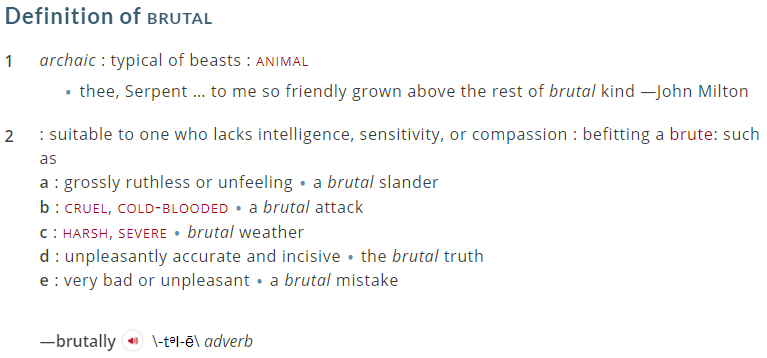
Definition of brutal
“Brutal.” Merriam-Webster.com, Merriam-Webster, http://www.merriam-webster.com/dictionary/brutal. Accessed Mar. 2017.

Check out that definition. There is nothing in there that speaks to any kind of morality or good intention, and certainly nothing virtuous. Even the entry about brutal truth contains no compassion. Accurate? Yes. But unpleasantly and incisively so.

So then someone who prefaces the delivery of truth with “I am going to be brutally honest” is – by their own admission – embarking on a non-virtuous wielding of honesty as a weapon to deliver misery. I propose that in the vast majority of situations, the fundamental reason for this is that even though they are using the word, they are not being honest about their own motivation – the desire to be brutal.

But I don’t want to be brutal!

It’s okay – I know. This notion of brutal honesty leads to a concern from good people who don’t want to be brutal. There is a perception that if the truth is brutal, or perhaps unsavoury, then a lie would be better. Keep in mind though that lies come with a heightened anxiety of their being discovered. This often leads to uncomfortable situations, where additional and more elaborate lies are needed to maintain the facade of truth.

It doesn’t have to be this way. There is a way to be honest and virtuous. I call it “graceful honesty”.

Honesty with grace

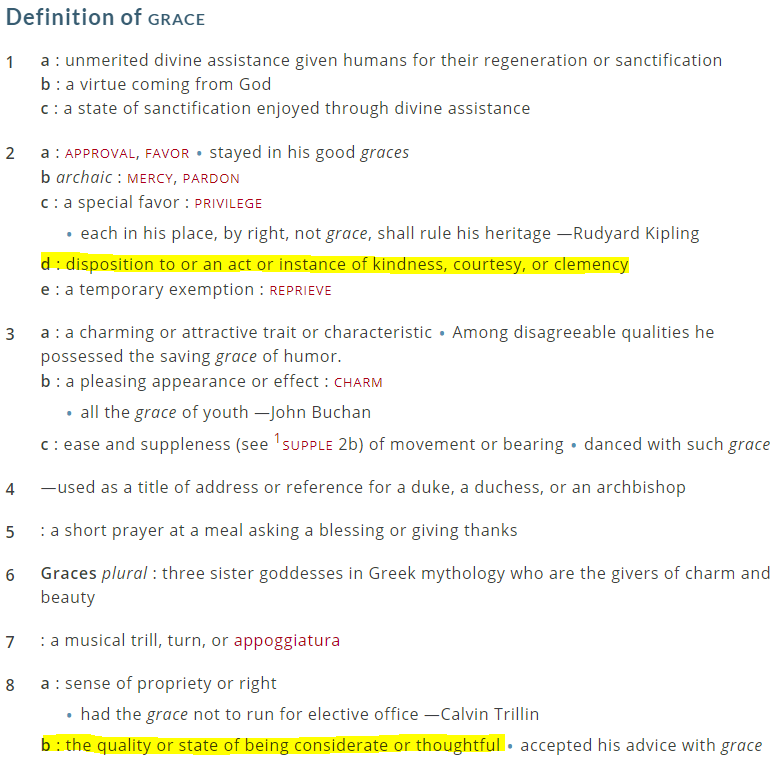
First, let’s have a look at the definition of grace, so that you can understand why I chose that word. Grace has many meanings, so I have highlighted the ones I am applying in this context:

Definition of grace
“Grace.” Merriam-Webster.com, Merriam-Webster, http://www.merriam-webster.com/dictionary/grace. Accessed Mar. 2017.

Recall earlier, when I spoke about the three virtues of “love”, “charity” and “kindness”. In many ways, the word grace encapsulates these, and so I choose it to describe the type of honesty I mean.

First, be honest with yourself

Graceful honesty isn’t difficult, but it does require some practice if you are not in the habit. The key to it is when you find yourself either tempted to be dishonest, or about to be brutally honest, you stop and spend some time being honest with yourself first. If your motivations are virtuous, then there will be a way to communicate honestly with grace. Conversely, if your intentions are nefarious, then hopefully you will be honest with yourself about that and choose some other course, having recognized the toxicity of your initial instinct. The key then, is to use self-reflection to uncover and put words to your motivation. I don’t want to use too many specific examples here, because it is easy to make arguments about the inaccuracy of an example as it applies to yourself, and then decide the concept is flawed, but I’ll indulge in one in the hope that it will be a good springboard.

Dinner at Kelly’s

Suppose you have been invited to dinner at your friend Kelly’s house, and you just don’t feel like going. The likelihood is that if you decide not to go, you will fabricate an excuse. Further, the excuse probably has a half-life greater than a few hours. What I mean by that is that it’s probably a concocted scenario that will likely be referred to at a later date. For example, you may claim “my kid is sick”, which you can bet Kelly will ask about in the next day or two, and may even ask your child. In this case you will have to remember the excuse so that you don’t accidentally contradict it later, and you may even have to recruit your family to perpetuate the dishonesty – something they are more likely to forget about, since they are not vested in the lie. Result? Anxiety.

Instead, consider this. You really do value your friendship with Kelly. You also don’t feel like going. Before choosing to be dishonest, you can spend some time in honest self-reflection. Why don’t you want to go? Be super analytical about that. You may discover that you actually do want to go, or you will confirm that you don’t. If you truthfully don’t want to go, you will now be better able to put into words what the real reason is, which will of necessity consist of the factors that are outweighing your legitimate desire to spend time with Kelly.

If you tell Kelly exactly that reason, and if Kelly is a good human, she will understand, because you have been fully honest and presented the reason in full context of how you struggled with the decision. She will appreciate the conflict, and understand the conclusion, even if she is disappointed.

But wait you say! I know Kelly! She would never understand! She would just be insulted! Well, I’m not foolish. I know this is also a possibility. But here’s the thing: this is only the current state of your relationship because of a history of implicit dishonesty about motivation. Which means there is room for more honesty – on her part and on yours. See, if at the core you both value each other and the friendship, then you mean no insult, and so how can she be insulted? And the core is all that actually matters – because it is impossible that either of you wants the other to be upset. That core exists, and honesty will land you there. Graceful honesty.

Graceful honesty doesn’t mean everyone is happy

In the example above, Kelly is probably going to be disappointed. You might also. That may seem contrary to virtue, but it isn’t. Not if you were honest about the factors that outweighed your desire to go. Disappointment isn’t a monster to be avoided at all costs. It’s a natural consequence of not being able to implement more than one choice at a time.

One of the great contributors to dishonesty is a desire to keep everyone happy – or at least not miserable. But it’s a trap. Lying by definition creates a false narrative. Perpetuating this to maintain a state of happiness, in fact maintains a state of delusion. One from which the participants (barring tragedy) must eventually emerge, and who’s discovery is unlikely to legitimize the illusion of peace they were enjoying. Put simply, the lie just sets everyone up for a bigger fall.

But life isn’t about being happy all the time! We all know this. We all experience negative emotions like sadness, anger, and disappointment. For the most part we don’t let these things impact the zoomed-out graph of our lives. Yet we find ourselves willing to skirt honesty with others to somehow shield them from these normal experiences.

Have you ever said something to someone in anger that you later regret? I’m betting you have. I’m betting some if it was pretty damn poisonous, and required a lot of apology, replete with the sentiment “I didn’t mean it”. But is that really true? More specifically, does “I didn’t mean it” mean the same thing as “it wasn’t true”?

My experience tells me that what we are really trying to say is “I regret using honesty to hurt you – it isn’t consistent with how I feel about you.” This can be about something you’ve been holding in for a while, or it can be about an emotion that was real in that moment, instigated by the anger. For example, “I hate you!” during an argument isn’t totally untrue, just imprecise: it really means “I hate this feeling I’m having right now that you are causing”, and it is 100% true. It is also 100% forgivable, because it is 100% understandable.

If you think about this for a while, you will see that the real mistake is not being honest earlier, when graceful honesty would have worked: “I love you, and I’m in it for the long haul, but I do get irritated when you don’t put the cap on the toothpaste. I do not equate this behaviour with you, and my irritation is therefore not aimed at you, but the behaviour.”

That last quote is wordy and annoying, I know. But it’s the idea I am trying to communicate, not a recipe for how to tell your husband to put the damn cap on the toothpaste. Very often we don’t disclose little irritants like that because we are concerned it will be taken as criticism of a loved one we don’t want to hurt, as opposed to observation of a behaviour that is independent of the reasons we care about the person exhibiting it. Graceful honesty would disclose all of that, and keep the barbs from growing onto a club that could be wielded in anger.

See, hiding the truth is silly. We are all in this reality together. We should share it. All of it.

Honesty is the sharing of reality.

Think about it. How can honesty be anything else? But as I said earlier, to do it with grace requires a deeper searching of our own motives than we normally do. So the next time you feel like a lie is warranted (or if you are tempted to inflict pain with truth), ask yourself why. What is motivating you? Who are you trying to protect? Who are you trying to help? When you feel the truth needs to be hidden, put away the issue whose truth is troubling you for a moment and look at the feeling itself – it will be the source of the honesty you should embrace. The reality you should share. It is the only way to build and maintain relationships that have value.

Thanks for reading,

Rich

Open-Mindedness

Recently I have been thinking a lot about why so many people seem inconvincible of certain things which I hold to be true. And while I could certainly make a list of some of these things, that is not the intention of this blog entry. Instead, I have been reflecting on open-mindedness and wanted to share.

Many people – myself included – often enter into discourse with someone of a differing opinion with the intention of convincing them to change their mind. For example, maybe your friend Paul thinks all trees in your neighborhood that are taller than 12 feet should be pruned to 12 feet or less, so as not to obstruct anyone’s view of the lakefront. You know that he’s clearly wrong! You get into a discussion. Only it’s not really a discussion – it’s an argument each of you is trying to win. Maybe out of frustration you start incorporating personal attacks. Maybe you get so angry at Paul’s refusal to capitulate, as well as the horrible things he is saying about you, that it ends your friendship. Maybe in the middle of the night, Paul prunes all of your tall trees. Maybe the next night you erect a 30 foot statue on your lawn directly in Paul’s line of sight to the lake … and so on.

It’s sad, and you don’t even like the statue, but what choice is there? Paul must be taught a lesson.

I wish this was hyperbole. Sadly, it is not. And the conclusion is clearly suboptimal.

Well … let me construct a basis for discussion with some (hopefully) fair assumptions. In doing so I’m going to have to use a little bit of math terminology, and it occurs to me that some people might not know precisely what I mean, or even be put-off by some of my more mathematical references. If you think this might be the case, I ask you to bear with me. The concepts and symbols I use are the best way for me to illustrate my point, and I’ve included here a bit of a math lesson, in case it is not something you’ve encountered in your life – it will clarify some of the words and concepts I use for the rest of this article. Of course, if you feel there’s no need for you to read this section, by all means scroll past it and keep reading (I won’t feel bad).


Some Math concepts

Sets
Mathematicians like to talk about collections of values that are somehow related, and when they do, they use the word set. We use curly brackets to list the objects (known as elements) of a set. So for example the set F=\{apple, orange, banana, kiwi, peach, nectarine\} is a set I have named F, and just so you know, it is the set containing all the fruits I might bring to work with me in my lunch. A subset of a set S is another set that only contains elements from S. So for example M=\{apple, kiwi\} is the set of fruits I brought to work in my lunch on Monday, and is a subset of F. On the other hand, A=\{apple, pineapple, banana\} is not a subset of F.

A Little Bit of Algebra (Apologies to the Arithmophobic)
Consider this simple algebra equation:
\displaystyle 3x+4y=7
The x and y are understood to be symbolic of numbers, but the use of symbols mean that they vary – which is to say, they are variable. The equation is a statement. In this particular statement,

x = 1, y=1
would be a valid solution (i.e., the equation becomes true), since
3\times 1 + 4\times 1=7.
So would
x = 5, y=-2,
since
3\times 5 + 4\times (-2)=7.
However
x = 5, y=2
would not be a solution (i.e., the equation becomes false), since
3\times 5 + 4\times 2=23,
which is not 7.

Statements
In math and philosophy, a statement is a sentence that must either be true or false (but not both, and not maybe). Very often the truth value (i.e., “true” or “false”) of the statement depends on values for variables contained in the statement. The algebra equation above is a statement. Another example is the statement “I like cheese”, which contains two variables: “I”, and “cheese”. If the “I” refers to “Rich Dlin” (i.e., it is me speaking and not you), and the “cheese” refers to “Havarti”, then the statement is true. If the “I” is “Rich Dlin”, and the “cheese” is “Cambozola”, the statement (I promise you) is false. Notice that if the “cheese” were to refer to “gingerbread cookie” the statement would be nonsense, since “gingerbread cookie” is not a cheese – even though it is true that I like gingerbread cookies, it is irrelevant in the context of this statement. A mathematician would say “gingerbread cookie” is not an element of the set of all cheeses. Going back to the algebra example, {(1,1),(3,-2)} is a subset of the set of solutions to the equation given. The actual set has an infinite number of solutions in it, but that’s more than I need to talk about here. What I will say is that the truth value of the statement “Three times John’s favorite number plus four times Gail’s favorite number will yield seven” is:

True if (“John’s favorite number“, “Gail’s favorite number“) belongs to the set of solutions of 3x + 4y = 7,

False if (“John’s favorite number“, “Gail’s favorite number“) does not belong to the set of solutions of 3x + 4y = 7, and

Nonsense if, for example, John claims his favorite number is “cinnamon“. Be on the lookout for nonsense – it is surprisingly common.


The Assumptions

Ok. Welcome back. Here are the assumptions I was talking about:

All questions have a right answer
… when the answer is justified properly with a well framed statement.
The truth value of the statement may be subject to variables that change which answer is correct, but with a fixed set of values for the variables, there is a right answer. For example, the question “Should all trees taller than 12 feet in our neighborhood be pruned?” could be answered “Yes”, justified with the statement “It is unacceptable for some trees in our neighborhood to block sight lines to the lakefront”. Note that here the answer to the question is “yes” if the statement is true, and “no” if the statement is false, and may reasonably depend on whether or not the tree is also so wide, or part of a grove, as to make it impossible for a resident to see the lakefront from a different angle standing on the same property. It may also depend on whether 12 feet is a reasonable height with respect to whether or not sight lines get blocked. In this case these variables need to be introduced into the statement, or else agreed upon as not being variable.

The right answer may well not be knowable
 … even with the variable values fixed – which doesn’t mean there is no right answer!
As an example, consider the question “How many humans are alive on Earth right now?”

  • The number changes many times in a short span of time. So the truth value of the answer depends on what time it is indexed to.
  • The answer is subject to a definition of “alive”, and the answers to whether or not some organisms are living humans are in dispute.
  • “On” Earth needs to be defined. If I am in an airplane, am I on Earth? What if I am in low orbit?
  • However there is an answer, if we fix the variables.
  • There is currently no way, even with the variables fixed, to know the answer.

Knowing the truth is inherently valuable.
This is a big one. Many people demonstrate by their behavior that they do not adhere to this assumption. A simple example is the person who refuses to go to the doctor about a problem because they are afraid of what they might find out. In some ways, not wanting to know the truth is a human quality, especially in situations where a false belief has spawned an entire tree of values and beliefs we have been living by. If the root belief is false, what happens to the tree?

When it Comes to Truth, What We Want Doesn’t Matter
So with these assumptions, my position is that for any belief I hold, I am either right or wrong, and that I may not be able to tell. So then what am I to make of someone who disagrees? Can I immediately conclude that they are wrong? Clearly not. However I freely admit I want them to be wrong, so that I don’t have to be. After all, being wrong has some negative implications. On a fairly benign end it means I have been somehow deluded, which injures my pride. On an extreme end it may mean I have to discard an entire tree of conclusions that were premised on my error, leaving behind a buzzing hive of uncomfortable questions and observations about my previous behavior. But if the root belief is actually wrong, what choice do I really have? Since it is rooted in falsehood, the whole tree is an illusion anyway.

Here is a hard truth: What we want has nothing to do with what is true. I want there to be peace in the Middle East. But there is not peace in the Middle East, and no amount of wishing on my part, no matter how fervent, can alter the truth value of this or any other statement. On the other hand, what is true can and should definitely impact what I want. What we all want.

Ok. Here is another statement that is tautologically true: In the set of things I hold to be true, some might be false. And from a probability perspective, I am also comfortable saying that in the set of things I hold to be true, some are true, and some are false. I want to say “most are true and some are false”, but I am honestly not sure I have a reasonable argument to claim that, so we’ll leave it there as a desire more than a fact.

Shades of Gray
Now I will focus on statements where the truth depends on fixing values for the variables in the statement., which to me is the core of the shades of gray argument: In cases where there is a continuum of possibilities between true and false, almost everything in the set of things I hold to be true lies somewhere within the boundaries of the continuum, rather than on one of the ends.

Here a philosopher or mathematician might (and should!) argue that there can be no continuum between true and false, since those are binary options. My response is that I am talking about a sphere of reasonable answers centered on the truth, where anything outside the sphere is easily demonstrated to be false (or worse, nonsense), but things get a little more touchy inside the sphere. This is a consequence of my point about the truth of a statement depending on fixing values for variables the statement depends upon. To elaborate on this, I am going to define something called an assumption set.

Assumption Set
Suppose a statement depends on a set of variables. For example, consider the statement “Running is good for you.” The truth of this is not absolute. It depends on some variables:

  • How much running (the quantity of the running)?
  • How intense (the quality of the running)?
  • What preconditions do you have that running would exacerbate (e.g, bad knees, asthma, heart problems)?
  • Where do you plan to do your running (road, track, beach)?
  • and many more.

So before we could discuss whether the statement is true, we would have to fix values for these variables. I call these fixed values the assumption set. So for example an assumption set for this statement could be
R=\{45 minutes per day, at 80\% of maximum heart rate, \{sensitive to sunlight, plantar fasciitis\}, track\}.
Notice that one of the elements (the preconditions) in this assumption set is itself a set – that’s completely acceptable. On the whole, I would judge this assumption set to be a reasonable one – which is to say, the elements of the set have a probability associated with them that makes them not unexpected in the context of discussing the claim that “Running is good for you.”
Another assumption set could be
S=\{15 hours per day, at 120\% of maximum heart rate, \{multiple hip replacements, torn Achilles tendon\}, Interstate Highways\}.
On the whole, I would judge this assumption set to be very unreasonable – which is to say, it is highly improbable that this would be an assumption set on which the claim “Running is good for you” would be a relevant discussion.

Reasonable Answers (Approximately True?)
A reasonable answer to a question can be defined as a statement that is true when evaluated with a plausible assumption set. That is to say, the assumption set is comprised of elements that have probabilities high enough that if we observed them we would not be surprised. In situations where the variables are in constant flux, the approximate truth value of a statement may be argued as the one that holds given the most likely assumption set. In cases like this, we may generalize a statement as true, while being willing to challenge it in the face of a game-changing assumption set. We maybe won’t talk about who gets to define “plausible”, even though there are times when that becomes the most relevant thing.

Arguing(?) With an Open Mind
Here I have chosen to use the word “arguing”, even though in truth I prefer the word “discussing”. That’s because most people seem to think that discussions between people in disagreement need to be arguments. I disagree. Remember the assumption that we are not right about everything? And remember the assumption that knowing the truth is inherently valuable? These two should premise every discussion we enter into. So when discussing the answers to questions, or the truth about statements, we need to do our best to remember that what we are trying to do is get as close to the center of the sphere as possible, because that is a good thing to do, and because we may not be there yet.

Of course, we all think we are closer than an opponent. If not, we wouldn’t be having the discussion in the first place. But keeping in mind that if two people are in disagreement, one of them must be wrong, a productive conversation is one where at the end of it the parties have converged on something they both hold to be as close to true as they can see getting. When this happens, the world gets a win. I’ll list some techniques for true open-mindedness.

Discussing With an Open Mind

  1. Remember that you might be wrong.
    Put another way, be willing to change your mind, or adjust the approximate truth of what you believe.
    See, you believe that you are probably right. You may even believe that you are certainly right (although for the truly reflective, certainty is a pretty difficult thing to attain). But your opponent has the same thoughts. Both of you probably have many reasons for these. And they probably have a lot to do with assumption sets, and which one of you is applying the most plausible set. Sometimes the discussion is not about the truth of the statement but on the plausibility of the assumption set. Keep that in mind. Yours may be the less plausible. Or maybe both assumption sets are equally plausible, in which case the statement can be split into two (or more) more detailed statements that include some of the differing assumptions explicitly. But keep in mind that emotional attachment to an assumption set can and will blind you to the plausibility of an alternate set, and ultimately cause you to refute a statement with unreasonable (even fanatical) obstinacy.
  2. Have higher expectations for yourself than you do for your opponent.
    This means you need to challenge yourself to inspect the assumptions and claims of yourself and your opponent objectively, even if they are not doing the same thing. When you do this – and do it out loud – they hear that. Look at elements of the assumption sets and objectively evaluate their probability. Also evaluate whether they change the truth value of the statement or not. And be prepared to evaluate whether or not they render the statement as nonsense – this happens surprisingly often but it’s not obvious until it is isolated. Discussing things this way models a behavior that is necessary for the two of you to converge on a conclusion you both agree with. And if you are consistent with it, your opponent will often adopt the same style, if only because they think this is the way to convince you they are right.
  3. Thank your opponent, regardless of the outcome.
    I don’t mean this as a politeness. I mean this in the most sincere sense. Any opportunity we get to reflect on our set of beliefs is valuable. Sometimes your opponent and you will converge. Sometimes you will not, and they leave the exchange completely unmoved, perhaps even claiming “victory”. This is sad, since the only true victory would be a convergence of opinion, but ultimately it is not relevant to your own experience. Make it so that if you have moved on a topic, it is because you discovered something you were not considering, or were considering incorrectly, and now you are closer to the center of the sphere of truth. If you do not move, make it because you were not presented with any strong evidence that you needed to. In either case your beliefs will have been strengthened in some way, either because you changed to something as a result of new insight, or because you were challenged in some way, and it was unsuccessful. For this you have your opponent to thank.

How to Spot Real Open-Mindedness
Many people claim to be open-minded. It may be true, or it may be a trick (some people say it so that when you fail to convince them of something it will prove they were right). True open-mindedness doesn’t mean you are ready to believe anything. It means you are willing to change your mind when presented with evidence that objectively compels you to do so. If you know of (or are) someone who has changed their mind in the moment, during rational discourse, but who was fairly slow to do so, they are probably the type of person I am describing. This goes back to my point that we are probably not right about everything we believe. Which means mind-changing can occur. Which means if you’ve seen it occur, it occurred in someone with an open mind.

Thanks for reading,

Rich

Our Schooling System is Broken

It has been a while since my last blog – it was never my intention to go so long between posts but you know … sometimes life hands you other things. In any case I plan to start writing again more frequently, starting with a subject that has been on my mind for a while now: Education.

See, I am thinking our system might be broken. Scratch that – I know it’s broken, and in many ways. But I am talking about a fundamental issue, which is the assumption that performance in a school system with a standardized curriculum is a key measure of personal value. I will try to explain, starting with some background for context.

I Am a Teacher

It’s true. I am a teacher. A very happy one at that. I love my job. I teach high school math in Ontario, Canada, and have been doing that for about 15 years. Prior to that I worked as a software developer for about 10 years. When people ask me what I do for a living (something other adults seem to have a deep need to know upon meeting each other), the conversation always goes roughly the same way:

Other Adult: “So Rich, what do you do for a living?”
Rich: “I’m a teacher.”
OA: “Oh? Nice. What do you teach?”
(Rich’s note: There may or may not be a “joke” here by OA along the lines of “Oh yeah? You know what they say: ‘Those who can, do, and those who can’t, teach’ hahahahaha”)
Rich (being honest, even though it’s not what they meant): “Kids.”
OA: “Oh, haha. But seriously, what subject?”
Rich (with an inward eye-roll – here it comes): “I teach high school math.”
OA: “Oh god. I hate math. I remember I used to be so good at it until grade 8 when I had Ms. Heffernan. She hated me! And she was so terrible to the kids. She made me hate math. I never understood anything in math after that. I am so bad at math! The other day I tried to help my 7 year-old with her homework and I couldn’t even understand what they were doing. Do you tutor? I think I may need to hire you to help little Kelly with her math. Math is so confusing. I keep telling her she doesn’t need it anyway. I mean, I run a multi-million dollar business and I never use any of the math they tried to teach me in high school. Why don’t you guys start teaching useful stuff like understanding financial statements and investing? I had to learn all that stuff on my own. I don’t see why math is so important. I am really successful and I was never any good at it thanks to Ms. Heffernan …..”
Rich: “I apologize on behalf of all my brethren. Please carry on with your successful math-free life. Yes, I’d be happy to help Kelly, but honestly she probably doesn’t need any help. She’s 7. She will conquer.”

You get the point. But as I said, I seriously love my job. For many reasons. But perhaps the main one is that it keeps me connected to the fluidity of humanity. I keep getting older, but my students do not. They are the same age every year. And because I spend a large number of hours each day immersed in their culture, it forces me to keep my thinking current, so that I can continue to effectively communicate. In this way I feel less like some sort of flotsam floating on the river of time and more like a beaver dam of sorts, constantly filtering new water on it’s way downstream, being shored up with new materials as each generation passes through. I am like a connection between the past and the future, and the older I get, the larger the gap I am privileged to span. And in any case, young people are perpetually awesome. It brings a faith in humanity I’m not sure I could get in other ways to see firsthand the caretakers of the future.

School Is Not Really About Education

I can hear your thoughts.

Um, what? Isn’t school by definition about education?

Well, yeah. Granted it’s supposed to be. But it isn’t. All you have to do is talk to almost any adult existing in Western society today about it and they will tell you (often with great relish, as though they are solving world hunger), they never use a single thing they learned in school in their day-to-day lives. Which is of course false. But mostly true. If you went to school in Canada you probably at some point had to know things like what year Champlain landed in Quebec (1608, in case you’re stumped – I just Googled it). I can say with a fair amount of confidence that whether or not you have that tidbit of info available in your memory banks is not affecting your life in any measurable way. You probably also had to know the quadratic formula at some point. I don’t have to Google that one. It’s x=\frac{-b\pm\sqrt{b^2-4ac}}{2a}. Nifty, isn’t it? Sorry if I scared you.
Here. Check out these definitions of “education”. I Googled it.

Definition of Education
Side note: Google is so cool. I’m 48. I have existed both with and without Google. I had to assimilate the use of Google as a verb into a lexicon that did not previously have it established that way. Your kids didn’t. They have to establish the word googol as a noun referring to the number 10^{100} into a lexicon that likely does not have it established that way.

See? The very first definition says I am wrong. School is about education, literally by definition. Oh, but check out definition number 2! Now that is a good one. Education is an enlightening experience! The thing is, in many cases, and for many people, school isn’t enlightening. In many cases, school is an exercise in conformity and alignment. It’s a system which simultaneously (and somewhat arbitrarily) defines success (um, I think I mean worth) and then provides measures for individuals to evaluate their success (yeah, I definitely mean worth).

Performance of Curriculum is a False Measure of Worth

Ok. So when you were a kid, around the age of 5, your parents sent you off to school. And almost immediately, you started to get report cards. They aren’t cards anymore. In many cases they aren’t even paper. But still called report cards. A figurative card summarizing your score on a number of predetermined criteria for success. And make no mistake – from that very first report card on, kids are sent the message that they must perform according to standards so that they get good report cards. I’m going to stay away from the early years, since that’s not my area of expertise, and fast forward to high school, which is. Let’s look at an example. This is based on a real person, whose name I’ve changed. Yes it’s anecdotal. It’s not meant as proof, only to demonstrate my point.

Sally is a young lady in grade 9 who has never particularly had an interest in math – at least in how it’s presented at school. She really doesn’t care about direct vs. partial variation, or the sum of the exterior angles of a polygon, or about how doubling the radius affects the volume of a sphere. But Sally goes to school, in a system which has not only determined that these things are important, they are also mandatory. So she has no choice but to engage in attempts to learn about these things, despite the fact that she is actually incapable of being interested in them. Sally is awesome, by the way. A genuinely caring human with deep empathy, intense loyalty, and a great sense of humour. Sally is also depressed, because she feels worthless. No matter how hard she tries, she can’t figure out how substituting 2r for r into the formula V=\frac{4}{3}\pi r^3 causes the volume to increase by a factor of 8. In a test designed to determine if Sally can do these things, her performance was dismal. Her mark on that test was a 58%. The class average was 85%. When the teacher returned the test, she made comments like “Well, I know that I taught about exterior angles, but it is clear that some of you did not learn it.” When Sally brought the test home to show her parents (who, incidentally, knew that Sally had the test coming up, hired a tutor to help her prepare, and then asked if she had gotten it back each day after school starting the day after it had been written until the day a week later when it was returned), her parents were frustrated and disappointed. Sally has been conditioned to believe that her ability to understand direct and partial variation is critical. Because it is mandatory, her inability to care or comprehend is forcibly highlighted. And subsequently, her performance is recorded for posterity on her report card. Sally’s final grade in math ends up being 61%. Her parents are disappointed. Sally is devastated. She believes there is something fundamentally wrong with her, because she legitimately can not measure up to the standards set in a system she has no choice but to be engaged in.
Breaking Down the Process

Let’s have a look at this situation of Sally’s, and the number of places where the system went wrong.

First off, the concepts Sally has to learn have honestly been arbitrarily determined. See, someone, somewhere, decided that Calculus is an important prerequisite subject for many university and college programs. And to learn Calculus (a grade 12 subject in Ontario), you arguably have to start with concepts like direct and partial variation in earlier grades. And because grade 9 is truly too early to know if programs that require Calculus are in your future, this pre-calculus material is incorporated into the curriculum for pretty much everybody.

Second, math is mandatory. In Ontario high school is a 4-year program, and you must have a minimum of 3 math credits to earn a high school diploma. All of this has nothing – and everything – to do with Sally. Next comes the process. Sally’s teacher created quite possibly an amazing series of lessons on these topics. Sally just doesn’t have the wiring for them, so even though the teacher may be phenomenal, it will have a marginal impact on Sally’s ability to synthesize the material. Sally used to ask questions in class. Now she doesn’t, because she learned that even when she asked, it didn’t help. Sally is deeply empathic – she has seen firsthand the good intentions and effort of her teachers in the past. She can read facial expressions and body language. She has seen her teachers answer her questions and try to help her and seen how much they believe the answers and help are working, so she has pretended that it was, since that was easier than admitting that it wasn’t, because it meant burdening herself with her inadequacy instead of her teachers.

Third, Sally has been conditioned to believe that it is all being done so that she can get high grades. Because ultimately her success is defined by her report card. And because pretty much everyone is telling her that you don’t need this stuff in life anyway. You just need to learn it to get high grades so you can be successful. Which means the only purpose to learning this stuff is the test you will eventually write on it. This is exacerbated by the well-intentioned parents who put so much emphasis on the test – both before and after. You’ve heard the question “When am I ever going to use this?” Well the answer for most kids is “Next week, when you are tested on it.”

See? It’s all artificial. Sally is a high-worth kid, forced into a situation she isn’t wired for, and told that her worth is defined by her performance in that situation. It’s incredibly sad to watch.

The Present and the Future

So here’s where we are now. Many kids and parents these day believe that high marks are critical. The perception is that material presented in school is not inherently valuable, but instead the value is that it is a vehicle to high marks. This means that kids will often do anything it takes to get the high marks. This includes cheating, but that’s not really what I am driving at. What I mean is that they develop strategies that focus on getting high marks, as opposed to learning. Cramming for tests, paying for courses in small private schools that guarantee (implicitly or explicitly) very high grades, or negotiating with teachers (even to the extent of aggressively bullying) after the fact are all standard operating procedure. What is so terrible is that Sally may be able to get high grades using any of these tactics. But Sally will also always know that she didn’t earn them. She will always know that she is not good at something that she should be good at if she is to be valuable. And if and when she manages to gets the high grades anyway, that sense of fraudulence will haunt her. I’ve seen it. It’s tragic. Sally has a great future if she can discover her true worth. The worth she was born with and the worth that her friends probably value more than anything she can do in a math class. But she may or may not discover it.

What I Do About It

I love people. And that includes the kids I teach. And I teach high level math, which is honestly not for everyone. I get a lot of kids coming through my classroom doors who are not there because they want to be, and who will not be able to draw the joy from studying math that I really, really do. I have constraints. I have to teach the material as it’s laid out by governmental process. I have to assign grades that reflect students’ performance against some pretty specific criteria. But within this I make sure that each and every kid I teach knows that I value them as a person. That I care about their story. That I see them not as a 2-dimensional projection of my consciousness, but as a multi-dimensional consciousness of their own, with a narrative as rich and intricate as mine. I make sure that they understand that any evaluation I do of their abilities in math is a tiny, tiny cog in the complex machinery of their existence, and has zero impact on my impressions of them as people, or on my estimation of their worth. I show them that it is totally acceptable to love and be passionate about math, without tying that love and passion to an evaluation. It’s not about the math. It’s about giving them permission to take joy out of abstractions, and to pursue the things that they were wired to do. I’m not always successful. Some kids are too preconditioned. But I will never stop trying.

Thanks for reading,

Rich

Thoughts From a Dance Dad

Lately it seems as though the amount of time I have to write is inversely proportional to the amount of ideas I have to write about. But today’s entry is about something I’ve been thinking about for years: Dance.

Early Years

145-4524_IMG.JPG
My Little Ballerina (age 5)

My daughter is a competitive dancer. She’s 15, and has been dancing since she was around 3. She’s gone to countless dance camps, workshops, and of course classes. So I have been a dance spectator for about 12 years. Prior to that I knew next to nothing about dance, save for the fact that I have never been any good at it.

At first, dance was pretty much entirely about how cute the kids all looked executing choreography. They got to wear these elaborate costumes and perform for friends and family at recitals. The teachers and teaching assistants are always on stage at the same time as the kids, and the kids essentially never take their eyes off them, mimicking the movements they’ve all spent months in class learning. It’s exceedingly adorable, and naturally every person who comes to watch immediately rushes to them afterwards to tell them how wonderfully they danced. In short, it’s a typical exercise in getting kids involved in an activity that provides some structure around working toward a goal, and then the kids get congratulated on essentially existing for the duration. And it’s awesome.

As the years progressed, we saw less and less boys involved. I won’t attempt to analyze that or comment on why it might be, but political minefield notwithstanding, it is true. This meant that as the dancers grew, it became – for my daughter’s group at least – a girls-only activity.

Emerging Talents
1042Starting around the age of 8 or 9, and lasting for 3-4 years, it starts to become obvious which of the girls are well suited to dance and which are not. This obviousness is not lost on the girls. Dance becomes a micro-society where “Haves” and “Have-Nots” start to identify, and the behaviours that result are what you would expect. In a way it mirrors what is happening at that age in school, but from where I sat it was definitely magnified at dance. These can be pretty difficult years for the girls, and perhaps more so for the parents. As I watched from the sidelines, I always told myself that whether a Have or a Have-Not, there are very valuable lessons to be learned from these dramas, and whether my daughter was receiving or giving grief (it certainly seemed she was receiving a lot more than giving, but nobody ever accused a dad of being impartial), my wife and I always did our best to ground her in reality and look for the long-term life lessons that could be taken. I do think, subjectivity aside, that I can safely say my daughter began to show real talent for dance during this time. I can also say, objectively this time, that she emerged from this phase with an inner-strength and confidence that is astounding. As I watch her navigate the social quagmire of the tenth grade, I am exceedingly proud and awed at how well she manages to stay true to herself and her friends, while gliding above the drama that can consume most kids of that age. She never judges others, and always stays honest in helping her friends deal with whatever the current issue is. In and out of the dance world I have watched her handle victories with honest grace and compassion, and failures with resolute determination. She’s my hero, and I firmly believe we have the “emerging talent” years of the competitive dance program to thank for that.
From Girls to Women
As the girls mature into women, things change at dance in a way that I could never have understood if I were not so immersed in it. This phase is not something I came to understand only as my daughter entered it – the nice thing about being a dance dad is that every recital and dance competition you attend features dancers from all the age groups. So that long before my daughter was in high school I have been observing this stage of a dancer’s development. I also have the added advantage of being a high school teacher, and so for my entire career have had the pleasure of seeing how dancers take the lessons from dance into seemingly unrelated arenas, like a math classroom, which really is my domain. Having a daughter in dance always made me pay attention to how older dancers behaved, kind of as a way of glimpsing my daughter’s future. Here are some observations I’ve made over the years, and observations I have now had the pleasure of seeing manifest in my own daughter.

Dance is a Language
This is not metaphor. Dance actually is a language. It took me some time to fully appreciate that. Because of my daughter’s involvement in dance, our family has been marisa-dancewatching So You Think You Can Dance since season 2. It’s a great show to be sure, but I admit at first I was too absorbed in marveling at the physicality of it to understand what it communicates, despite the fact that the judges on the show really do a great job emphasizing this (I always assumed they were saying it metaphorically). But like a child that learns to speak simply from hearing the spoken word and contextually absorbing meaning from the sound, I began to absorb meaning from the movement. The first thing I realized was that unlike languages that use words, dance doesn’t translate to any other language, and communicates things which can’t be communicated any other way, with the possible exceptions of fine art, or poetry. Really good fine art will enthrall and speak to the viewer through infinite contemplation of something static. Really good poetry succeeds at using words which individually can be quite linear, by combining them in a way to create depth and consequently say something the language the poem is written in was not necessarily designed to say. Really good dance? A different thing entirely. It speaks to our humanity on multiple levels, and the fluidity of it allows the choreographer/dancer to tell us stories no written word could approach.
Words are discrete, and a picture is static. But motion is a continuous medium, and the very continuity of it results in an infinity of expression within a finite frame of time and space. It has been said that dance is poetry in motion, but I honestly have come to see it in the reverse. Poetry is dance stood still. I can’t find words to describe this any better, because words will fail here. If you want to know what I mean, watch dancers. And in the same way that second and third languages improve thought processes and imagination, so does dance – but it does so in a way that is magnified a thousandfold because of its unique method of delivery, and because of the world of thought and emotion it opens up for communication. It also is unique in that you don’t have to be able to speak it to understand it. You only have to watch.

Dancers Make the Best Actors
Because of my passion for theatre, I have had the immense pleasure of being both actor and director in various musicals. And here is what I’ve noticed – not all great actors are dancers, but all dancers are definitely great actors. To me there is no mystery as to why this is. Many actors focus on the words they’re saying or singing, trying to pour all of the character they’re portraying into the delivery of the lines or lyrics. Physicality is often an afterthought, or a simple by-product of the emotion they are feeling about the performance. For dancers it’s entirely different. Because of their fluency in dance, they are simultaneously vocalizing and dancing the performance. By dancing I don’t mean the choreography that often accompanies musical numbers, although naturally a dancer excels there. Rather I mean that they are speaking to us in two languages simultaneously. And even those of us not able to communicate with dance can still understand it. So I have often found myself thinking of a dancer “It’s not a je ne sais quois she has. It’s a je sais qu’elle est une danceuse” (yes, you have to speak some french for that one  😉 ).

Dance is Empowering
Okay. So obviously dance results in physical fitness. You can always spot a dancer by their muscle tone, posture and grace in simple movement. The importance of this can’t be underplayed. But the kind of empowerment I’m talking about here is more than that. I flying-marisaremember once at a dance recital there was a senior acro small group number about to start (see what I did there – Dance Dad knows the terminology). It was clear from the opening positions that one of the dancers was going to execute a crazy trick to start the dance. Before the music started there were hoots and hollers from the wings and from the audience, and one dancer’s voice from the wings rang out with “You GO girl!”. I was momentarily taken aback. I think maybe I had just read an article or watched a show where that phrase was called into question as demeaning to women. And then I looked around. The stage and venue was dense with strong, confident young women, certain of themselves and certain of their power. And the dancer who called it out numbered among them. I couldn’t see anything demeaning at that point about what she had said, but on a deeper level I realized just what dance had done for these kids. It showed them what inner strength, determination and dedication could do. And so naturally I began to think about the dancers I’ve taught in my math classroom and I had this moment of revelation. It is exactly that quality that has always made them stand out to me in that setting. Not that they all excel in math, because not all kids do. But that regardless of their abilities in math, there is always an inner strength and peace that says “I know who I am, I know what I can do, and I know how to commit to improving.” Where many students in high school still need the explicit motivation that our culture seems to thrive on too often, the dancers have internalized their motivation in the best way. I can’t say enough how important that is for success in life.
unsung-marisa

Thanks for reading,

Rich